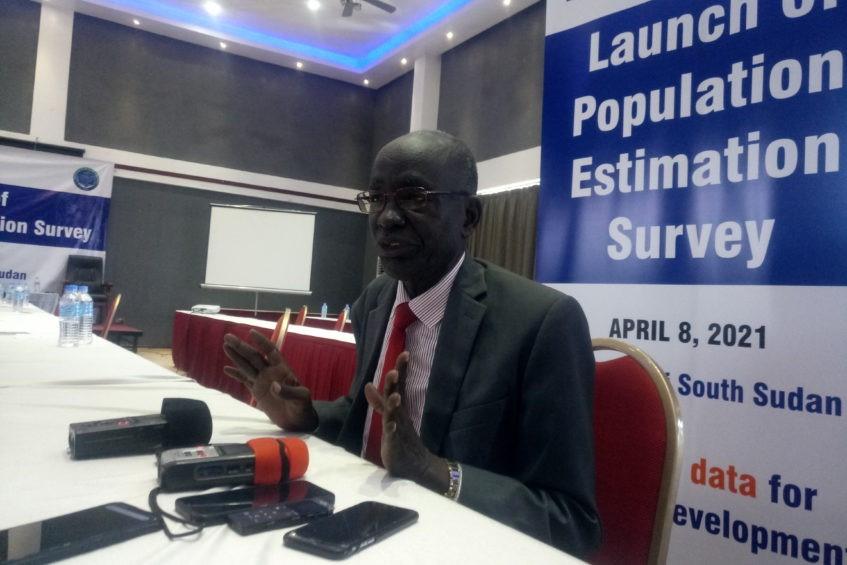
Africa-Press – South-Sudan. The South Sudan National Bureau of Statistics (SSNBS) said the data for the population estimation survey will not be used for the December 2024 elections.
Isaiah Chol Aruai, the chairperson of SSNBS, also said the data is not from a population census.
Instead, he said the survey is for planning purposes and the provision of services to the citizens by the government.
“When we talk of a sample, we don’t count the whole area, we only take some parts of that population,” Chol said.
He stated that there were some areas that they could not access due to insecurity or flooding.
Chol continued that the survey was done at the selected sites within the ten states and the three administrative areas based on satellite imagery.
According to SSNBS, the survey included internally displaced persons and persons living in the Protection of Civilians (PoC). He added that the data, however, did not capture South Sudanese refugees as well as refugees sheltering in South Sudan.
“This method is new in the country. The consultants who are training our people are not from here. They are based in the United Kingdom, and they analyze the data objectively regardless of where it came from,” Chol said.
Asked why Warrap has more people than the rest of the states, Chol said the sample selected was not based on whether the area was a state or not.
Last week, the SSNBS released a new survey (PES) which puts the country’s population at 12.4 million people.
According to the data, Warrap is the most populated state with a total population of 2,639,484 while Abyei Administrative Area emerged as the least populated area with just 133,955 people.
However, the population estimation was received with mixed reactions from a section of South Sudanese who questioned the authenticity of the data and the period under which it was collected. Some argued that they never saw any data collection agents.
But SSNBS said that used satellite imagery, a system used in war-prone countries like DR Congo, Somalia, Columbia, Nigeria, and Afghanistan.
Some expressed worries that the data could be used to rig the forthcoming election.
Chol argued that the densely populated locations in Warrap were more than in the other states.
“According to the information we got from IOM, Warrap has more IDPs of about 380,000 people,” he stated.
Meanwhile, in a report released last month by the UNHCR, 2.3 million South Sudanese are said to be living as refugees in neighboring countries, and an additional 2.2 million people are internally displaced in eight out of 10 states in the country.
Chol said only a few selected counties in Central Equatorial State, Yei, and Morobo Counties, were counted including
“In Juba itself, it was not the whole town that was counted. It was only certain places within Juba, Kator, and Munuki Block,” he added.
The SSNBS expressed their readiness to conduct the population census as stipulated in the revitalized peace agreement once the unity government gives them directives. “But there has to be peace and stability, and enough funding because conducting population is costly,” he said.
The Chief of Population and Social Statistics at the Bureau of Statistics, Mark Otwari Odufa, said among the three regions of South Sudan, it is the Upper Nile and Equatoria regions that have had a mass displacement of people since the start of the conflict.
He said places like Yei, Kajo-Keji, and Lainya are mostly deserted, the same applies to some parts of the Upper Nile.
“We have people who have crossed over to neighboring countries like Ethiopia, Sudan, Uganda, Kenya, and some even to the Democratic Republic of the Congo,” he said.
“Although there is communal violence in Warrap, the displaced people rotate within the region, and very few of them cross over to neighboring Sudan or other countries,” Otwari added.
Source: The City Review South Sudan
For More News And Analysis About South-Sudan Follow Africa-Press