Yiep Joseph
Africa-Press – South-Sudan. Students at the School of Geology and Mining at the University of Juba have appealed to the government to strengthen public institutions to enable them embark on constant practical learning in earth sciences.
Earth science is the study of the Earth’s structure, properties, processes, and four and a half billion years of biotic evolution.
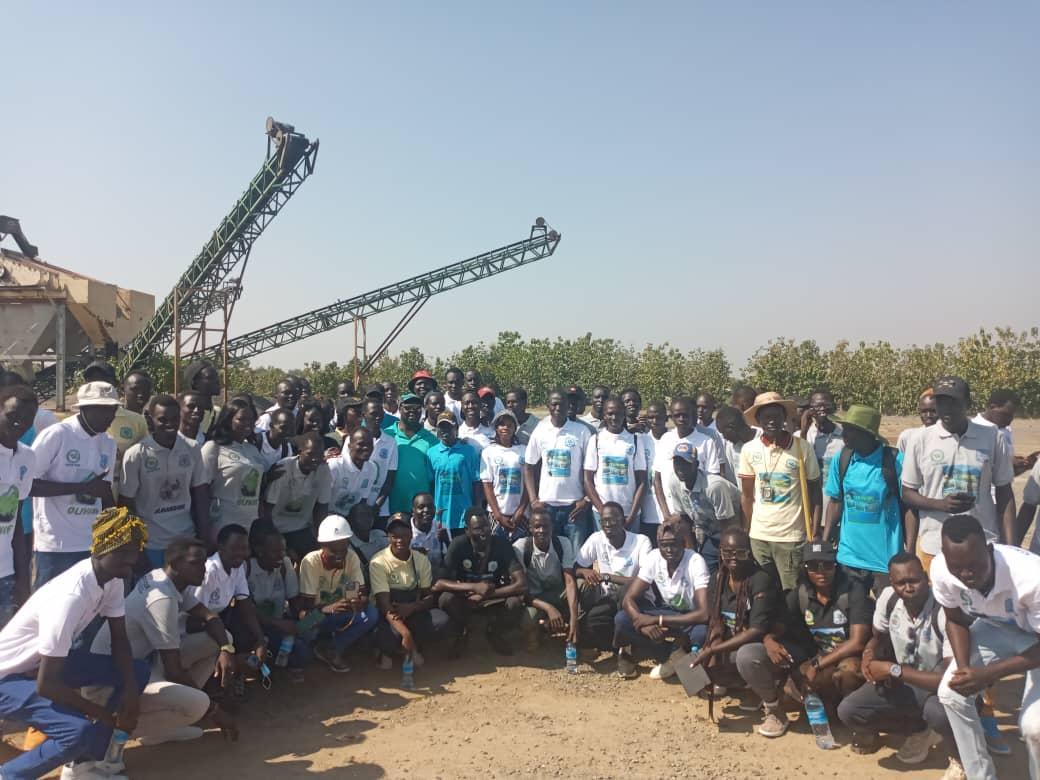
The remarks came during the first geological (geo) tour of Luri Mountain and the ARC Mining Site by the third-year students.
They appealed to the government to provide the necessary equipment to the university to enable them to conduct practical tours frequently.
With support from the Geological Society of South Sudan (GEO-SSS), a group of students from the School of Geology and Mining had a tour of Luri Mountain and the ARC mining site over the weekend under the theme “Uncovering the Earth’s secrets, shaping the future with knowledge.”
In an interview with The City Review, Maghar Manyang expressed that geology and mining need practical learning, but limited resources have prevented students from doing so frequently.
“This is our first field tour, but as a science school, it is part of our practice to have tours to various mining sites across the country frequently, but due to a lack of required resources, that has not been the case,” Maghar said
He urged the government to put more resources in the field of science in various institutions, particularly the University of Juba, to improve practical learning.
“I appeal to our government to provide enough funds and equipment to the University of Juba to ensure that students have practical as frequently as required,” he said.
He added that while the students remain committed, the lack of means to reach mining sites remains challenging.
Nelson Okot, one of the lecturers who guided the students through rocks and mineral studies at the mining site, said the tour was meant to equip students with the necessary knowledge.
He said that visiting mining sites remains a vital practice that all institutions must embark on to graduate those fully equipped with the knowledge to deliver services in the mining and engineering sectors.
Okot added that earth science students help students to understand the world as a whole as they discover new things.
He promised that the lecturers could continue to do what they could to ensure that students have practical skills as required, but urged the government to support and strengthen earth sciences in institutions.
Amath Garang Kuot, a student representative, appreciated the students for showing their willingness to facilitate their tour.
She added that practicality remains a must in earth science, for which a tour of mining sites is paramount.
Ajak John Ateng, the founder and president of the Geological Society of South Sudan (GEO-SSS), promised that the society would continue to collaborate with all institutions and students in all aspects of strengthening earth science with the hope of producing the best geologists and engineers in the country.
“We came here with them (students), and this is the work of society to promote earth sciences by ensuring that they get enough and required knowledge,” Ajak said.
He urged students to remain committed to their practical learning, adding that it takes a lot of effort and commitment for one to have knowledge of earth sciences.
The University of Juba, South Sudan’s main institution of higher learning, was reported in 2019 to be at risk of closure due to financial stress.
John Akec, the vice chancellor of the University of Juba, was reported to have threatened to close the university due to the financial crisis; however, he reversed his decision after some interventions.
Source: The City Review South Sudan
For More News And Analysis About South-Sudan Follow Africa-Press