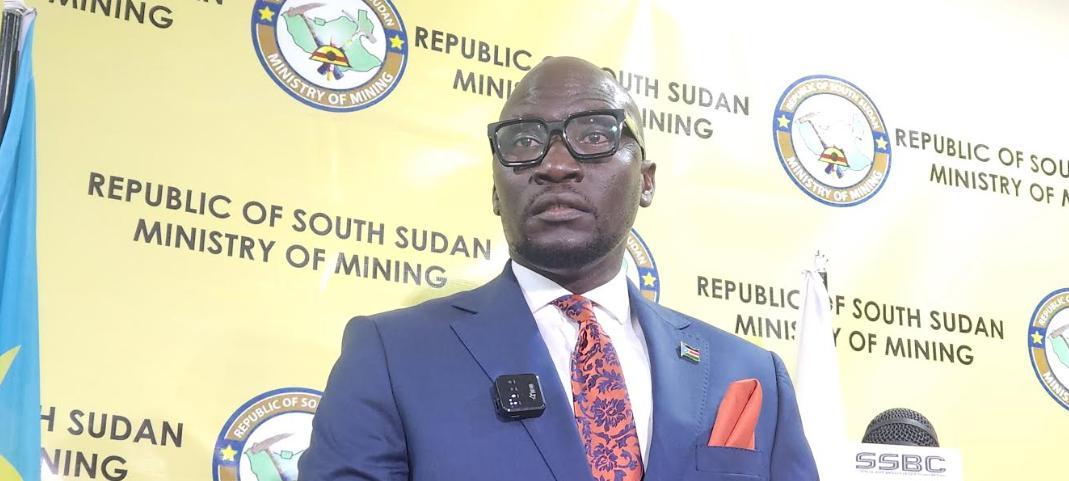
Africa-Press – South-Sudan. The undersecretary in the Ministry of Mining, Santino Mathiok Akuei, has dismissed allegations linking Adut Salva Kiir, daughter of President Kiir, to mining operations in Jebel Iraq in Central Equatoria State and other parts of the country.
However, independent investigative reports have provided evidence that President Salva Kiir’s family members and close associates hold stakes in a wide array of businesses, including companies involved in the country’s mining sector. Watchdog groups allege this is part of a broader pattern of “kleptocracy” where the ruling elite profits from the nation’s resources with little transparency.
Key findings from reports, particularly by the watchdog organization The Sentry, indicate direct family involvement with at least seven of Kiir’s children holding interests in companies across various profitable sectors, including mining. Adut Salva Kiir was a shareholder in Rocky Mining Industries Limited, and another daughter, Winnie Kiir, formed a mining company with Chinese investors and received exploration licenses in mineral-rich areas.
Kiir’s close associates and lower-level ministers have held shares in no fewer than 32 South Sudanese companies established to extract minerals. This network also extends to other lucrative sectors like oil, banking, and telecommunications.
The reports argue that a weak regulatory environment and a lack of transparency have allowed high-level corruption to flourish in the minerals sector, which risks fueling further conflict.
These findings suggest a system where political power is leveraged for personal and family financial gain through the control of national assets, as detailed in reports like “The Taking of South Sudan” and “Untapped and Unprepared” by The Sentry. More information is available on The Sentry’s website at thesentry.org and on their data platform atlas.thesentry.org.
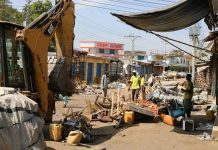
Last week, an SSPDF officer, only identified as Mathdiew, stormed a gold mining area in Jebel Iraq and told artisanal miners who had just discovered a rich gold vein to vacate because the area had been allocated to Adut Kiir’s company. The miners resisted, and commotion ensued, leading to the soldiers killing and injurury of several miners.
Speaking to reporters at a Press Conference in Juba on Monday, Mathiok said the claims circulating online and among communities were false and not backed by any government record.
“We categorically deny any allegations that Hon. Adut Salva Kiir Mayardit holds an active license with the Ministry of Mining,” he said. “Hon. Adut has neither sought nor been granted any mining concession nor shown any interest in mining activities within Jabel Iraq. The Ministry has no record indicating her involvement or ownership in any mining operations in South Sudan.”
Mathiok urged authorities to investigate the recent deadly incident at Jebel Iraq, where four miners were killed, insisting that blame should not be shifted onto individuals without evidence.
“We call on all relevant authorities to thoroughly investigate the incident in Jebel Iraq and to hold those responsible accountable,” he said.
Mathiok said the minister recently issued a series of ministerial orders aimed at tightening regulation, improving transparency, and preparing for a nationwide geological survey.
He also revealed that the ministry suspended exploration and small-scale mining licences in Western Bahr el Ghazal, effective 1 November 2025.
“This measure allows the government to initiate a comprehensive geological survey of South Sudan, starting in Western Bahr el Ghazal State,” he said, adding that the launch is scheduled for 28 January 2026, with preparatory work already underway.
The ministry met with mining companies on 8 November to explain the suspension and to seek their cooperation. According to Mathiok, stakeholders raised concerns, including the need for a Chamber of Mines, which the ministry said it supports “as it is vital for policy developments and review.”
Mathiok also highlighted a 5 November order regulating gold trading and exports.
“Only entities holding a ballast mineral trading license are authorized to buy, sell, and export gold,” he said. “Small-scale miners are permitted to sell the gold locally to licensed traders. The minimum export quantity is set at 1,000 grams.”
He said the directive aims to curb illegal trade and strengthen accountability. A further order issued on 11 November introduces licensing requirements for gold refineries. Only five licences will be issued initially, each valid for five years.
Applicants, he said, “must meet strict criteria including business registration, proof of operational premises, financial stability and compliance with environmental and safety standards, including anti-money-laundering and Know Your Customers requirements.”
Refineries will be required to establish operations within 12 months of receiving a licence.
“Yes, there is illegal mining that is going on within the country,” he said. “The only way to curb this is through geological mapping,” he stated. “When the geological survey is conducted, that is when the matters of concern related to illegal mining will be stopped.”
He added that the pending Bill to establish the South Sudan Mining Corporation would strengthen oversight once passed.
On cooperation between states and the national government, Mathiok said both levels “work jointly” under the Mining Act, insisting there is no overlap in roles.
Swiss report on gold smuggling dismissed
When asked about a recent Swiss-based report alleging gold smuggling by armed groups and individuals, Mathiok rejected its credibility.
“For any report that is not on our social media platform, it’s null and void,” he said. “They haven’t presented it to us so that we should know the findings. So it is null and void, and it is not authenticated. It might be a bias.”
He warned that authors of misleading reports “can be held accountable.”
Mathiok confirmed that an inspection team sent to Jebel Iraq in September found foreign nationals involved in illegal mining. The Undersecretary also clarified that artisanal mining is regulated at the state level, not by the national ministry.
“Artisanal miners… are not regulated in our Mining Act,” he said. “They are supposed to apply for an artisanal mining license with the state, and the state is supposed to regulate them.”
He said national security and mining police are handling investigations into the Jebel Iraq incident and will provide a final report in due course.
For More News And Analysis About South-Sudan Follow Africa-Press