Africa-Press – South-Sudan. The Ministry of Finance and Planning has addressed growing concerns regarding the unequal distribution of funds to states and administrative areas, citing a reliance on nearly two-decade-old data and a rigid constitutional formula.
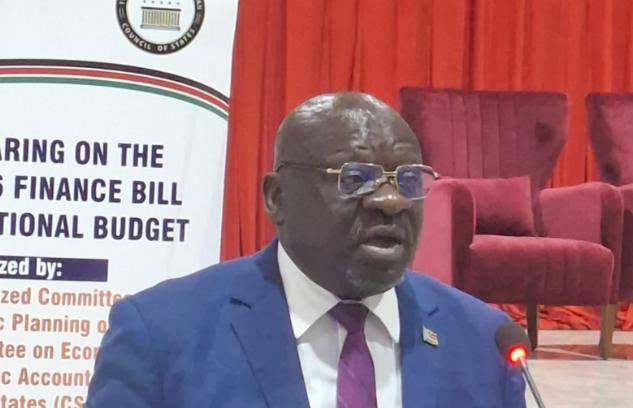
Speaking during a public hearing for the 2025–2026 Draft Budget at the National Legislative Assembly on Friday, February 13, Undersecretary for Planning Hon. Benjamin Ayali clarified that the perceived disparities are the result of a mathematical necessity rather than administrative bias.
The 60/40 Split
Hon. Ayali explained that the National Government currently employs a two-tier formula for all regional transfers. Under this system, 60 percent of the total allocated funds is distributed equally across the board to every state and administrative area, while the remaining 40 percent is allocated strictly based on population size.
However, the Undersecretary acknowledged a significant hurdle in this process: the population data currently being used is derived from the 2008 Census. Despite the government of South Sudan historically objecting to the accuracy of that data, it remains the only official dataset available to the Ministry to form a basis for these transfers.
“We don’t have any other data other than the census of 2008 to form a basis for the allocation of transfers to states and administrative areas,” Ayali stated, addressing representatives who questioned why some regions receive significantly more than others.
The Challenge of New Administrative Areas
The debate particularly touched on the Greater Pibor and Ruweng Administrative Areas. Hon. Ayali noted that many current administrative boundaries did not exist during the 2008 census. Using the Greater Pibor Administrative Area as an example, he reminded the gallery that the area originally consisted of only two counties before expanding to its current seven.
Because the Ministry only recognizes the 79 counties officially recorded in its historical database, newly created counties that did not participate in the 2008 census lack the formal data required to trigger higher population-based funding. Hon. Ayali asked rhetorically how the Ministry could create a formula for a county that was not there during the census period.
National Records vs. Local Expansion
The Undersecretary emphasized that while states have expanded their internal county structures over time—notably during the period of the 32 states—the budget allocation must remain anchored to the official national records to maintain financial consistency.
By reaffirming the 60/40 formula, the Ministry of Finance signaled that until a new national census is conducted, the disparities in state transfers will likely persist. The current budget remains firmly anchored on the results of the census of 2008, ensuring that 60 percent goes to every state equally and 40 percent is tied to those historical population figures.
For More News And Analysis About South-Sudan Follow Africa-Press