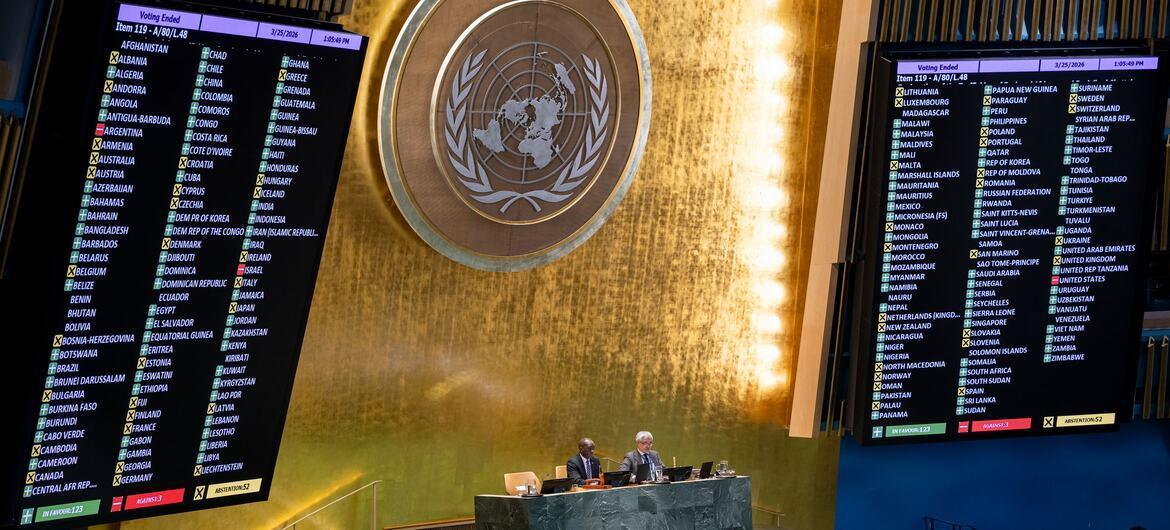
Africa-Press – South-Sudan. South Sudan joined 122 other countries in voting for a United Nations resolution recognising slavery as the gravest crime against humanity, in a move that places the young nation alongside a coalition of states calling for historical accountability and reparatory justice.
The resolution, spearheaded by Ghana on behalf of the 54-member African Group on Wednesday, was adopted with 123 votes in favour, while Argentina, Israel and the United States voted against. A further 52 countries, including members of the European Union, abstained.
Speaking ahead of the vote, Ghana’s President John Dramani Mahama said the resolution marked a moment of “solemn solidarity” and a step toward healing the enduring wounds of transatlantic slavery.
“Today, we come together in solemn solidarity to affirm truth and pursue a route to healing and reparative justice,” Mahama told the General Assembly in a statement obtained by Sudans Post.
The resolution frames the transatlantic slave trade and the enslavement of Africans in Europe and the Americas as “the gravest crime against humanity,” citing its scale, brutality, and long-lasting global consequences. For more than four centuries, millions of Africans were forcibly taken from the continent, subjected to inhumane conditions, and exploited across plantations.
It further underscores the lasting legacy of slavery, linking it to persistent racial inequalities, systemic discrimination, and global disparities that continue to affect people of African descent.
The text also highlights the importance of addressing historical injustices through measures that promote human rights, dignity and healing, while affirming that claims for reparations represent a concrete step toward remedy.
However, the resolution faced opposition, most notably from the United States. Ambassador Dan Negrea, Washington’s representative to the UN Economic and Social Council (ECOSOC), described the text as “highly problematic in countless respects.”
He argued that the United Nations should focus on maintaining international peace and security rather than advancing what he termed “narrow specific interests and agendas.” The United States also reiterated its position that it does not recognise a legal right to reparations for actions that were not illegal under international law at the time they occurred.
Despite the divisions, the debate in the General Assembly was marked by strong moral appeals and reflections on the historical and human cost of slavery.
President of the General Assembly Annalena Baerbock described slavery and the slave trade as among the gravest violations of human rights in history, noting that both the United Nations Charter and the Universal Declaration of Human Rights were shaped, in part, by such injustices.
She added that African countries suffered not only human loss but also long-term economic damage due to the mass removal of generations of people.
“It was, to put it in colder terms, mass resource extraction,” Baerbock said.
UN Secretary-General António Guterres called on member states to confront the enduring legacies of slavery, including systemic racism and inequality.
“Now we must remove the persistent barriers that prevent so many people of African descent from exercising their rights and realising their potential,” Guterres said, urging governments to commit fully to equality and human dignity.
He pointed to initiatives such as the Second International Decade for People of African Descent and the African Union’s Decade of Reparations as key frameworks for advancing justice and inclusive development.
The session also featured a poignant contribution from Barbados’ Poet Laureate, Esther Philips, who invoked the memory of slavery’s victims and challenged world leaders to act.
“There are spirits of the victims of slavery present in this room at this moment, and they are listening for one word only: justice,” she said.
For More News And Analysis About South-Sudan Follow Africa-Press