
By Dr. Luka Biong Deng
Africa-Press – South-Sudan. Summary: The Iran war that erupted by the end of February this year has triggered serious economic and security shockwaves, particularly after Iran imposed restriction on the Strait of Hormuz; one of the world’s most critical maritime chokepoints. These shockwaves are likely to be exacerbated further if the Houthis, Iran-backed group in Yemen, disrupt the global seaborne trade in the Red Sea. The surge in fuel prices, the most immediate transmission mechanism of the Iran war, constitutes the major impact as it is felt beyond the Middle East, particularly by the countries that are reliant on fuel imports. Despite its reliance on oil exports, South Sudan has not benefited from this windfall but instead it has been uniquely affected by the increase in fuel prices as reflected by its exceptionally high average fuel prices in March 2026, which is the highest in the region and almost a double of the word average fuel prices. With its profound downstream effects on transport costs and cost of living, the surge in fuel prices has exacerbated the already fragile livelihood conditions. These high fuel prices and their downstream effects on the livelihoods are occurring in the midst of enormous energy potentials. The Iran war has exposed structural fragilities, largely caused by governance deficits, and has also triggered a wakeup call for strategic rethinking of how to deliver a sustainable national energy security. What is missing in South Sudan is a strategic leadership to harness these huge energy potentials by developing and implementing a national energy security strategy to ensure reliable, affordable energy supplies by diversifying sources, and promoting energy efficiency.
Introduction:
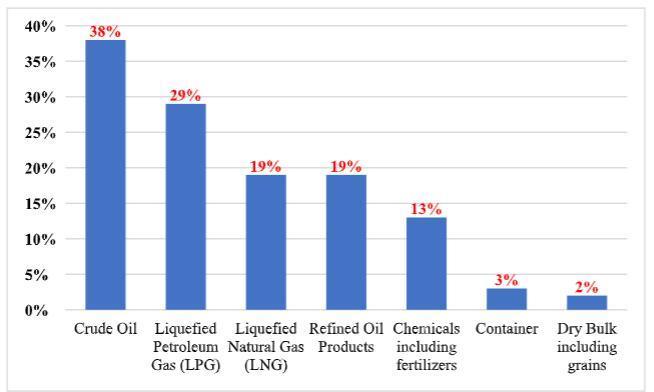
The Iran war that erupted on February 28, 2026, has rapidly developed into a conflict that triggered reverberating shockwaves beyond the Middle East. After almost one month, the repercussion and the consequences of this conflict are globally felt by most countries and even our environmental ecosystem; particularly after Iran imposed restriction on the Strait of Hormuz; one of the world’s most critical maritime chokepoints[1]. It is estimated about 38% of the world’s crude oil, 19% of the world’s liquefied natural gas (LNG), 29% of the world’s Liquefied Petroleum Gas (LPG), 19% of the world’s refined oil products and 13% of the world’s chemicals including fertilizers passed through the strait (see Figure 1)[2]. In 2024, the total oil transported through the Strait was around 20 million barrels per day (bpd), or the equivalent of 25 per cent of global seaborne oil trade. Crude oil and condensate account for 14 million barrel per day (bpd) and petroleum products for 6 million bpd.
The disruptions of the Strait of Hormuz have serious implications for global trade, development and security. With the closure of the strait, the ship transits through the Strait have come to a near halt with total number of daily ship transits through Strait of Hormuz dropped by 97%. This has resulted in the crude oil prices surged to the highest level since 2022 causing considerable increase in energy, fertilizer and transport costs – including freight rates, bunker fuel prices and insurance premiums – resulting in upsurge in food costs and intensifying cost-of-living pressures[3]. It is estimated that the Middle East accounts for 15.8 percent of Africa’s imports and 10.9 percent of its exports, while the Strait of Hormuz handles around 20 percent of global oil exports and nearly 90 percent of Persian Gulf oil exports[4]. If the Iran war exceeds six months, it is estimated that the Africa’s gross domestic product (GDP) will contract by 0.2 percentage points with the extent of this impact would vary across the continent based on levels of import dependency, exposure to the Middle East, and global market conditions[5]. These disruptions occurred at the time many African countries are struggling to address the challenges of extreme weather conditions, and the consequences of the global shocks of the COVID-19 and the war in Ukraine.
Besides these disruptions caused by the closure of the Strait of Hormuz, the Red Sea might be the next target, particularly the recent attack of Israel by the Yemeni Houthi in show of their solidarity with Iran. As Iran is using the Strait of Hormuz as its strategic leverage in its war with US and Israel, it is most likely that it will use its proxy network and instrument of regional pressure in Yemen to disrupt the global seaborne trade in the Red Sea. This will have far reaching consequences as experienced in the 2023-2024 Houthi attacks that resulted in drastic reduction by 70% in container tonnage through the Red Sea and Bab-el-Mandab in two months and the insurance premiums for Red Sea transits plunged by tenfold, cascading into higher import costs for every country dependent on that corridor, making the Red Sea impassable[6].
The entry of the Houthis into the Iran war poses again the risk of the disruption of the global seaborne trade in the Red Sea with fears that the commercial vessels may be rerouted around the Cape of Good Hope by avoiding the Bab-el-Mandeb strait and the Suez Canal route to reach the Indian Ocean. But this rerouting will be at the cost of longer supply chains and higher consumer prices across the continent[7]. The participation of the Houthis in the Iran war will undoubtedly present a real threat to and destabilizing factor in the Horn of Africa and the Red Sea, which can result in raising the cost of the Iran war on the Horn of Africa but also the global economy[8].
In addition, the Horn of Africa hosts the largest US military base in Africa, camp Lemonnier in Djibouti, a key logistical hub for American operations in the Horn of Africa and the Gulf and a smaller airfield base in Manda Bay in Kenya that is used by the US for regional security, crisis response, and training. Also, Somaliland is emerging as a potential host for an Israeli security presence. These countries are situated at one of the world’s most important maritime chokepoints, where the Red Sea narrows into the Gulf of Aden, making the Horn of Africa a potential strategic point and the next front in the Iran war[9]. This will heighten rivalry and competition in the Horn of Africa not only between great powers but also the emerging middle powers.
Although South Sudan is far a distant from the battlefield in Iran and Gulf, it is not removed from the consequences of the Iran war, particularly in an interconnected global economy. Given its geography as a landlocked country with an oil-dependent economy, South Sudan is increasingly susceptible to the upshots of the Iran war and with serious economic implications for its citizens. These consequences will further exacerbate the already fragile conditions, as South Sudan is grappling with protracted violent conflicts, persistent food insecurity and impacts of extreme climate conditions. This paper provides the analysis of the immediate and structural implications and impacts of the Iran war on South Sudan as well as possible ways to address such impacts in the future.
Economic Implications:
The most obvious impact of the Iran war on South Sudan is economic in terms of foreign trade, transport costs, and fuel prices as the most immediate transmission mechanism of the conflict. The severity of the economic impact depends on the structure of the economy. As the oil-exporting country with oil accounting for over 50% of its gross domestic product (GDP), roughly 90% of government revenue, and nearly all exports, the surge in oil prices as result of the Iran war is an opportunity but it presents as well serious economic challenges to the economy of South Sudan. This apparent economic gain from the high oil prices is misleading as the economy of South Sudan is an imports-reliant. It was estimated in 2024 that the exports per capita was $42.4, while imports per capita was $94.3, making South Sudan among the top 5 countries with the highest imports per capita[10]. This implies that the increase in the crude export revenues as a result of the Iran war can be easily cancelled out by higher import bills.
Also, the participation of the Houthis in the Iran war will likely disrupt the global seaborne trade including the oil export of South Sudan through the Red Sea. The history reminds us that the short-term windfalls hardly translate into long-term development gains in the absence of sound governance and strategic investment of those revenues[11]. Since its independence in 2011, South Sudan has not only been unable to diversify its economy by investing its oil revenue in agriculture as the mainstay of the rural livelihoods but also failed to build a credible refinery except the mini refinery in Bentiu in Unity State with a capacity of 3,000-10,000 bpd but it has been dormant for years and has now resumed operation.
In addition, the surge in fuel prices as a result of the Iran war and with its profound downstream effects on transport costs, and electricity generation, South Sudan as an exclusive net energy importer is exceptionally exposed to this distress. The historical data on oil prices provides a grim outcome as a 10% increase in oil prices alone is estimated to push African inflation upward by around 2%[12], causing enormous suffering for African populations with household income that is largely spent on food and basic essentials. Also, it is estimated that during the 2022 Russia-Ukraine war, the African inflation surged from an average of approximately 4.5% to 9.5% [13].
During March 2026, the first month of the Iran war, most African countries started feeling the heat of the substantial surge in the global fuel prices. It is estimated that the fuel prices increased by 50% as of 24 March[14], causing serious economic impacts in Africa[15]. These impacts include interruption of crude oil supply, raised global energy costs, increased production costs in critical sectors like agriculture causing higher food prices, raised transport costs and generated market instability that many African countries that rely heavily on fuel imports cannot avoid. With most African countries importing the refined petroleum products, the continent will continue to be susceptible to these global shocks, recurring cycles ofdiesel-driven inflation, weaker growth, and social instability unless they invest in local refining, diverse energy sources, and strategic reserves[16].
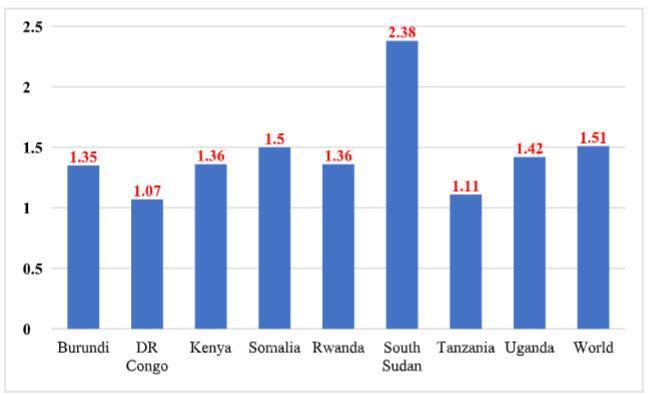
In the East African Community (EAC), the fuel prices in most member states increased in March 2026 but lower than the world’s average fuel price with exception of South Sudan (see Figure 2). This regional disparity in the fuel prices is a reflection of the level of dependence on inland transportation such as South Sudan that is experiencing the most acute price spikes, while those with efficient coastal supply routes remain marginally more stable. In addition, domestic energy policies and regional trade barriers may explain this regional variation in fuel prices. In South Sudan, the fuel prices increased by 106% by the end of March, making its average fuel price the highest in the region. Besides being a landlocked country, the persistent violent conflict has increased the level of criminality and lawlessness in South Sudan, making inland transportation of goods including fuel very expensive with many roadblocks and high unregulated taxes and fees on the imported goods. In Juba, the capital city of South Sudan, the retail prices of maize and sorghum as basic food commodities surged in March 2024, mainly caused by macroeconomic challenges[17] but also due to oil prices shock created by the Iran war. Also, this exceptional surge in South Sudan’s fuel prices is indicative of a fractured regional supply chain and absence of national energy security policy and energy transition roadmap for ensuring more sustainable energy security.
In coping with the effects of the Iran war, South Sudan that generates 96% of its electricity from oil started prioritizing electricity power rationing in March 2026 with some who can afford switching to solar power[18]. These desperate and unsustainable attempts to meet power needs are ironically prioritized in a country that holds significant, largely untapped hydropower potential, with an estimated capacity of over 2,500 megawatts (MW) to 4,860 MW[19] that exceeds the domestic power consumption. In Central Equatoria state alone, there are eighty-two (82) potential small hydropower (SHP) sites along the Bahr el Jebel and the Kaya rivers with a total output power of 1651.69 MW[20]. In addition, South Sudan has quite high level of solar energy in most of the country with global horizontal solar radiation with a value of 5.5-6.0 kWh/m2/day (kilowatt-hours (kWh) received on a 1 square meter (m2) surface over 24 hours)[21]. South Sudan has also considerable wind energy potentials with wind speeds across most of the country of about 5.0 m/s (meter per second) and a high level of generation of municipal solid waste of about 0.64 kg per capita per day.
Security Implications:
Given its exclusive reliance on the Red Sea for exporting its oil to international market through Sudan, South Sudan will be directly or indirectly affected by the implications of the Iran war for security and stability of the Horn. Given its strategic geographical location as it sits along the Red Sea and the Gulf of Aden, has a large US military bases and is in close proximity to Yemen, the Horn is in a precarious position, making it a node in the Iran war[22]. If the Iran war persists, Iran will use its backed militant group, the Houthis in Yemen, to disrupt the global seaborne trade in the Red Sea. Although the Houthis have the capacity to disrupt the Red Sea shipping, they may be cautious to do so this time around as the current war will weaken Iran militarily as well as limiting its support to its backed armed groups in the region. In addition, Iran may destabilize the Red Sea maritime by directly targeting the US military and security bases in the Horn, particularly the Lemonnier camp in Djibouti.
Given its strategic position as a route for transporting the oil of South Sudan to international market, the implications of the Iran war on conflict in Sudan is of great national security interest of South Sudan. The violent conflict that erupted in Sudan in 2023 has been largely shaped by external sponsorship of the Gulf countries and Iran. With the Iran war, the military and external support to the warring parties, the Sudan Armed Forces (SAF) and the Rapid Support Forces (RSF), will reduce considerably or come to a halt. This reduction in external military backing and couple with reduction of their gold exports to the Gulf countries may des-escalate the civil war as well as providing opportunity for finding a meaningful peace in Sudan[23]. However, there is a possibility that one or both parties to the conflict in Sudan may take the opportunity to escalate conflict with the possibility of disrupting the oil exports of South Sudan
Also, the persistent surge in fuel prices will not only increase the cost of living to intolerable level but it will increase level of criminality, civil unrest, uprising and tensions between citizens and their governments in the region. In addition to the rising cost of living, the civil servants, particularly the law enforcement forces, have not been paid for months, making security situation in the country perilous. There is now a considerable surge in crimes and violence in major towns of South Sudan with crime reaching very high level of 88.69% in Juba, the capital city[24]. This increase in fuel prices and coupled with reduction in foreign aid, will increase the level of food insecurity and will pose challenges to the United Nations Mission in South Sudan (UNMISS) to discharge its mandate of providing protection to the war-affected communities.
Conclusions: A call for national energy security strategy
The cycle of global shocks, natural and man-made, will persist with great intensity and widespread global impacts, particularly the international trade. These shocks will continue to be exacerbated by the geopolitics that is supplanting and overrunning globalization. Some of the lessons learned from the COVID-19 pandemic is the reactive response to the pandemic, as most countries do not have coherent proactive and forward-looking national security strategies[25]. Also, the pandemic with the lockdown scenario has invoked the infant industry argument and the need for homegrown capacities to produce basic essentials and commodities for survival during the future pandemics. The global fuel crisis caused earlier by the Iran war has not only exposed structural fragilities of most African countries, largely caused by decades of import dependency, governance deficits, and under-investment in productive and energy capacity but it calls also for strategic rethinking of how to deliver a sustainable national energy security[26].
South Sudan has enormous potentials for renewable energy development and potential capacity to providing sustainable energy to its citizens. Besides enormous fossil fuels potentials, South Sudan has high solar, wind and solid waste energy potentials. What is missing in South Sudan is a strategic leadership to harness these energy potentials by developing a national energy security strategy to ensure reliable, affordable energy supplies by diversifying sources, and promoting energy efficiency. This strategy should be one of the key elements of the national security strategy and with the aim of:
reducing reliance on imported fuels by building high-capacity refineries such as Tharjiath Refinery Project to meet not only the local energy needs but also the needs of the neighboring countries,
scaling up renewables, particularly investment in hydropower production such as Fula Rapids Hydropower Project,
balancing energy transition goals by integrating renewables with traditional energy sources,
ensuring uninterrupted availability of energy sources at an affordable price, often moving toward lower-carbon systems,
diversifying sources of energy byreducing dependence on single suppliers or types of energy, enhancing supply chain resilience.
The Iran war is a blessing in disguise as it will encourage and even force the African countries with fuel import-dependent economies to revisit the ways they have been generating, producing, processing, planning and delivering energy to their citizens. South Sudan has the potentials, opportunities and capacities to provide a sustainable energy security to its citizen simply through new strategic and people-centered policy guidance in the energy sector.
The writer, Luka Biong Deng, is a Senior Research Fellow and Consultant at the Sudd Institute, an Adjunct Professor of Peace, Development, and Security Studies at the University of Juba, and an Adjunct Distinguished Professor of African Security Studies at the Africa Center for Strategic Studies (ACSS), National Defense University, USA.
[1] Viktor Katona. “How Iran Plans To Bypass The World’s Main Oil Chokepoint”
[2] https://unctad.org/system/files/official-document/osgttinf2026d1_en.pdf
[3] Ibid
[4] https://www.undp.org/africa/publications/policy-brief-impacts-middle-east-conflict-africa
[5] Ibid
[6] https://horninstitute.org/the-us-israel-war-on-iran-and-africas-mounting-dilemma/
[7] https://horninstitute.org/the-iran-war-gulf-restraint-is-buffering-the-horn-of-africa/
[8] https://horninstitute.org/the-iran-war-gulf-restraint-is-buffering-the-horn-of-africa/
[9] https://www.semafor.com/article/03/16/2026/why-the-horn-of-africa-could-become-the-next-front-in-the-iran-war
[10] https://oec.world/en/profile/country/ssd
[11] https://horninstitute.org/the-us-israel-war-on-iran-and-africas-mounting-dilemma/
[12] https://en.wikipedia.org/wiki/Economic_impact_of_the_2026_Iran_war
[13] Ibid
[14] https://www.undp.org/africa/publications/policy-brief-impacts-middle-east-conflict-africa
[15] https://africa.businessinsider.com/local/markets/10-african-countries-with-the-highest-diesel-prices-in-march-2026/rv447lm#:~:text=Chinedu%20Okafor,freight%2C%20construction%2C%20and%20manufacturing.
[16] Ibid
[17] https://www.fao.org/giews/food-prices/price-warnings/detail/en/c/1757856/
[18] https://www.bbc.com/news/articles/cq8wkq1n9epo
[19] https://energycapitalpower.com/hydropower-a-top-solution-for-south-sudans-electricity-expansion-2
[20]https://www.researchgate.net/publication/367179962_Preliminary_assessment_of_small_hydropower_potential_using_the_Soil_and_Water_Assessment_Tool_model_A_case_study_of_Central_Equatoria_State_South_Sudan
[21] https://aenert.com/countries/africa/energy-industry-in-south-sudan/
[22] https://horninstitute.org/the-us-israel-war-on-iran-and-africas-mounting-dilemma/
[23] Ibid
[24] https://www.numbeo.com/crime/in/Juba-South-Sudan
[25] https://www.ia-forum.org/Files/July%202020%20IA%20Forum1.pdf
[26] https://horninstitute.org/the-us-israel-war-on-iran-and-africas-mounting-dilemma/
Source: Radio Tamazuj
For More News And Analysis About South-Sudan Follow Africa-Press