
Africa-Press – Tanzania. NoneCanada is reviewing its long-standing support for Tanzania after a violent crackdown by police and soldiers reportedly killed hundreds of civilians protesting a disputed election.
Ottawa has provided $3.4-billion in international assistance to Tanzania since its independence, seeing the East African country as a stable and peaceful partner – a status that is now in jeopardy as arrests and imprisonment continue.
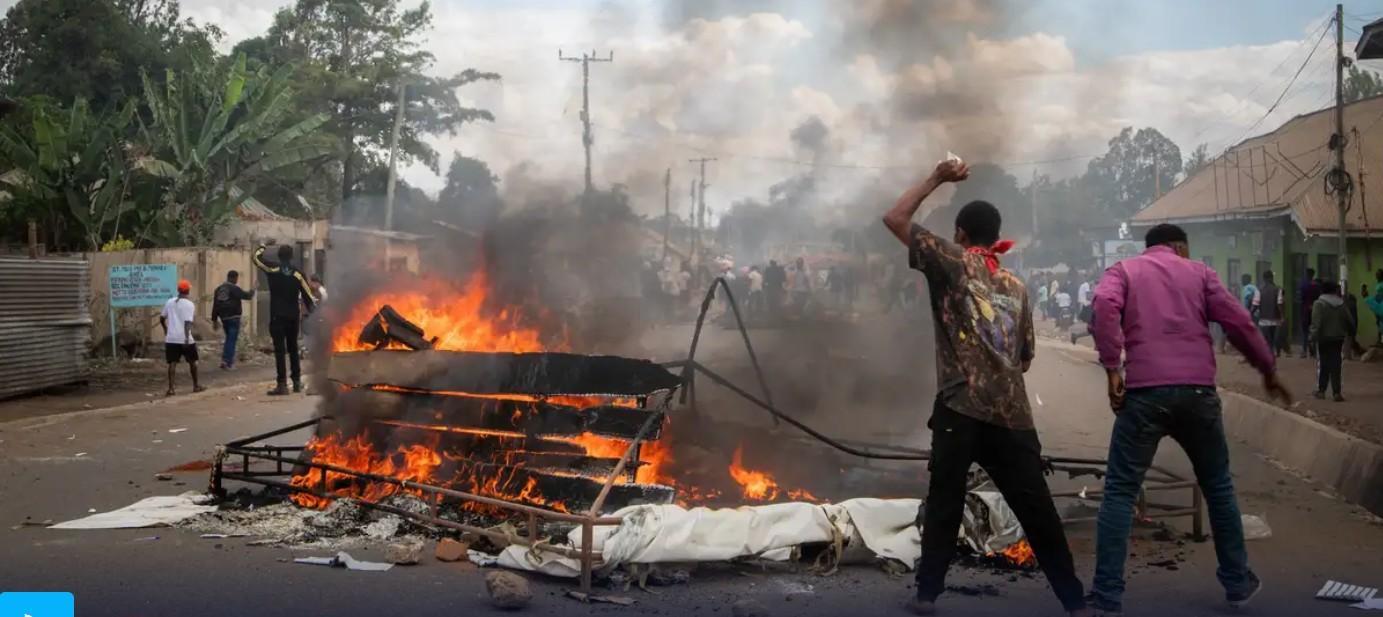
Tanzania’s government mobilized a massive presence of police and soldiers to prevent a planned national demonstration on Tuesday. Most streets were eerily quiet, with many Tanzanians afraid to venture outside for fear of arrest. Smaller scattered protests were reported in a few places.
Tanzania has been a top recipient of Canadian aid for decades, including in 2023-24 when it received $141-million in support, according to Global Affairs Canada.
“In light of recent developments, Canada is undertaking a comprehensive review of its international assistance to Tanzania to ensure the continued effectiveness and integrity of its programming,” spokesperson Alexandre Fournier told The Globe and Mail on Tuesday in response to questions.
Canada will focus its aid on health, education and inclusive growth programs for the poorest and most vulnerable communities in Tanzania, he said.
Since its independence in 1961, Tanzania has been governed by a single ruling party, now known as Chama Cha Mapinduzi, or the Revolutionary Party. The government banned the two biggest opposition parties from October’s election, allowing President Samia Suluhu Hassan to claim a landslide victory of 98 per cent.
Last week, Canada joined 15 other Western countries and the European Union in calling for an independent inquiry into the deaths and other violence in the aftermath of that election.
“Credible reports from domestic and international organizations show evidence of extrajudicial killings, disappearances, arbitrary arrests, and concealment of dead bodies,” a joint statement said.
The statement called on Tanzanian authorities to release all bodies as well as all political prisoners, and to address reports by election observers that cited “clear shortcomings in the electoral process.”
Commonwealth ministers issued a similar statement, voicing concern over human-rights abuses in the postelection crackdown and hinting that Tanzania could be suspended from the Commonwealth if it fails to lift restrictions on media outlets and civil society groups and if it fails to bring justice to the perpetrators of violence.
The United States also announced a comprehensive “reconsideration” of its own relations with Tanzania after the police and military violence.
In a statement last week, United Nations human-rights experts cited estimates that at least 700 people had been killed in the postelection crackdown, with some estimates suggesting that thousands may have been killed. There are “chilling reports on the disappearance of victims’ bodies from morgues, and allegations that human remains are being incinerated or buried in unidentified mass graves,” the experts said.
Organizers had planned a nationwide demonstration on Tuesday, the anniversary of Tanzania’s independence. But the government warned that any protests would be illegal and could be deemed a coup attempt.
In the commercial capital of Dar es Salaam, soldiers and police set up roadblocks, halted buses, restricted the movement of people and blocked key intersections to prevent crowds from gathering. Helicopters rattled low in the sky in several neighbourhoods, watching for any protest activity.
At one traffic junction, troops set up a roadblock with armoured vehicles and heavily armed personnel to inspect all long-distance buses arriving in the city. Passengers were ordered to step out, line up and present identity cards. Those without documents were briefly detained.
“I had to wait almost an hour because I didn’t have my ID with me,” said carpenter Juma Kusaya, who had travelled from the city of Morogoro. “They kept asking questions. I’ve never seen checks like this inside the city.”
In a northern suburb, police blocked motorcycles from using the main road leading to the city centre, while buses stayed off the roads. “I’ve been stranded since early morning,” said Mariam Kilindo, a nurse waiting at a bus stop. “There is no public transport at all. People are walking long distances just to find a way to get to work.”
Despite the restrictions, small groups of protesters attempted to gather in Dar es Salaam and elsewhere. In the city of Mwanza, on the shores of Lake Victoria, a group of young protesters confronted a line of soldiers, complaining about the killing of civilians and calling for a change of government.
In the weeks before Tuesday’s planned protest, Tanzanian authorities arrested at least 10 activists and opposition supporters for making online posts about the protest, according to Human Rights Watch.
Authorities also intensified their harassment and surveillance of activists, the organization said. They demanded the suspension or restriction of the Instagram accounts of three activists, and Instagram’s owner, Meta, complied with the demand.