
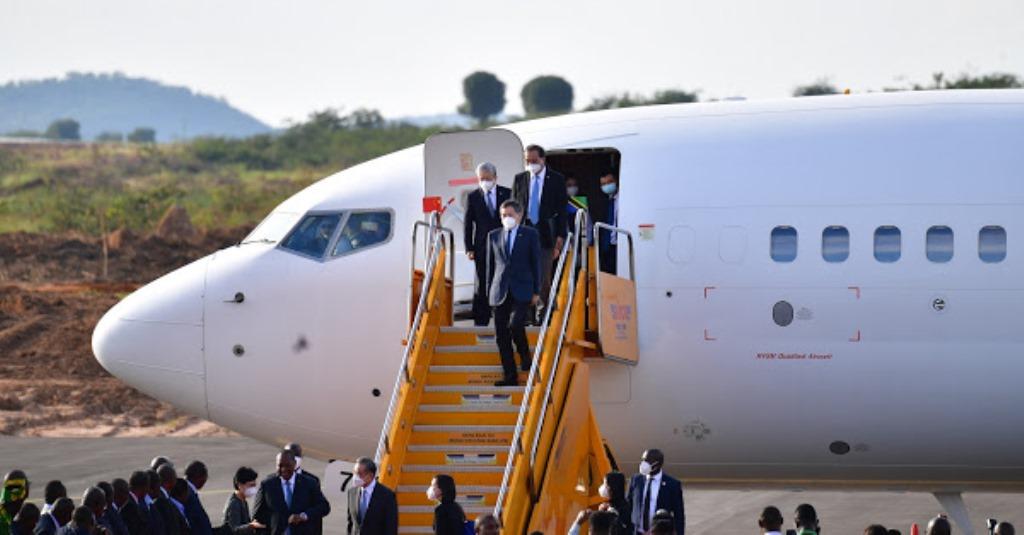
Africa-Press – Tanzania. THE arrival of China’s State Councillor and Foreign Minister Wang Yi, is set to steer the Sino- Tanzania long-standing relationship to new heights.
Signing of a crucial contract for the construction of the 1.32 billion US Dollars (about 3.06tri/) Standard Gauge Railway (SGR) from Mwanza to Isaka heralds the visit of China high profile delegation, led by Mr Wang.
Wang and his entourage jetted into the country yesterday for a two-day official visit.
Among other activities, the Chinese leader will witness the signing of the crucial contract, further boosting Tanzania’s infrastructure development initiatives.
While in the country, the Chinese Foreign Minister will grace a series of activities, according to the Minister for Foreign Affairs and East African Cooperation, Prof Palamagamba Kabudi.
“The visit by the Chinese Foreign Minister demonstrates the unbreakable long term traditional friendship between the two brotherly countries, which was established by the foundforeign ing fathers of the two nations, Mwalimu Julius Nyerere and Mao Tse-tung,” said Prof Kabudi.
Since Monday, Mr Wang has been paying official visits to five African countries, including Nigeria, the Democratic Republic of Congo (DRC), Botswana, and Seychelles.
China Ambassador to Tanzania, Ms Wang Ke, underlined the importance of the visit, saying she believes it will take China- Tanzania traditional friendship to a new-height.
The envoy said the Chinese Foreign Affairs Minister’s visit to Tanzania is a tour of solidarity, cooperation and friendship and new steps to build an even closer China-Africa community with a shared future.
“No matter how the international and regional situation changes, China will always be a reliable friend and comrade of Tanzania,” the ambassador said.
China has always placed Tanzania on its foreign itinerary for many years since bilateral relations were established almost five decades ago and Minister Wang’s two-day official visit in the country signifies yet another milestone.
China established diplomatic relations with the then Tanganyika and Zanzibar in 1961 and 1963 respectively.
When Tanganyika and Zanzibar were united and became Tanzania on April 26, 1964, it became natural for China to extend its diplomatic ties with Tanzania.
According to the government Chief Spokesperson, Dr Hassan Abbasi, in recent years, the two countries’ relations turned from political to economic and social development.
For instance, in the last 30 years, the Foreign Direct Investments (FDIs) from Beijing to Dar reached 7.5billion US dollars for Mainland and 142.9 million US dollars to Zanzibar.
The FDIs translated to almost 950 noticeable investments for both Mainland and Isles.
“This makes China one of the leading investors in Tanzania,” Dr Abbasi said. Dr Abbasi said the Sino-Tanzania relations remain very different from other African countries. “To us, we regard his (Mr Wang) visit as coming to pay homage to a distant brother…it is a brotherhood visit,” Dr Abbasi said.
The China-Tanzania relation dates back to 1960s, when China was still a developing country and it was cemented when Dar es Salaam campaigned for Beijing to regain its United Nations Security Council “veto power” and the construction of Tanzania Zambia Railway (Tazara) in early 1970s.
“Tanzania assisted China a lot to learn about Africa and equally significant, Tanzania learned a lot from China, especially in the area of social development via socialism,” Mr Abbasi said.
Thus efforts are made to increase the Dar es Salaam share of export to Beijing using Chinese online marketing companies. This comes at a time when the trade balance between Tanzania and China is in favour of the latter.
On average, Dar es Salaam exports goods worth 145million US dollars, while imports 1.77billion US dollars of goods a year, according to the World Integrated Trade Solution (WITS).
WITS data further shows that in 2018, China topped Tanzania importation list, where Beijing accounted for 20.7 per cent of total Dar es Salaam imports.
The second in the list was India with 14.3 per cent and the third was United Arab Emirates (UAE) with 10.2 per cent.
The two–day official visit of Chinese delegation is anticipated to open more channels to boost Dar es Salaam’s exports, while strengthening bilateral ties with the Asian giant.
“Our long relationship is based on mutual understanding forged by the two founding fathers of both nations (Chairman Mao Tse Tung and Mwalimu Julius Nyerere),” Dr Abbasi said.
The Chief Spokesperson said Tanzania’s low share of trade to China is down to the fact that most Tanzanians are using traditional ways of doing business, where buyers and sellers want to meet face to face.
“Currently, 49 per cent of sales of goods and services in China are done online (online shopping). We have to change as well and go online,” Dr Abbasi said.
To address this challenge the ministry through Dar embassy in China has begun negotiations with the business network company Alibaba, to open up opportunities for Tanzanian products to be sold in the Chinese market through the network.
Tanzania remains one of the countries that have benefited the most from receiving Chinese aid through the China-Africa Cooperation Forum (FOCAC).
In the first term of President Magufuli’s regime, a total of 11 projects have been implemented through FOCAC.
The projects include construction of the Office of the Ministry of Foreign Affairs and East African Cooperation in Dar es Salaam, construction of the University of Dar es Salaam Library, construction of two Unguja and Pemba Water Projects; expansion of Abdalla Mzee Hospital in Pemba as well as the construction of doctors’ houses.
Other projects include renovation of Mao Tse-Tung Stadium in Unguja, construction and maintenance of the Benjamin Mkapa Stadium in Dar es Salaam, rehabilitation of Moshi Police College and construction of Kagera Technical College. China also has a number of projects present under feasibility study.
The projects include construction of Mwalimu Nyerere Agricultural University, University of Transport (NIT) and expansion of Jakaya Kikwete Heart Institute (JKCI) as well as construction of Ngorongoro Geopark.
In the education sector, he said, China increased the number of scholarships to study in China. In 2015-2020, a total of 500 Tanzanians had access to long-term training and 1,029 received shortterm training in China.
Thus, the coming of Mr Wang, signifies that the relation between Tanzania and China has withstood the test of time, removing disturbances and has become a model for international relations and its South-South cooperation.