

Africa-Press – Tanzania. Dar es Salaam
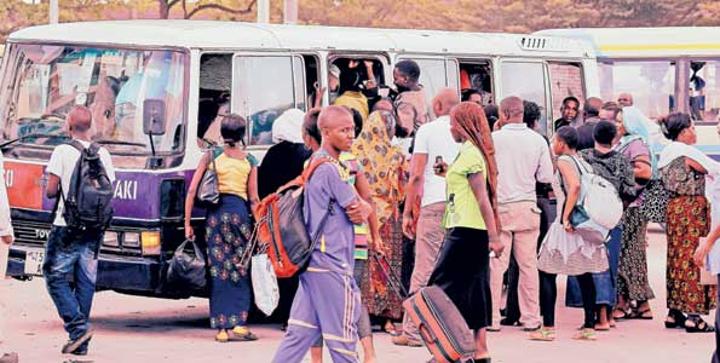
. The risk of catching coronavirus in public transport remains high as the directive to observe social distancing largely remains ineffective.
Commuter bus owners and crews continue to defy the government directives to ensure buses do not carry more than their installed seat capacity (‘level seat’ mode).
Commuters risk contracting the Covid-19 by succumbing to the demand-and-supply rule as they are compelled to board crowded buses to their daily workplaces.
Transport stakeholders highlight why it’s not possible to implement the level seat rule and wearing of face masks despite battling the third wave of the Covid-19 pandemic.
Dar es Salaam Bus Owners Association (Darcoboa) chairman Kisimati Jaffar told The Citizen that if the government wanted them to maintain level seat, then it should adjust bus fares upwards.
“We are very much aware that the high cost of fuel has contributed to a rise in global demand but in a situation like this how can one operate at level seat? The authorities should think of adjusting bus fares upwards for us to operate profitably,” he said.
The government directed bus operators to ensure they carried no more than the seat capacity by August 1, but operators pointed out that high cost of fuel was hindering them to obey the order.
The operators argue that fuel prices have gone up “by 58 percent during the past 12 months due to a rise in global demand and increasing local taxes and levies.”
In Dar es Salaam, motorists currently pay over Sh2,400 per litre of petrol, up from Sh1, 520 in June last year, available data show.
Explaining, Mr Jaffar noted that if the government was not ready to adjust the daladala fares upwards it must come up with an awareness initiative to sensitize the public on the importance of wearing face masks while using daladalas.
“We will continue transporting passengers as we always do, if nothing changes,” he added.
According to him, take a look at some marketplaces like Mabibo, Kariako and Ilala, it is business as usual as people are shopping in crowded places.
“So why bringing restrictions on daladalas?”
A daladala driver plying the Makumbusho-Tegeta Nyuki route, Mr Abduli Hassan, said they were aware of the government directives but wondered how they could earn money and manage to pay the employer the daily cash.
“Last year, the business was fair because the price of fuel was not high but, at the moment, somehow the business is difficult. Thus, when you see us delaying at the bus station, don’t raise your voices because we want to load our daladala so that we can take something to our families and pay our employers,” he said.
“Take a look at passengers and count how many people are wearing face masks…. You can see the number is small because most of them cannot afford to buy masks,” he claimed.
Tegeta resident Celina John said that if the government wanted to control Covid-19 it should deploy more buses on the roads so that passengers who were being compelled to board an already packed bus would not do so.
“As you can see everyone is rushing to get into a daladala because they want to get to their workplace or attend to some business. People are forced to board crowded buses because they need to work to feed their families,” she said.
She noted that a lot of people go to work by daladala, and the best way to maintain level seats was to add more daladalas on the roads.
Land Transport Regulatory Authority (Latra) road transport director Johansen Kahatano said they were currently working hard to ensure the 70 Uda Rapid Transit (Udart) buses started operating as soon as possible, to increase supply of the buses.
“We are optimistic that once the Bus Rapid Transit (BRT) starts operating, commuters will soon start to observe social distance because buses will increase,” he said.
Mr Kahatano said besides that, they were registering private buses, specifically those used for hiring and tour to help complement ordinary daladala on roads.
“We have decided to register the private buses because last year when Covid-19 was over, we experienced a lot of challenges because some individuals wanted to continue operating,” he said.
“When the first outbreak of Covid-19 was reported in the country, daladala’s implemented level seat because a number of buses were given licences to operate…
“It was easy to implement the seat capacity rule because schools were also closed and most employees were working from home unlike at the moment.”