

Africa-Press – Tanzania. CHIEF Justice, Prof Ibrahim Juma, on Monday disclosed various criteria used to nominate the appropriate person among 85 High Court Judges to be the Principal Judge, including fulfilling all constitutional qualifications, humility, prudence and broad understanding of judicial issues.
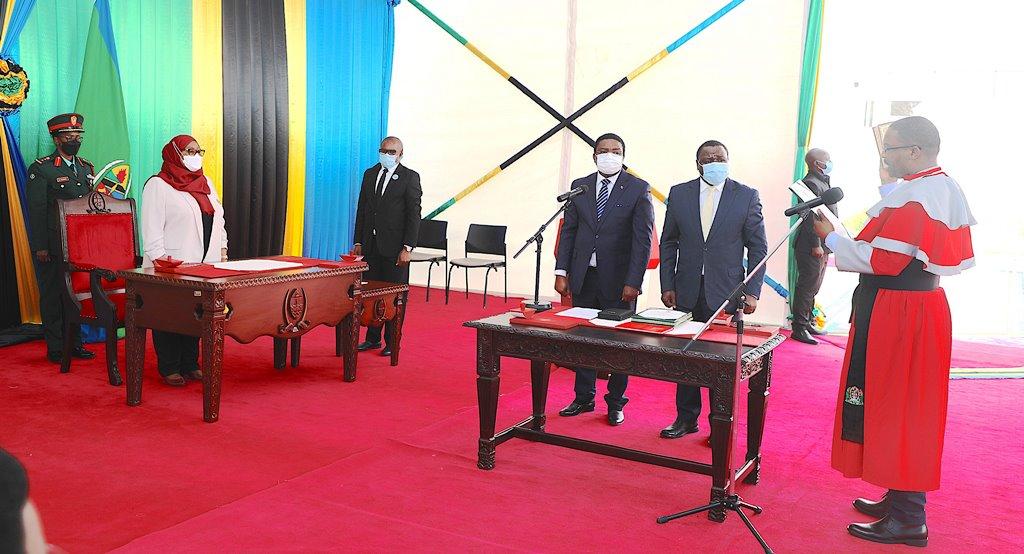
Speaking at a brief swearing-in ceremony conducted at State House in Dodoma by President Samia Suluhu Hassan, the Chief Justice congratulated Judge Mustapher Siyani on his appointment as Principal Judge and that he has fulfilled all the constitutional qualifications to be able to hold such an important position.
Prof Juma explained that there are criteria that were used by the Judicial Service Commission before advising the President on such appointments considering that the Principal Judge is the Special Adviser to the Chief Justice and carries major responsibility of overseeing the High Court and all lower courts.
“If you look at the number of High Courts where there are 16 zones and four divisions, 29 Resident Magistrate Courts, 139 District Courts and 960 Primary Courts, your job is really not easy, because you are the chief administrator of all areas and you need every day to know what is going on,” he said.
The Chief Justice said that due to such heavy responsibilities, the Judicial Service Commission had various criteria in mind, including a broad understanding of the Judiciary and its internal cultures, considering that in any institution, many things are hidden.
“I believe you know the Judiciary well. If you understand in detail what the Judiciary is all about you will be in a very good position to make improvements. Those were the characters that you and others who were sent to the President for the nomination had,” he told the new Principal Judge.
Furthermore, Prof Juma informed Judge Siyani that he should understand that the Judiciary is not an island, which does not interfere with or interact with other pillars of State, thus, he should understand the boundaries of the Judiciary and the boundaries of other pillars, including the existing challenges.
“You have to be wise, your age is young and you are a leader. You will lead people who are older than you, (so) wisdom, dignity and humanity is something that any leader in your position should have,” said the Chief Justice.
According to Prof Juma, the Principal Judge should also understand where the Judiciary was heading to since sometimes the Judges and Magistrates deliver judgments without knowing that they tool live in world.
“Therefore, it is your responsibility to remind us where the world is going and where the Judiciary is moving so that we can understand, because if you do not understand where your country is going you will always criticize what is happening,” he said.
Prof Juma reminded him of the concept of the Judiciary moving towards using the internet in conducting all judicial issues as the matter was clear considering the significant investment in the Information and Communication Technology (ICT) and that it’s the time to make that investment to bear fruit.
The Chief Justice also directed the new Principal Judge to effectively manage all aspects that guide the Judiciary of Tanzania in implementing the five-year strategic plan.
He named them as good governance, accountability and resource management; timely access to justice and Strengthening public trust. He pointed out that without public trust and the cooperation of other stakeholders, the Judiciary becomes useless.
On the occasion, President Samia also swore in the former Chief Justice of Zanzibar, Mr Omar Makungu to be Justice of the Court of Appeal.
According to Prof Juma, Justice Makungu has been the Chief Justice of Zanzibar for more than 10 years and has been missing the opportunity to come to the Court of Appeal for a long time because the President of Zanzibar has been saying “he still needs him.”
He also congratulated the new Shinyanga Regional Commissioner, Ms Sophia Mjema, who in her capacity is a major stakeholder in the Judiciary.
“I believe that when you arrive in Shinyanga, the Judge in Charge and other judicial officials will visit you and inform you of the various challenges that the Judiciary is facing,” he said.