

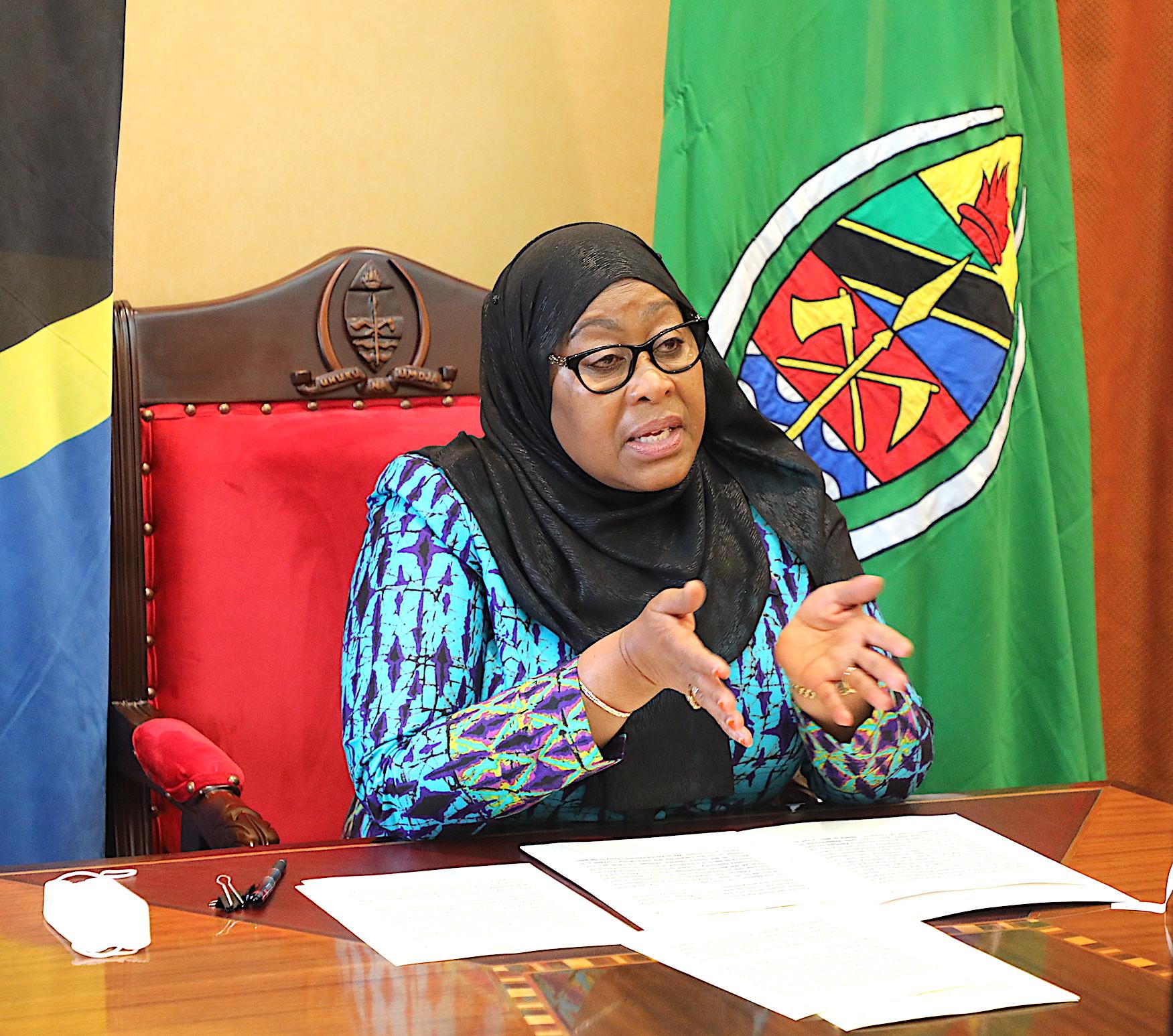
Africa-Press – Tanzania. PRESIDENT Samia Suluhu Hassan has instructed the Judiciary to start using Kiswahili in writing and delivering judgment, since the language is more conversant to many Tanzanians.
She said the use of Kiswahili language instead of English will enable clear understandings on judgment to all parties involved in the case. President Samia was speaking yesterday at Dar es Salaam State House, shortly after launching a Tanzania Gender Bench Book on Women that has been written by the Tanzania Women Judges Association (Tawja) with support from the Sweden Development Agency (SIDA).
She said, since the country has already made amendments on the law that declares Kiswahili as the language of law of the country, then it’s time for the judiciary to start writing judgments using the national language.
“It’s a high time our courts started issuing judgments in Kiswahili language,” she said, adding the language will improve administration and dispensing of justice.
In February this year, the Parliament passed a bill for the amendment of the Written Laws (Miscellaneous Amendments) Act, 2021 to substitute English with Swahili language as the language of the law, Court and records in the administration of justice in Tanzania.
The Head of State also reassured her commitment to ensure provision of justice and maintain the country’s stance on promoting good governance, and human rights for the sake of enhancing political, social and economic development.
Going forward, she commended Tawja for its continued efforts on promoting women and children rights, noting that the government would continue backing the efforts to ensure rights of the mentioned groups are highly protected.
The government will continue educating Tanzanians on the importance of protecting and maintaining human rights for the greater interest of national development.
Speaking on the just launched book, President Samia said the document was crucial and could be used by judges and magistrates as reference for issuing judgment and other legal issues pertaining to the rights of women and children.
“Moreover, the book must be translated into Kiswahili language for it to be more understood to many people, also there must be regular review for it to be updated,” she stated.
In another development, Chief Justice Professor Ibrahim Juma said the Judiciary of Tanzania is now developing a special software, which will be used to translate judgments delivered at all levels of Courts in various languages, including Kiswahili and English.
He made the revelation, while speaking to the judicial officers of the Serengeti District Court during his working visit to various Courts in the Musoma Zone of the High Court of Tanzania.
“The money has already been allocated and we have found experts to be able to give us the software. You can decide to write your judgment in Kiswahili, the software will translate it into English, or you will write it in English, the software will release it in Kiswahili,” he said.
The Chief Justice added, “We want by ‘the Law Week’ next year to have the software that would enable a citizen to choose the language he/she wants his/her judgment to be delivered in.”
According to Prof Juma, Judges of the High Court and the Court of Appeal have decided to have such a software, because they could not stop using English language in writing judgments, an act that could be interpreted as separating with the World.
He pointed out that Mwalimu Nyerere had previously said that English is the Kiswahili of the World and that English is the language of business, although Kiswahili may be more important.
“If we can have such software we will enable the public to understand many words which are in English in Kiswahili. Therefore, the citizen will be selective, if he wants his judgment in English, he will have it, if he wants it to be in Kiswahili, he will get it as well,” the chief Justice said.
Prof Juma also warned that the 21st century world was moving towards using more than one language, including English which is still an international commercial language.
According to him, separating oneself from the English language is like digging himself into a pit from which he could not escape.
The Chief Justice stated that the measures are aimed at translating the law into Kiswahili in order to avoid language conflicts, which are then forwarded to the Attorney General, who in turn submits them to the Government Draftsman, ready for publication in the Government Gazette.
For the Judiciary, Prof Juma explained that they are translating all court Rules, which are in English language and prepared by the Chief Justice and the Rules Committee, adding that already they have translated more than 50 regulations, which will be forwarded to the relevant authorities for legal interpretation.
For More News And Analysis About Tanzania Follow Africa-Press