

Africa-Press – Tanzania. TANZANIA is massively reaping its rewards in the mining sector, thanks to regulatory reforms and amendments that have regularly been undertaken by the government for the past six folds to speed up the sector’s growth.
The mining sector registered incredible transformation in the last 60 years supporting an equitable economy, helping the indigenous as well as supplying raw materials, according to the Minister for Minerals Dotto Biteko.
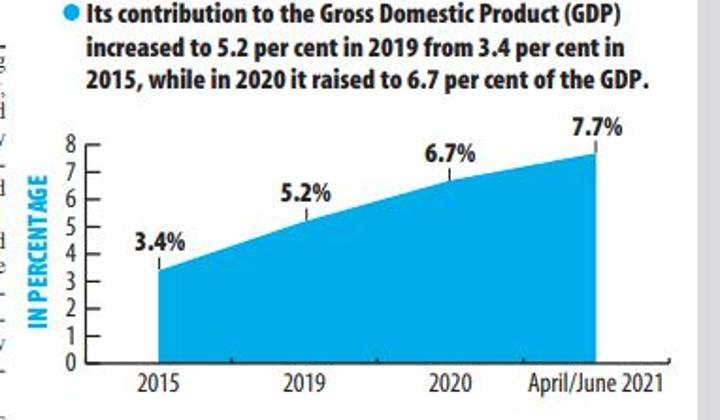
Its contribution to the Gross Domestic Product (GDP) increased to 5.2 per cent in 2019 from 3.4 per cent in 2015, while in 2020 it raised to 6.7 per cent of the GDP.
Giving the ministry’s achievements, challenges and way forward since independence, Minister Biteko told reporters here yesterday that Tanzania stands to earn even more rewards in the sector come 2025, where its contribution to the GDP is anticipated to hit 10 per cent.
Mr Biteko detailed that gold artisanal accounted for 27 per cent of the government revenues collected from the sector in 2020/21 up from 10 per cent the group accounted for in 2017/18.
He said the contribution of the mining industry to the economy stood at 7.7 per cent between April and June this year. “With these trends, there is no doubt that by 2025 the contribution of the mining sector will reach 10 per cent of GDP as expected,” the minister affirmed.
Reflecting on the sector’s growth during the 60 years of independence, Mr Biteko touted tremendous strides, attributing the feats to legal reforms and friendly investment environment adopted down the years.
Before and after independence, the mining sector was governed by the Mining Ordinance of 1920. He specifically credited the upward trend to several major decisions made by the government since independence, saying the decisions have brought positive impacts not only to the mining sector but also to the protection of the country’s natural resources in general.
Biteko said the transformation in the industry was a result of a review of the mining legislations of 2010 and subsequent amendments in 2017.
The government initiated the amendments of the Mining Act, 2010, followed by the introductions of the Mining (Local Content) Regulations, 2018. These regulations have to be followed by contractors in order to ensure that local content rules are adhered to by all persons or companies involved in the mining industry.
Following the amendments of the Mining Act, a committee has been established to oversee the implementation of regulations in the mining industry in Tanzania.
These regulations clearly state that priority has to be given to qualified Tanzanians in employment and on job training, among other things. Official figures released by the state indicates that in 2020/21 for instance, participation of local companies in the industry reached 961, an equivalent of 66 per cent of all firms providing goods and services in the industry. There are, however, 506 foreign firms or 34 per cent.
“The presence of a large number of Tanzanian service providers has been largely fuelled by the management of the Mining Act and the requirement to involve Tanzanians,” he noted.
The Minister went on to explain that the government had further released about 1,044 mineral exploration licences. Biteko said 15 licences have been released for large-scale mining activity, 161 for medium scale, and 34,000 licences for small-scale miners. A total of 1561 licences have been issued for conducting mineral business across the country.
Financially, the minister said the government collected 584.8bn/- about 111.03 per cent of its target as of June 2021. He said mining activities were going on before and even after independence but at a very low rate.
The small per cent of mining activities after independence, he said was necessitated by the fact that the government decided to reserve the mineral resources until when the country was ready to harvest the resource.
The major gold mining before independence were Sekenke in Iramba, which operated from 1909 and closed business in 1956.
It was producing 4,300 kilogrammes of gold annually during that time. The pre and post-independence gold mines and the gold kilogrammes produced in bracket were Geita from 1938 to 1966 (17,440kg) and Buhemba from 1913-1970 with (12, 213-kgs).
He said compared to where the country came from, currently, Tanzania has nine special mining licences of which six are gold, one for diamond, tanzanite and coal.
The construction of the 24.5-kilometre Mererani Tanzanite wall has boosted revenue collection from 166m/- a year to 3.9bn/-. Soon, Biteko said they will issue another special mining licence to Nyanzanga gold mine in Mwanza and Rare Earth Element in Songwe Region, adding within a short time, the government will start seeing operation of graphite mine in Lindi to be undertaken by Shanta Gold Company.
It follows a recent move when the government signed a joint ventures agreement with LZ Nickel Company from the United Kingdom and esablished Tembo Nickel Corporation Limited with two subsidiaries namely Tembo Nickel Mining Company Ltd and Nickel Refinery Company Ltd. “As you may recall, we officially handed over this licence to this company on October 27, 2021, in Dodoma,” he said. The project will create about 978 jobs and generate 7.54 billion US dollars (about 17.35tri/-).
“These are major transformations in the mining sector in 60 years of Uhuru considering, where we came from, where we are and the way forward,” said Biteko.
He said they are keeping on setting in place conducive mining business operations as well as infrastructures needed through the Tanzania Mining Commission for an open and transparent industry for increased efficiency.
Minister Biteko also said the government has also been putting in place significant infrastructure such as electricity, telephone, water, roads through the Public-Private Partnership (PPP) in areas where new major mines are likely to be established, including improving management system for mining licences.
Other areas to be worked upon includes strengthening the National Mining Corporation (STAMICO) to be fully involved in exploration, extraction and service activities in the mining sector on behalf of the government and all Tanzanians.
For More News And Analysis About Tanzania Follow Africa-Press