
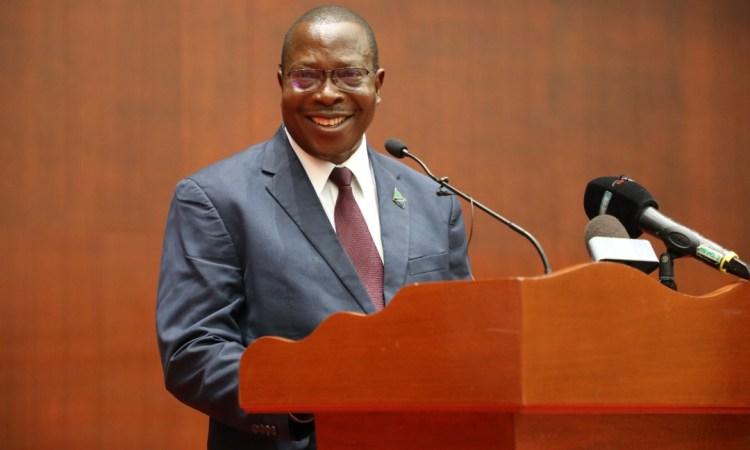
Africa-Press – Tanzania. THE Vice-President, Dr Philip Mpango, has emphasized on the necessity of considering how Tanzania produces and trades in order to boost the economy and improve people’s lives.
Dr Mpango made the remarks in Dar es Salaam on Wednesday at the opening of the Research on Poverty Alleviation (REPOA) 25th Annual Research Workshop.
“It is clear that the workshop’s focus aligns well with strategic areas of the third National Five-Year Development Plan (FYDP III) 2021/22 – 2025/26, manufacturing, trade, and competitiveness, which are critical for accelerating the structural transformation of our economy required to propel Tanzania to upper-middle-income status,” he said.
The VP said that the workshop’s topic, ‘Transforming the Tanzanian economy via competitive manufacturing and trade,’ fits well in the FYDP III main theme; ‘Realizing Competitiveness and Industrialization for Human Development.’
Speeding up competitive and inclusive growth, boosting the capacity of domestic manufacturing and service delivery, promoting investments and trade, accelerating human development, and raising skills are among the primary focus areas of FYDP III, noted the VP.
“It is important to recognize that Tanzania is not the only country with such aspirations when we talk about building an economy relying on natural resource-based industries and trade,” Dr Mpango said.
“We are competing for capital, markets, and raw materials as well as in regional economic blocs like the Southern African Development Community (SADC), East Africa Community (EAC), and African Continental Free Trade Area (AfCFTA).” REPOA was registered in 1994 and began operations in 1995 with the mandate to contribute to the alleviation of poverty in its multiple dimensions through research and capacity building.
Over time, REPOA’s mandate has expanded beyond alleviating poverty to encompass growth and socio-economic transformation for poverty reduction. Earlier, Minister for Trade and Industry Prof Kitila Mkumbo said the government has been using the findings of REPOA for a quarter of a century.
“This commitment shows that the government engages with the Civil Society Organisations (CSOs) to boost the economy of the country,” he said Prof Mkumbo stated his ministry is now engaged in industrial mapping, a six-month process that would cause an industrial master plan for the country to determine which industries to promote and where they should be promoted.
Ms Elisabeth Jacobsen, the Norwegian Ambassador in Tanzania, said Tanzania has the potential to establish an enabling climate for sustained investment in renewable energy, allowing for a smooth transition to a greener economy while also providing customers with inexpensive energy.
“This can be accomplished by fostering Public-Private Partnerships. This isn’t important to the energy sector, but Tanzania should prepare sectors like agriculture, water, and infrastructure to adapt to climate change and help communities become more resilient to its effects,” she said.
REPOA Executive Director, Dr Donald Mmari said over the past 25 years REPOA capacity building initiatives have benefited over 3,000 researchers, analysts from the government, higher learning institutions, CSOs and the media.
For More News And Analysis About Tanzania Follow Africa-Press