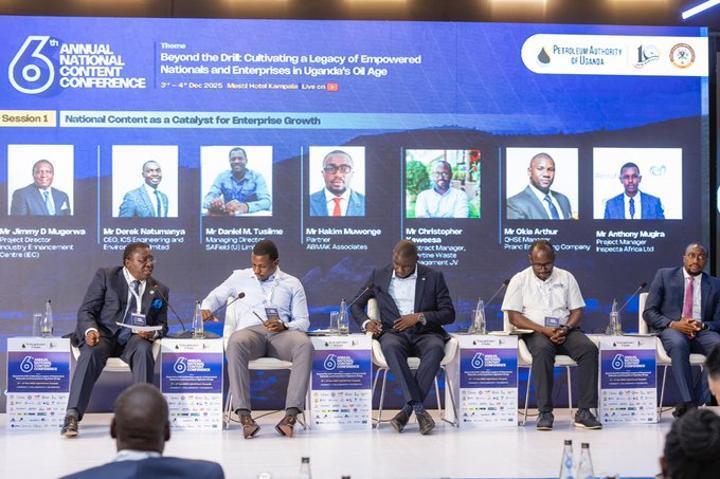
Africa-Press – Uganda. The 6th National Content Conference highlighted significant progress by Ugandan companies benefiting from the Petroleum Authority of Uganda’s national content program, showcasing measurable gains in standards, training, and employment within the oil and gas sector.
During the second day of the two-day event, stakeholders reflected on successes ranging from increased ISO certification and strengthened engineering standards to enhanced waste management systems.
Yet they also acknowledged ongoing challenges, including collapsed joint ventures, underpricing of contracts, gaps in certification, and struggles to meet international compliance standards.
Topics You Might Like
Ugandan Companies Celebrate Gains at National Content Conference
Business
The conference concludes with the National Content Awards, which celebrate excellence in Uganda’s oil and gas supply chain.
Jude Mugerwa from the Industrial Enhancement Centre (IEC) reported notable achievements, including the production of over 64 publications, more than 180,000 website visitors accessing resources, and training for 600 SMEs, with 350 expected to graduate in two weeks.
He added that the centre has welcomed over 4,000 visitors and delivered 4,650 training man-hours, reflecting a focused effort to strengthen Uganda’s supply chain.
Technical players also credited the national content framework for driving sectoral growth. Derek Natumanya of ICSE Engineering said oil and gas revenues now account for 60 percent of the company’s income, enabling diversification into other sectors.
Technology transfer from a joint venture with Worley has enhanced standards applied in major national projects, including railway engineering.
Despite these advances, many speakers highlighted obstacles to deeper local participation. Okia Arthur of Rand Engineering noted that 60 percent of joint ventures formed during exploration have failed due to misaligned expectations, weak communication, and inconsistent quality.
SMEs continue to face hurdles in obtaining certifications, meeting compliance standards, and accurately pricing tenders, often underquoting and seeking adjustments later.
Looking ahead, companies recommended increased government support to help SMEs acquire critical certifications, expanded training on international standards, guidance on tender pricing, and deliberate efforts to ensure non-oil firms also benefit from national content initiatives.
Stakeholders urged regulators to refine policies that promote growth, sustainability, and long-term competitiveness.
As discussions shift toward solutions and reforms, the 6th National Content Conference closes today with the National Content Awards, recognising outstanding contributions to Uganda’s oil and gas supply chain.
For More News And Analysis About Uganda Follow Africa-Press