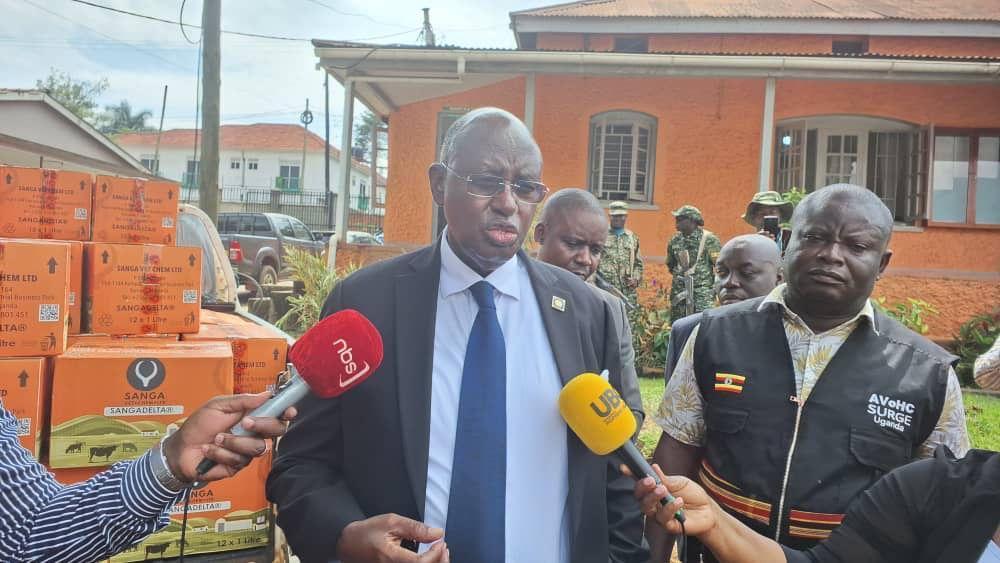
Africa-Press – Uganda. The government has launched a Shs2.4 billion tsetse fly control programme covering 78 high-risk districts, amid warnings of renewed threats of sleeping sickness and animal trypanosomiasis linked to persistent infestation in parts of the country.
The State Minister for Agriculture, Animal Industry and Fisheries in charge of Animal Industry, Bright Rwamirama, said sustained farmer-led use of control chemicals is critical if recent gains against the disease are to be preserved.
Rwamirama made the remarks while officially launching the distribution of tsetse fly control chemicals to affected districts.
“Our country’s livestock and people remain at risk of trypanosomiasis due to high tsetse fly infestation in some areas. Tsetse flies cause sleeping sickness in humans and nagana in livestock, particularly in high-risk zones,” Rwamirama said.
He noted that the diseases continue to undermine livestock production and productivity, while also affecting tourism due to infestations along wildlife conservation corridors.
“These diseases remain a major barrier to national livestock production. In addition, wildlife conservation corridors have become centres of tsetse infestation, negatively affecting the tourism sector,” he said.
Rwamirama cited cross-border challenges, particularly along the Uganda–Tanzania border, where uneven control efforts in the past allowed tsetse flies to spread into Ugandan districts.
“While we sprayed, our neighbours did not spray on their side. At one time, we even went about 15 miles into Tanzania. Over time, the flies spread and affected areas such as Ntungamo and parts around Lake Victoria,” he said.
He noted, however, that infestation levels remain relatively low in some districts because many farmers are commercial producers who regularly use acaricides that also suppress tsetse flies.
“The good news is that the chemical we are using is effective. When animals are properly treated, the tsetse fly succumbs,” Rwamirama said.
The minister stressed that government cannot sustainably supply the chemicals indefinitely, saying the current intervention is intended to demonstrate effectiveness and encourage routine farmer uptake.
“We cannot supply these chemicals forever. We are demonstrating that they work and that farmers can use them because they are locally available and affordable,” he said.
He expressed concern that in some areas farmers abandon treatment after government-led spraying exercises, increasing the risk of disease resurgence.
“The most disappointing scenario is when government suppresses tsetse flies and farmers do not continue applying the chemical. That is how re-emerging cases of sleeping sickness occur,” Rwamirama warned.
He said government is working with the Ministry of Health and regional bodies, including the African Union–Interafrican Bureau for Animal Resources (AU-IBAR), to implement a coordinated, zone-based control approach.
“We want to spray every affected zone without leaving room for re-emergence. We had a national eradication roadmap, and although some efforts were disrupted, we are committed to re-establishing them,” he said.
Rwamirama reaffirmed government’s commitment to safeguarding public health and livestock productivity, pledging strict monitoring of government-sponsored chemicals.
“As MAAIF, we shall ensure that use of these chemicals is properly monitored and that the impact is documented. Districts must report successes, challenges and lessons to guide future action,” he said.
Speaking at the launch, the Assistant Commissioner for Trypanosomiasis Control, Robert Wangoola Mandela, said the annual intervention targets districts at high risk of African trypanosomiasis, which affects humans, livestock and wildlife.
“Today, we are launching the distribution of chemicals to districts facing very high risk. This annual exercise suppresses both the vector and the disease so communities remain free from sleeping sickness,” Wangoola said.
He said reduced public attention to sleeping sickness in recent years reflects deliberate government interventions rather than elimination of risk.
“You may not be hearing much about sleeping sickness because of sustained efforts by the Ministry of Agriculture to prevent a resurgence,” he said.
Wangoola said Uganda has made significant progress since the 1990s, with cases drastically reduced south of Lake Kyoga, though challenges persist in northern regions.
“South of Lake Kyoga the situation has significantly improved. However, north of the lake we still face considerable challenges,” he said.
The most affected sub-regions remain Lango, Acholi, Teso, Karamoja and West Nile, while Busoga, Bukedi, Bunyoro, Ankole and Kigezi have recorded major improvements.
According to the ministry, Uganda has not registered a case of the chronic form of human African trypanosomiasis in the last five years, and discussions are ongoing with the World Health Organization to declare the country free of the chronic disease.
However, a few cases of the acute, zoonotic form continue to be reported.
“This disease affects livestock, humans and wildlife. This year, we registered two human cases around March near national parks,” Wangoola said, attributing the risk to wildlife reservoirs.
To strengthen control efforts, government has procured 120,000 litres of deltamethrin-based insecticide worth Shs2.4 billion, to be distributed in Ankole, Teso and Lango sub-regions, as well as districts surrounding Murchison Falls National Park.
Wangoola said sustained funding of about Shs5 billion annually for at least five years would significantly reduce the disease burden in humans, livestock and wildlife.
African trypanosomiasis remains a major public health and economic concern, particularly in livestock-dependent communities, with authorities warning that continued vigilance is essential to protect recent gains.
For More News And Analysis About Uganda Follow Africa-Press