Africa-Press – Uganda. Finance Minister Matia Kasaija has said disciplined fiscal management and strong revenue mobilisation are central to Uganda’s goal of tenfold economic growth.
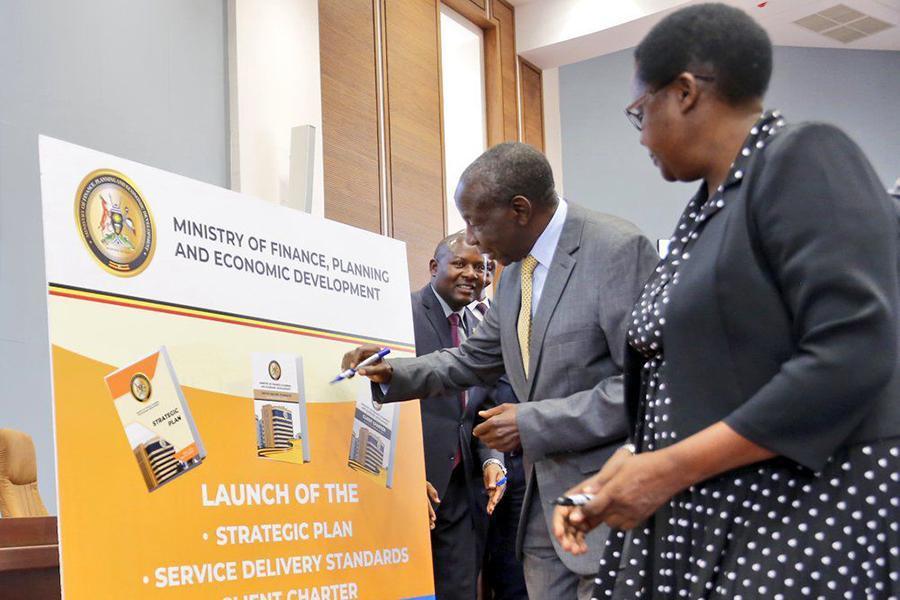
Speaking on Wednesday during the launch of the Ministry of Finance, Planning and Economic Development (MoFPED) Strategic Plan, Client Charter, and Service Delivery Standards, Kasaija described fiscal credibility as vital for investor confidence, macroeconomic stability, and public trust.
“At the heart of this transformation agenda is fiscal credibility. By maintaining disciplined fiscal management, strengthening domestic revenue mobilisation, and ensuring our public investments deliver measurable returns, we lay the foundation for the tenfold economic growth ambition,” he said.
Flanked by Minister of State for Finance Henry Musasizi, Kasaija emphasized that disciplined fiscal management is not merely a technical goal but a foundation for effective government service delivery.
The launch was attended by Deputy Head of Public Service Dr. Theopista Wenene, representing Head of Public Service and Secretary to Cabinet Lucy Nakyobe, who praised MoFPED for developing documents to guide interventions over the next five years under National Development Plan IV (NDP IV).
“MoFPED is one of the most critical institutions of government and must provide leadership by example in conforming to the set standards,” Nakyobe said.
Permanent Secretary Ramathan Ggoobi outlined the ministry’s five-year goal to establish fiscal policy credibility, ensure efficient public investment, and coordinate development financing as a foundation for rapid economic growth under the theme, “Fostering Strategic Investments for Rapid and Inclusive Economic Growth.”
The strategic plan focuses on strengthening macroeconomic and fiscal policy credibility, mobilising and coordinating financing instruments to reduce the cost of capital and attract private investment, expanding and diversifying sustainable financing while preserving debt sustainability, strengthening public investment management for structural transformation, improving efficiency, credibility and development impact of public expenditure, and building institutional capacity, systems, and data infrastructure for effective governance and delivery.
“Our agenda is ambitious: to achieve average economic growth of at least 8 percent, reduce poverty, create new jobs, and sustain macroeconomic stability,” Ggoobi said.
Priority interventions include financing oil and gas commercialisation, capitalising government development banks, supporting industrial transformation, empowering women entrepreneurs, and improving the Parish Development Model (PDM) to transition households into the money economy and profitable enterprises.