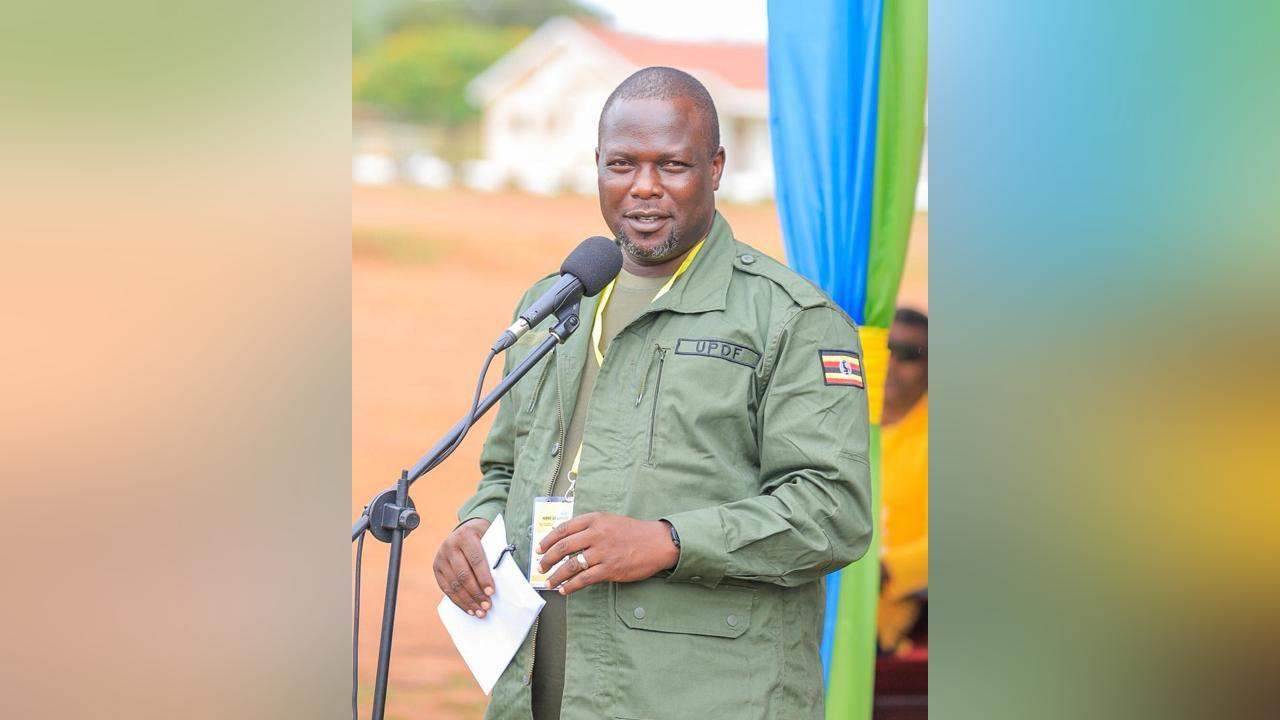
Africa-Press – Uganda. The Secretary General of the National Resistance Movement (NRM), Richard Todwong, has announced that the party’s 2026–2031 manifesto is aimed at consolidating Uganda’s socio-economic gains while making a decisive transition toward achieving higher middle-income status.
Todwong made the remarks on Sunday during the sixth day of the ongoing NRM leaders’ retreat at the National Leadership Institute (NALI) in Kyankwanzi, where he presented under the theme: “Achieving Higher Middle-Income Status for Uganda: 2026–2031 Election Manifesto.”
“Our focus is to protect the gains we have made and now move into a new phase where we ensure that every household participates in wealth creation,” he said.
Todwong explained that the new manifesto is anchored in Uganda’s historical economic evolution—from a largely subsistence economy prior to colonial rule, through the enclave structure of the colonial period, to the economic collapse experienced before 1986. According to
Todwong, the NRM inherited a nation with weakened institutions, a collapsed economy, and limited human resource capacity when it assumed power.
Over the years, he noted, the government has undertaken deliberate efforts to rebuild the country through strategic planning and policy implementation, guided initially by the NRM’s 10-point program. These efforts have since been carried forward through successive manifestos emphasizing peace, unity, democracy, and economic transformation.
Todwong stated that earlier development phases focused heavily on restoring peace and stability—key prerequisites for growth—especially during periods when insecurity affected large parts of the country. With stability largely restored, the government shifted focus toward broad-based prosperity, modernization, and investment in sectors such as agriculture, infrastructure, and industry.
Todwong said the upcoming manifesto marks a strategic transition from what President Museveni has described as “hardware” to “software” aspects of development.
“These hardware issues included infrastructure, peace and security, macroeconomic stability, and governance systems. We have largely addressed them. The focus now is on the software—human capital development and putting money in people’s pockets,” he said.
Citing economic progress, Todwong noted that Uganda’s GDP has grown to approximately 68.5 billion U.S. dollars, with projected annual growth of about 7 percent. He added that implementation of the current 2021–2026 manifesto stands at roughly 88 percent, reflecting substantial delivery on government commitments.
Among the key achievements highlighted were increased industrialization, a significant rise in the number of factories, growth in export earnings to over 13 billion U.S. dollars, expansion in electricity generation, and a strong recovery in the tourism sector following the COVID-19 pandemic.
Todwong also pointed to improvements in social indicators, including higher life expectancy, reduced infant mortality, and enhanced health outcomes, attributing these gains to sustained public investment in social services.
Despite these advancements, Todwong acknowledged persistent challenges such as environmental degradation, regional disparities in development, and limited access to essential utilities like electricity and clean water in some areas.
Todwong emphasized that the next phase of the NRM’s agenda will prioritize inclusive growth by addressing these gaps and ensuring equitable distribution of development across all regions.
“Our intention is to spread industrialization and investment across the country so that all regions benefit equally,” he said, citing ongoing efforts to establish industrial parks and attract investment to underserved areas including Karamoja and Northern Uganda.
Todwong underscored that the ultimate objective of the new manifesto is to empower households to become productive and self-sustaining participants in the economy.
“We have done well in infrastructure, health, education, and security. Now the focus is to ensure that the last household in every constituency that is not yet producing income becomes productive and part of the money economy,” he said.
Todwong further stressed the importance of aligning Members of Parliament with the manifesto, noting that the Kyankwanzi retreat serves as a critical platform for fostering a shared understanding of government priorities and strengthening coordination within the party.
Todwong expressed confidence that, with disciplined implementation, unity, and continued leadership, Uganda is well-positioned to achieve its ambition of transitioning into a higher middle-income economy.
The NRM retreat at Kyankwanzi continues to provide a forum for reflection on Uganda’s development journey, assessment of progress, and strategic planning toward sustainable and inclusive growth.
For More News And Analysis About Uganda Follow Africa-Press