Africa-Press – Uganda. A strong call to action has been made to Uganda’s private sector to prioritise safety, dignity and inclusion in the workplace.
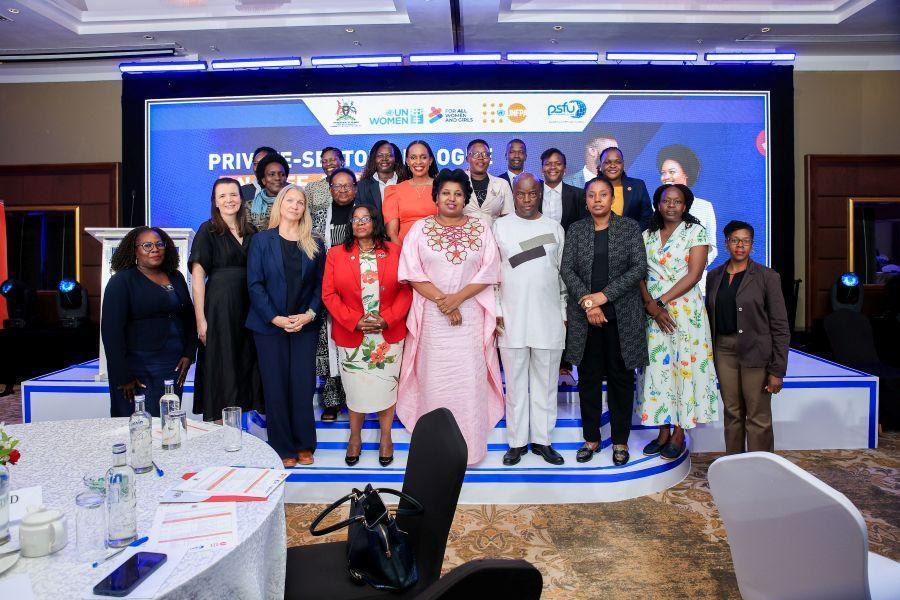
The call was made during the National Dialogue on Safe, Respectful and Survivor-Centred Workplaces at Sheraton Kampala Hotel that brought together government officials, private sector leaders, and development partners to confront the growing challenge of sexual and gender-based violence in the world of work—an issue increasingly shaped by rapid digital transformation.
The dialogue was organised by the Ministry of Gender, Private Sector Foundation Ugandan, United Nations Population Fund and the UN Women.
Speaking during the dialogue, the Commissioner for Gender and Women Affairs in the Ministry of Gender,Dr. Angela Kafeero, emphasised the urgent need to move from policy to practice, calling for concrete institutional action.
“Every workplace must have clear, enforceable policies that address sexual harassment and gender-based violence in line with national laws and international commitments. We must also strengthen reporting systems so that workers can speak out safely and confidently,” she said.
Kafeero acknowledged that despite existing frameworks—including Uganda’s Employment Act and the ratification of ILO Convention 190—implementation remains a challenge, largely due to underreporting and weak institutional mechanisms.
“There is little we can do when victims remain silent. We need to create environments where reporting is safe, confidential and survivor-centred,” she added.
The Vice Chair, Board of Directors, Private Sector Foundation Uganda, Sarah Kagingo underscored the shifting nature of work, driven by digitalisation, artificial intelligence, platform economies, and evolving employment models.
“While these shifts present immense opportunities for productivity and innovation, they also introduce new and complex risks related to workplace safety, dignity and protection from violence and harassment. As private sector leaders, we must respond with foresight, responsibility and decisive action,” she said.
She pointed to global evidence from the International Labour Organization indicating that more than one in five workers have experienced violence or harassment at work, noting that Uganda mirrors this troubling trend.
National data shows that 8% of women have experienced workplace violence, with verbal abuse accounting for 84% of reported cases.
Broader findings from the Uganda Bureau of Statistics reveal that 84% of Ugandans have experienced verbal abuse, 21% sexual violence, and 49% online violence, highlighting the scale of the crisis.
Kagingo highlighted structural labour market challenges, noting that Uganda’s workforce stands at 9.3 million people, with approximately 7.1 million employed in the informal sector—an area dominated by women and characterised by vulnerability, limited protections, and reduced access to decent work.
“Women remain concentrated in informal and low-paying jobs, with lower participation rates compared to men. These structural inequalities increase exposure to workplace risks and limit economic empowerment,” she noted.
Jacqueline Makokha from UNAIDs, who represented the UN resident coordinator stressed that workplace violence extends beyond human rights concerns, affecting economic performance and national development.
“Unsafe workplaces limit women’s participation in the labour market, reduce productivity, and undermine trust in institutions. Safe and inclusive workplaces, on the other hand, are drivers of economic growth, innovation and sustainable development,” she said.
Makokha called for a shift from commitments to tangible action, outlining key priorities including strengthening workplace policies, establishing confidential reporting systems, embedding accountability, and leveraging partnerships to scale solutions.
“Safe workplaces are not optional. They are essential to business integrity, workforce wellbeing and national development,” she noted.
She reaffirmed the commitment of the United Nations system, including UN Women and UNFPA, to support Uganda through technical expertise, capacity building, and private sector engagement.
Adding an economic lens to the discussion, Mona Muguma, the Chief Executive Officer of ABI Finance, highlighted the significant financial cost of gender-based violence.
“We are losing approximately shs3.76 trillion annually in productivity, which is about 2.7% of our GDP. This is not just a social issue—it is an economic crisis affecting businesses, institutions, and the country as a whole,” she said.
Muguma emphasised that workplace safety is integral to sustainable business practices, linking it to Environmental, Social and Governance (ESG) principles.
“Preventing gender-based violence sits firmly within good corporate governance, social inclusion, and responsible business practices. Leadership must ensure that policies are not only in place but actively implemented and monitored,” she noted.
She further stressed the importance of internal accountability systems, questioning whether organisations have effective reporting channels, support services for survivors, and mechanisms to track and respond to cases.
“Sometimes we assume we are safe because no cases are reported, but we must ask ourselves—do employees feel safe enough to speak up?” she posed.
The dialogue marked a critical step toward strengthening Uganda’s response to workplace violence, with stakeholders committing to advancing practical, survivor-centred solutions that ensure dignity, safety, and opportunity for all workers.
For More News And Analysis About Uganda Follow Africa-Press