Africa-Press – Uganda. The Forum for Democratic Change (FDC) has rejected the outcome of the 2026 presidential elections, while launching a broad attack on recent government trade enforcement operations and the proposed Protection of Sovereignty Bill, 2026, describing the developments as evidence of democratic backsliding.
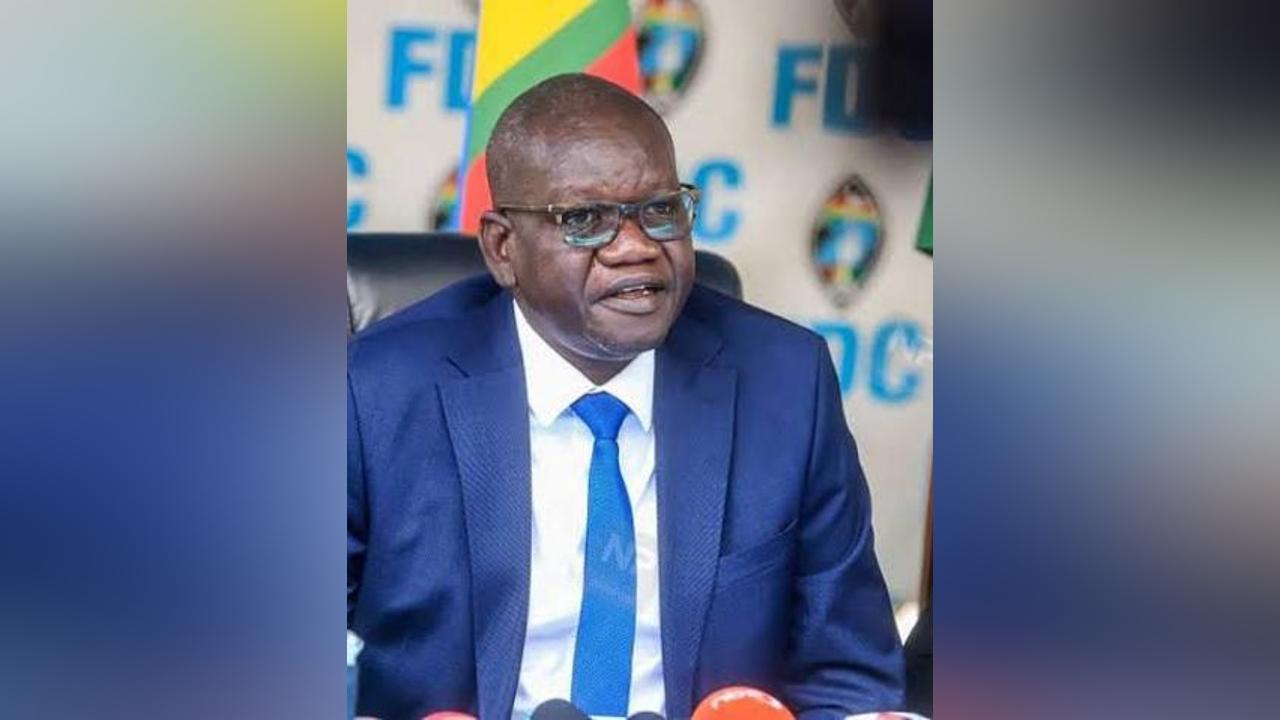
Addressing a political briefing on April 27, 2026, FDC president Patrick Oboi Amuriat said the party would neither recognise nor legitimise the results declared by the Electoral Commission of Uganda, accusing it of failing to conduct a credible and independent electoral process.
“The Electoral Commission, a body wholly appointed and answerable to the regime, did not reflect the true will of Ugandans,” Amuriat said, citing alleged internet restrictions, voter bribery, and heavy security deployment during the voting period.
He maintained that despite rejecting the presidential outcome, the party remains politically active, pointing to the election of nine FDC Members of Parliament across areas including Arua City, Soroti, Jinja, and Kitgum.
He said the results demonstrate continued public support for the party even under what he described as a constrained political environment.
Amuriat outlined a post-election strategy focused on strengthening parliamentary engagement and internal party structures.
He said newly elected legislators would undergo induction, while the party develops a legislative agenda covering governance, budgeting, oversight and constitutional affairs.
Beyond Parliament, the FDC plans to expand training for its local government leaders through a Leadership Academy aimed at improving governance, accountability and grassroots mobilisation.
A central theme of his address was the need for opposition unity. Amuriat called for coordinated action among parties including the National Unity Platform, Alliance for National Transformation, Democratic Party, and Uganda People’s Congress, among others.
“Liberation of Uganda from decades of one-man rule cannot be the project of any single political organisation,” he said, warning that opposition actors must collaborate or risk political irrelevance. “We either work together or we shall be buried in a mass grave.”
He also renewed calls for the release of political detainees, arguing that continued detention undermines constitutional protections and judicial independence.
On economic policy, Amuriat strongly criticised recent evictions of street vendors, particularly in Kampala and other urban centres, saying the enforcement had displaced informal traders without consultation or safeguards.
“These cities and municipalities must benefit all citizens, not belong to a few powerful actors,” he said, arguing that street vending should not be criminalised.
He claimed many vendors had previously operated with the knowledge of authorities and had paid local taxes, raising concerns about inconsistent enforcement. He called for compensation for destroyed property and demanded a transparent relocation and consultation framework before further action is taken.
Amuriat also urged Parliament to scrutinise the role of the Kampala Capital City Authority in the evictions.
A significant portion of his address focused on the proposed Protection of Sovereignty Bill, 2026, which he described as a major threat to civil liberties, economic freedom and political expression.
He argued that the bill could criminalise foreign financial support, including diaspora remittances and development funding, while placing restrictions on journalists, researchers and civil society organisations.
“This bill is aimed at silencing, imprisoning, and destroying Ugandans’ ability to speak, assemble, and live in freedom,” Amuriat said.
He questioned the necessity of the legislation, noting that Uganda already has existing laws regulating financial flows and political activity, including frameworks on anti-money laundering, NGOs and political parties.
Amuriat also highlighted what he described as a contradiction in government policy, pointing out that Uganda continues to rely on foreign aid and concessional financing for key sectors such as health, education and infrastructure.
He warned that restricting foreign funding for citizens while maintaining dependence at the state level could create economic instability.
Calling the bill a “bigger monster” than existing legal frameworks, Amuriat said it could not be fixed through amendments and should instead be withdrawn entirely.
“Sovereignty belongs to the people of Uganda, not to any minister or institution,” he said.
The FDC leader said the party would pursue both legal and political avenues to oppose the bill, while mobilising public opinion alongside civil society, religious leaders and the diaspora.
His remarks underscore growing political tensions as Uganda navigates post-election disputes, economic policy concerns and legislative debates that critics say could reshape civic space and governance in the country.
For More News And Analysis About Uganda Follow Africa-Press