Africa-Press – Uganda. As global temperatures rise, surface waters – including rivers, lakes and reservoirs – are becoming dangerously erratic. This is because in a hotter climate, there are rapid swings between intense evaporation and sudden, extreme rainfall.
Water is at the centre of the climate crisis. In Africa, around 400 million people currently lack access to basic drinking water services.
But beneath the continent lies an invisible safety net. Africa sits atop an estimated 0.66 million cubic kilometres of groundwater – around 20 times the amount of freshwater stored in all of Africa’s lakes combined.
I am a groundwater specialist whose research focuses on the sustainable use of groundwater and managing aquifers. I’m also currently part of a team of hydro-geologists and water policy experts working on the Groundwater for Advancing Resilience in Africa project.
The team I work with is building a continent-wide digital map showing regions where groundwater might be safely extracted. At the same time, we are carrying out fieldwork at specific locations to ensure groundwater is used sustainably and equitably.This is because groundwater can be used to keep water running during droughts, but it must be carefully managed. Hydro-geologists also need to know exactly where it is safe to pump so that aquifers don’t become depleted.
Why some African aquifers can refill and others cannot
Because people can’t see groundwater, they may believe that it exists in great underground reservoirs. In fact, groundwater resides in the microscopic architecture of the earth – the pores of sandstone and the fractures of solid rock.Whether it can be technically extracted depends not just on porosity (how much water the rock holds), but on its specific yield (how much of that water can actually be pumped to the surface).
If an underground area holds a useful quantity of water that can also be pumped out at a reasonable rate, it can be considered an aquifer. But across Africa, these aquifers vary enormously.
In north Africa, deep beneath Libya, Algeria and Egypt, lie massive sedimentary aquifers. They are formed from compressed layers of sand and sediment that act as giant geological sponges. They hold large volumes of water that can be easily drawn out.These aquifers can therefore support high-yielding boreholes pumping up to 20 litres of water per second.
When grouped into large wellfields, these networks can, in theory, extract hundreds of millions of litres a day, enough to supply expanding cities and commercial agriculture.However, there is a catch: these north African aquifers sit deep beneath arid deserts. They are filled with “fossil water” that rained down more than 10,000 years ago when the Sahara was green. This water is now isolated and sealed beneath layers of shale and clay. It cannot be replenished by rain. Once the water is used up, it’s finished.
The other problem with draining these aquifers is that as the water is depleted, the aquifer system may even start to collapse. This would cause the surface to subside. (Roughly 70% of the world’s major aquifers face risk of serious depletion, which could cause areas like Jakarta, Mexico City and California’s Central Valley to physically sink.)
In sub-Saharan Africa, groundwater is mainly held in ancient, hard Precambrian crystalline basement rocks. These rocks lack natural pores, but can hold water in physical cracks. Pumping water from them is like trying to suck water through a cracked pane of glass – not much comes out.
Even if this groundwater is not enough to supply a city or town, it can still sustain rural community handpumps and small-scale irrigation. Most importantly, the aquifers refill or “recharge” during the rainy season. This makes them a widespread, renewable buffer against drought.
A blueprint for climate resilienceA key part of our project is to build a continent-wide map that combines hydro-geological data (where the water is and how fast it refills) with human data (where people live, farm, and build pit latrines). The latest version of the map indicates that about 94 million rural Africans live in areas where groundwater could provide safe drinking water, with major “hotspots” in South Sudan, Cameroon, Liberia, Guinea, Sierra Leone and the Democratic Republic of Congo.
Around 333 million live in places where it could be used sustainably for irrigation, including parts of Cameroon, Congo, Gabon, Liberia, Guinea and Tanzania, among other areas.
However, the map also shows that about 535 million Africans live in areas where human activities may be polluting groundwater, including large parts of Algeria and Libya and some areas of the DRC and Angola. This means the water quality there would need to be carefully monitored before being used.When it’s complete, we hope the map will provide regional bodies like the African Ministers’ Council on Water and regional economic communities with important information on groundwater opportunities and risks and help guide policy and investment decisions.
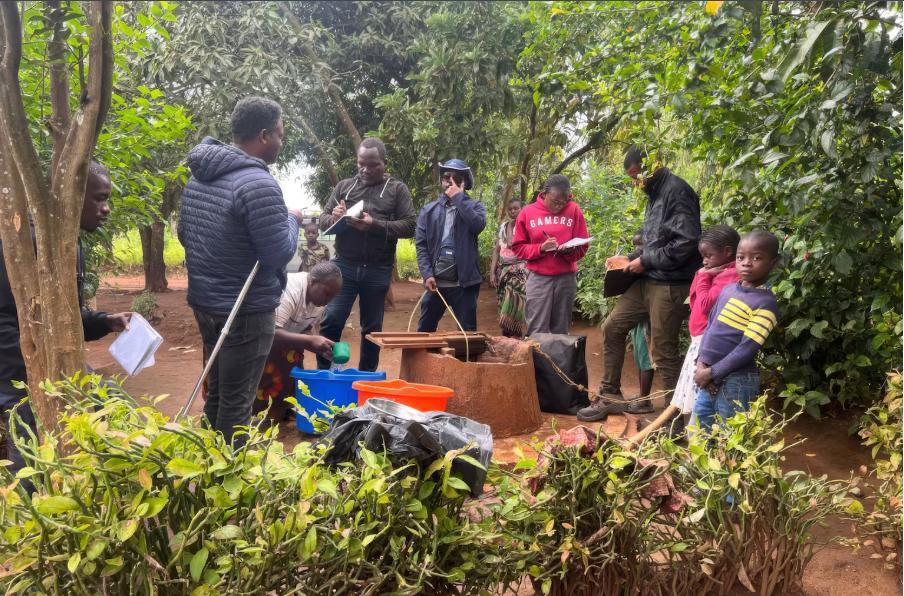
But there’s also a need for “detective” work on the ground. For this, our project conducted fieldwork in west and south-east Africa.
Very often, aquifers span across the borders of neighbouring countries. If one country draws too much groundwater it might leave the other with a shortage, or water that is too salty. So it’s important to monitor the level and quality of the entire aquifer.
Our teams decided to investigate two shared aquifers. The first lies underneath the Mono River Basin (a vast 24,300km2 area on the border of Togo and Benin) and the other below the Shire River Basin, shared by Malawi and Mozambique, spanning approximately 22,430km2.
The first step is to assess the groundwater already available at the two sites. This is done using monitoring boreholes which provide information on the aquifer’s condition by measuring water levels, temperature, and salinity using sensors.In both pilot sites, our teams have completed a “hydro-census”. We checked government records of monitoring boreholes, then tracked them down. We found that many needed repairing or upgrading with the latest monitoring equipment, which we’re in the process of completing. In the Shire aquifer system, there were very few monitoring boreholes, so we worked with government water departments to drill new ones.
We’re also in the early stages of assessing the groundwater picture in Uganda’s Upper Nile Water Management Zone.
The idea is to create modern groundwater monitoring networks that will help neighbouring countries share data and manage shared aquifers sustainably.
This will help countries protect and manage groundwater for the long term, ensuring it remains a reliable source of water for rural communities facing climate change.
For More News And Analysis About Uganda Follow Africa-Press