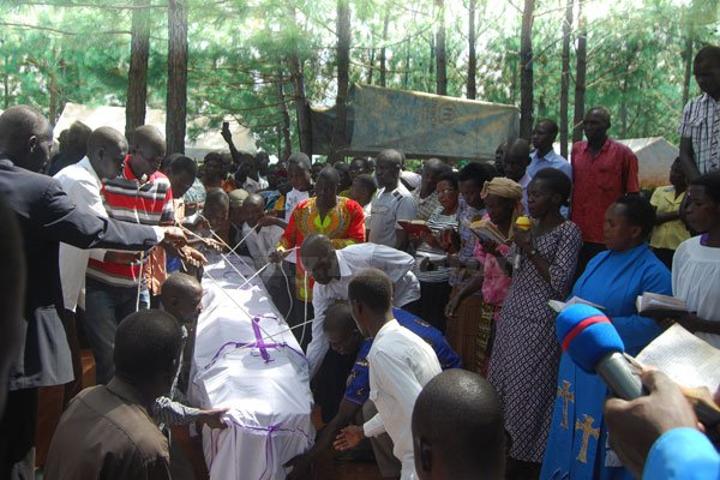
Africa-Press – Uganda. The new concept of ‘scientific’ burials as a measure to contain the spread of Covid-19 has been a blessing in disguise for many poor households in Lango Sub-region.
The burials are restricted to only 20 people and mourners leave immediately after sending off their loved ones.Before the government imposed the first lockdown in March 2020, huge burial expenses used to milk the bereaved families dry.
The money was spent on hiring catering and funeral services, and tents. What used to be an ordinary funeral arrangement was no longer the case.
Burial expenses used to shoot up to a tune of Shs30 million or beyond, depending on the deceased’s social status and financial strength.
Whenever some rich people die, all the resources they left behind would be squandered by some selfish relatives purportedly for a decent send-off, according to a mini survey by this newspaper.
Majority of mourners, who struggle to get food at the funerals, often on average give Shs500 as the highest amount of money as condolence.
Even those who contribute Shs100 and Shs200 would expect to be served a bottle of soda and a piece of beef, which in an upscale restaurant costs between Shs10,000 and Shs15,000.
Mr Sam Odongo of Lira Mobile Funeral Services said their services, which include among others, body transportation and executive caskets, range from Shs500,000 and above.
Mr Benard Ogwang, the Okii Okabo clan chief in Apac Municipality, said burial expenses have reduced.“I have buried some of my subjects during this lockdown and we were able to save some money, thanks to the ‘scientific’ burial of only 20 people in attendance,” Mr Ogwang said.
“Previously, we were left with debts after the burials. So, I appeal to people to learn a lot from these Covid-19 restrictions on burials.”
Mr Bonny Opio, a resident of Ayegero Village in Akere Parish, Apac Sub-county in Apac District, said the restrictions saved them from selling a piece of land to bury a relative.
“It was a common practice [in our community] that in case we lost a relative, a piece of land is sold to organise for burial. But when we lost a relative two weeks ago, we only slaughtered one goat, which was enough to feed the mourners and those who helped us in the burial arrangements,” he said.
Pastor Thomas Opio Okene of Amuli Baptist Church in Kwania District, said he has been advocating for a reduction in burial expenses. The chairman of Lira business community welfare, Mr Joseph Olet Magezi, also agreed, saying there should not be meals for mourners during lockdown or after the restrictions have been lifted.
“Members of the Lango tribe no longer have pity for the bereaved families, but they go to funeral ceremonies with the expectation of being fed on good meals,” he said.
Mr Olet, who is also the leader of Arak Ocola Yamyam clan, said the condolences cannot replace the already wasted resources.
“Sometimes a person dies after a long illness and many of the family assets could have been sold off to pay medical bills, but the mourners again expect that the bereaved family’s cows should be slaughtered to feed them,” he said.
Mr Bosco Ogwang Edola, the director of Uganda Chambers of Commerce and Industry for northern and northeastern region, said expensive burials leave widows and orphans suffering because all the family resources are often wasted on funerals.
Mr Edola recalled that in the past, mourners used to leave without eating after the burial.
“But now things have changed; you find that the burial budget can go up to a tune of Shs20m to Shs30m or even beyond depending on the deceased’s social status and financial strength,” he said.
Lango Diocese Bishop Alfred Olwa last Sunday directed that there should be no cooking at funeral services during this period.
He made the directive during service from his home at the Anglican headquarters in Boroboro Ward, Lira City East Division.
Bishop Olwa said there is no need to feed mourners because the bereaved families are already burdened by other burial expenses, including medical bills.
In Apac, the district Covid-19 task force has already banned airing of death announcements to prevent many people from attending burials.
“We resolved to ban airing of death announcements on radios because it mobilises people to converge in a particular place yet gatherings have been banned to control the spread of Covid-19,” Mr Emmanuel Ngabirano, the Resident District Commissioner, who is also the district Covid-19 taskforce chairperson, said.
He added: “We have also stopped cooking. No slaughtering of animals because there are no people to eat that food.”
The RDC said the move is also aimed at saving money.
However, he said the bereaved families are at liberty to inform relatives on the phone.
Compiled by Bill Oketch, Patrick Ebong & Santo Ojok