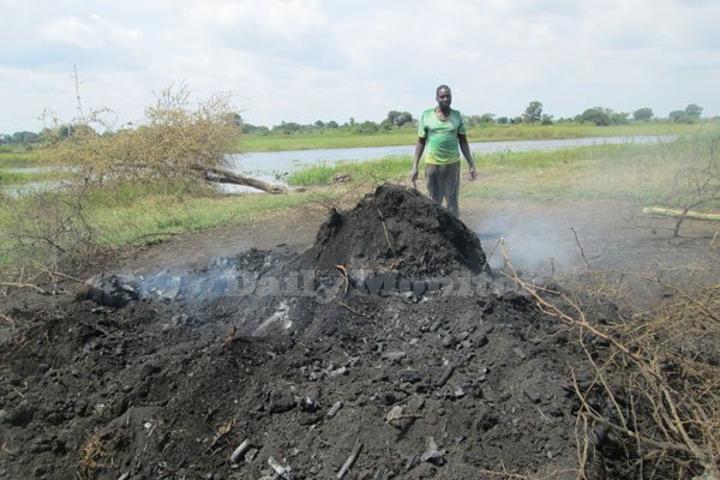
Africa-Press – Uganda. The once thick wetlands that covered rivers Awoja and Agu in Ngora District have been depleted, leaving the Awoja water catchment area almost bare.
The catchment area serves as water pumping points for Soroti City, Ngora, Kumi, Kalaki, and Kaberamaido districts.Residents of Ngora and Serere districts have continued to destroy the remaining vegetation cover on the two rivers despite several attempts to stop it.
In 2011, the Ministry of Water and Environment through the directorate of Water resource management embarked on protecting key water bodies in the country, with Awoja catchment management plan being the first in 2014.Environmentally-friendly land use clinics were created among communities neighbouring Awoja.
These clinics involved sensitisation of residents on how to plant trees and other economic incentives to stop communities from destroying the ecosystem around the rivers.
However, Mr Musa Akoro, 47, a resident of Odo Village, told Daily Monitor last week that the battle to save Agu wetland was lost in the early 2000s.
He said the old trees species known in Teso Sub-region such as Agirigiroi, Ecomai, Eyoroi and Ekaramai, which were in wetlands, have all been destroyed.
“After all those trees were cut, the locals turned to the thorny shrubs for charcoal and firewood. I can stand in Abuket in Serere District and see Ngora district headquarters, which is about 22 kilometres away. The marshes we grew up using for making mats are almost extinct,” he said.
Mr Akoro said the cattle keepers have worsened the situation by cutting the surviving thorny trees for fencing off kraals.
The neighbouring Kokong wetland on the shores of River Awoja, which according to the Ngora district environment officer, Ms Margaret Awekonimungu, is about 100 acres, has also suffered heavy destruction.
However, Mr John Kalisa, a cattle keeper in Agu, accused residents of Ngora, Serere and Kumi of destroying the wetlands.
“I came here in early 2000, the wetland was still intact but people with trucks descended on it, cutting trees for firewood. We watched on because we were squatters looking after cattle, we didn’t want to enter into any woes with them,” Mr Kalisa said.
Mr James Oluka, a resident of Agu Trading Centre in Ngora, attributes the destruction on population pressure.“We are a rural community, we can’t afford power or gas for cooking, should we starve because we want to protect the wetland, yet we can derive firewood from it?” he asked.
Ms Awekonimungu said they have trained committee members to act as vigilantes to save wetlands from total depletion.
She said wetland committees will protect Kokong, Agu, Omaditok, Abuya, Adiesa, Orisai, Aciisa, Kodike, Nyaguo, Opot,Kamodokima, and Ajamaka wetlands.
Ms Awekonimungu confirmed that encroachers had already settled in wetlands such as Agu swamp on River Agu.The environment officer said a couple of years back, a team under the Awoja catchment management plan from Ministry of Water and Environment trained groups in Ngora on conservation enhancement, but since then, they have never shown up.
“Early this year, we engaged the communities, managed to plant about 2,000 seedlings but the drought has failed the project as majority of them have withered,” Ms Awekonimungu said.
She said for now, the only sub-county which is moderately green is Kobwin, bordering Nyaguo tributary, and is part of Lake Kyoga.
“The district had intended to have another set of trees planted in the second season but there are no rains,” Ms Awekonimungu said.
Mr Mike Odongo, the Ngora district chairperson, called for restoration of the vegetation.“The effects we see today in Ngora and the rest of Teso Sub-region are as a result of the destruction. The winds that are carried right from the side of Bugisu come carrying sand and polythene papers, which shows how the green cover has been depleted,” he said.
Mr Odongo said despite the population pressure, people can still co-exist with nature by adapting smart environment energy saving mechanisms which don’t necessitate destruction of tree cover.