Africa-Press – Uganda. The National Social Security Fund (NSSF) managing director, Mr Richard Byarugaba, yesterday made a U-turn, saying they do not have cash to pay savers eligible for mid-term benefits.
Mr Byarugaba dropped the bombshell while appearing before the Gender Committee of Parliament, which is currently collecting public views and scrutinising the NSSF (Amendment) Bill, 2021.
The proposed law, among others, provides that any Fund member aged 45 and above and who has saved for at least a decade, is eligible to withdraw up to 20 percent of their savings.
Mr Byarugaba, who on August 6 and again October 4, told this newspaper that they would be able and ready to start paying mid-term benefit claimants this or next month, yesterday told legislators that the Fund does not have enough cash.
“The current process cannot permit us to implement a mid-term access as provided for [in] the policy…We are in the process of changing the system…Our target is to do that by the beginning of October,” he told this newspaper in August.
This was shortly after President Museveni and NSSF stakeholders agreed on changes to the first version of the NSSF (Amendment) Bill, 2019 before Speaker Jacob Oulanyah terminated it and other Bills under consideration on technicality.
Amending NSSF Bill
The decision gave birth to the successor NSSF (Amendment) Bill, which replicates contents of the previous version, and Parliament committed to expedite its enactment.
Following the back-and-forth, Mr Byarugaba told this newspaper on October 4: “On November 1, we will have a new system and if the law is passed by then, we will be able to make those payments.”
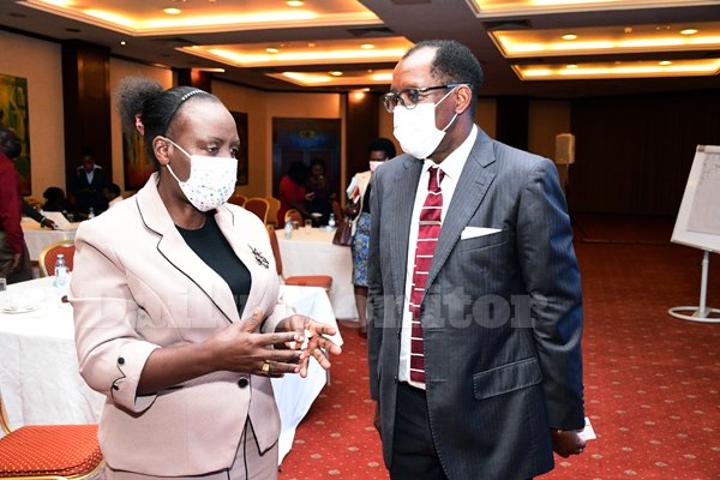
But appearing before Parliament’s Gender Committee sitting at Serena Kampala Hotel, alongside other top Fund staff, Mr Byarugaba said:
“As for the money, that is another question. This year we were going to pay Shs932 billion [in interests to members], but because of this new [NSSF Amendment Bill] law, we are going to pay an additional Shs902 billion. We are expecting Shs120 billion per month [in remittances by employers]; so, that money [for mid-term access] is not all available as soon as the law passes. We do not have the Shs1.5 trillion [for interests and mid-term benefit payments].”
Both the NSSF boss and Finance Minister Matia Kasaija, who is the political overseer of the workers’ money, have previously opposed mid-term access, arguing that it would drain the Fund and erode interest payable to members.
The Fund has given savers 12.15 percent above-inflation interest after its income grew by 25 percent to Shs1.8 trillion in the last financial year and its assets base increased from Shs13.3 trillion to Shs15.5 trillion partly on the back of increased contributions from more compliant employers and growing confidence in the Fund.
During the Financial Year 2020/2021, NSSF’s interest income grew by Shs200b, dividend increased by about Shs12b while real estate income stood at Shs53.5b, up from Shs11.1b.
Despite the roller-coaster performance, Mr Byarugaba yesterday told MPs on the Gender Committee that the Fund’s money have already been invested and there is no cash at hand to pay mid-term benefit claimants, if the NSSF Amendment Bill is enacted.
“As soon as the law comes into place, this money will become due. We do not want to be caught with our pants down,” he said in reference to the 9,300 eligible NSSF members whose total claims gross Shs902b.
Rather than focus on the 20 percent mid-term pay-out, Mr Byarugaba said the discussion should include expanded benefits proposed in the Bill, including voluntary savings beyond 15 percent and mandatory savings by all private sector employees, because 95 percent of NSSF members have less than Shs50 million and 70 percent of these have less than Shs10m savings, meaning they could end up getting as low as Shs2m in mid-term pay.
“What is Shs2 million going to do for you? 20 percent is not the solution, we need boosters to make sure that people save more money,” he argued.
In a rejoinder, Ms Linda Irene Mugisha, the Fort Portal City MP, who is a member of the Gender Committee, proposed that the percentage of the savings available to a member under mid-term access should be increased from 20 percent to 30 percent.
Mr Joab Businge, the Masindi Municipality MP, wondered why mustering Shs1.6 trillion for both interest and mid-term benefits is a headache for a Fund worth Shs15 trillion.
“Even if you are doing investment, we shouldn’t invest all the money to support the economy and forget the primary person [the NSSF contributor],” he told the Fund leadership, adding, “People are just on the edge waiting for the whistle. Many savers are waiting for this money.”
The clamour for mid-term access gained currency during the first Covid-induced lockdown last year when most people, including savers, suddenly lost jobs when their employers folded up or downsized, as the pandemic disrupted livelihoods and businesses.
Mr Byarugaba proposed that Parliament should in the new law empower the Finance minister, as the Fund’s political supervisor, to issue a statutory instrument to prescribe how the money for mid-term pay-out will be raised.
In both the notes to the revised NSSF (Amendment) Bill, 2021 and the Certificate of Financial Implication for it issued by the ministry of Finance, it was proposed that final benefits would be taxed, a proposal that sparked an opprobrium and prompted Attorney General Kiryowa Kiwanuka to say that the references were an “error” by drafters in his chamber.
Timeline
The committee members yesterday demanded for a specific timeline when the minister would issue the statutory instrument to prevent inordinate delays for eligible NSSF members to access 20 percent of their savings mid-term.
The committee unusually sat at Serena Hotel, across the road from Parliament Building, despite the House being on recess until next Tuesday. Ms Flavia Kabahenda, the committee chairperson, said they are sitting in hotels, including Africana, because the Committee Rooms at Parliament Building are not spacious enough to accommodate the 32 lawmakers on the Committee alongside members of the public making representations about the Bill.