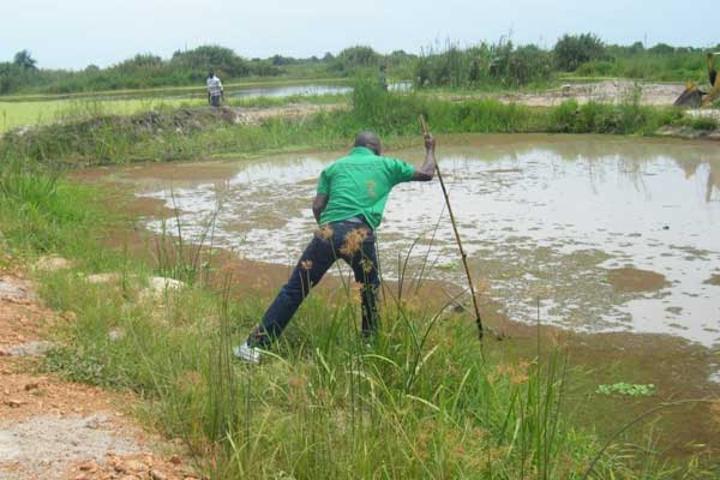
Africa-Press – Uganda. In 2017, local leaders in Masaka, Gomba, Mpigi, Butambala, and Kalungu districts pledged to conserve Lake Nabugabo eco-system and its catchment area after government unveiled a 10-year conservation plan for the area.
The government also expanded the wetland system boundaries from 22,000 hectares to 777,000 covering the five districts.
However, four years later, conservationists say the leaders have failed to fulfill their promise since the lake risks being scrapped off the list of Ramsar Sites (Site of international importance under the Ramsar Convention).
Mr Achilles Byarugaba, the executive director Nature-Uganda, told Daily Monitor recently that local leaders have failed to manage and restore the wetland, sensitise the public about the value of swamps, among other tasks.
“Every year, an environmental audit is done, and if the responsible bodies find it unworthy to keep it [Lake Nabugabo] on the list of Ramsar sites due to its continued destruction, they will remove it and we lose out,” he said.
Mr Byarugaba also cites the continued depletion of Lwera swamp on Kampala-Masaka highway.
“If local leaders were serious, we would not be seeing the wanton destruction of Lwera. Some of those carrying out farming are using chemicals and fertilisers, which end up in the lake and affect aquatic organisms,” he said.
The swamp, which stretches for about 20kms, is a major water catchment area that connects several rivers and wetlands in the five districts and drains directly into lakes Nabugabo and Victoria.
“It is true some wetlands were turned into gardens and forests converted into eucalyptus farms, but we are doing some work to restore those depleted eco-systems,” Ms Mastula Nakawungu, the Butambala environment officer, said. She said her office has issued notices to all wetland encroachers to vacate by end of December.
Mr Tonny Mwidyeki, the Mpigi natural resources officer, said the task of reclaiming wetlands is a collective effort.
“We are sensitising the communities and other stakeholders on the importance of conserving wetlands. Our emphasis has been on Kinyika wetland system. Last year, we restored about 10 acres of the degraded wetland,” he said.
Some leaders claim they lack the authority to stop the illegal activities.
“Sometimes when we oppose the destruction of the environment, the perpetrators continue because they know we cannot do anything to them. It is only the President who can prevail over them,” Mr Aloysius Jjuuko, the chairperson Bukakkata Sub-county, said.
Mr Gerald Ssenyondo, the former chairperson Lukaya Town Council, claims at one time, a minister told him to back off, saying part of Lwera is private Mailo land and owners possess titles.
“I just looked on, not because I support the destruction of the wetland, but I was powerless,” Mr Ssenyondo said.
However, he added that the activities in the wetland would not be a threat to the environment if the companies involved were following guidelines issued by National Environment Management Authority (Nema).
“We grew up seeing sanding mining in Lwera, and by that time, it was not threatening, but the excessive extraction and farming being carried out today poses a serious threat to the wetland,” he said. The swamp has in the past decade attracted many companies and individuals engaged in sand mining, fishing and agriculture.
A 2016 report by Natural Resources Parliamentary Committee revealed that the miners had reduced fish stock in Lake Victoria since the wetland acts as a breeding area. It recommended banning sand mining, but this has not been implemented.
Mr Richard Vvuba, the Kalungu environment officer, said they carry out routine inspection to ensure that restoration of the wetland is done.
Mr Godffrey Kiviiri, the Gomba chairperson, said they are working with police and environmentalists to engage the encroachers.
Compiled by Al-Mahdi Ssenkabirwa , Noeline Nabukenya & Brian Adams Kesiime
[email protected]