Africa-Press – Uganda. Ayub Khalifa is a serial winner and a revered personality in the women’s football circles. The Kawempe Muslim and national U-20 team coach boasts of a record four topflight league titles in the last seven years.
He has also won another record nine secondary schools girls’ championships in 11 years and a Cosafa U-17 gold medal in his debut month in September 2019 with the national junior side.
He almost broke the jinx for a Ugandan football side when he came a game closer to the U-17 World Cup qualification before Covid-19 struck.
What inspired you to join women football?
I started engaging in ladies’ football when I joined Kawempe Muslim SS in 1999. There were some two girls – Sarah Kabanda and Sumaiya Mayamba – who loved playing football so much and they were very good.
They used to play with boys and even requested to feature for the houses they were attached to in the inter-house games. Their involvement inspired a rule that every house should field at least a girl in their team.
Eventually, the number grew and we started training a girls’ side. It wasn’t easy especially because the school was Muslim-founded with strict religious principles and there was a lot of resistance.
So, how did you convince them?
First, I want to give a lot of credit to Hajji Ibrahim Matovu who was the headteacher by then because he shielded the idea and gave the girls a chance. We got an opportunity to play in the East African Schools games held in Kampala around 2005.
After the games, four girls were admitted to university on government scholarships after adding the four points that were given through the sports bonus points’ scheme.
Another six benefitted in the following year and that changed everything! [Snaps his fingers]. We were ranked among the best schools that took girls to the university.
That changed the mindsets of the colleagues who were initially opposed to the idea. That also encouraged many girls to join the school and play football.
I was training both boys and girls but it was hard because of the competition but now I’m talking about 3-4 years and we’re representing the country with the girls.
So, I decided to concentrate and focus on them. It was an opportunity to move out and represent the country. I saw an opportunity for myself and the girls.
What has kept you disciplined, successful and focused in a very challenging environment?
It is a very tricky environment especially for a male coach but what has kept me strong is that I’m a trained teacher who follows the professional code of conduct.
Others look at football as a game with players but I look at it as a subject with students. So, I go to teach football just the way I teach Technical Drawing in class; I carry the teaching principles to the pitch.
Is it more challenging handling a women’s team than a men’s one, especially as a male coach?
When I look at the side of the players, then it’s a bit easier to motivate the girls than the boys. The small incentives you give or do for the girls make them perform to your expectations and beyond which is not the same for the boys, their expectations are a bit higher.
For example, when the Fufa President Eng. Moses Magogo came to visit them, as he thought the girls would ask for a lot of money, they only asked for ice cream!
However, it’s not very easy to handle girls. Like I have said, a small thing motivates them, relatively a small thing switches them off. You can leave here laughing and the next minute you hear one of the girls crying that side, [when you ask] why? “Someone picked her sandals.”
And you imagine that you have a game and the one crying and the one who picked the sandal are in the same team! So, when handling the girls you have to be very sensitive in everything that’s happening around you or your actions. You can’t praise one and leave the rest! And you have to know how best to correct them even on the pitch.
How did it feel to stay away from the Kawempe Muslim WFC bench in the league at a time when there was a Caf Champions League slot at stake because of your national team duty?
To be honest, I felt bad. The time I was supposed to prepare and take charge of the team is when I was busy scouting girls who are currently in the national Under-20 team around the regions and then the Women Super and Elite Leagues respectively.
I felt that I had stayed over a month away from the team and therefore not the right person to handle them in the League tournament. So, I handed the mantle to my assistant Moses Nkata but unfortunately, we didn’t qualify.
Does Fufa bar you from doubling as a club coach like it is with the men’s teams?
No, I have not heard about that in women’s football yet.
If it comes to a time when you have to choose between Kawempe Muslim and the national team, what will you choose?
[Takes a deep breath] Kawempe is a place that has groomed me for 22 years now including the long period when I was not on the government payroll. So, it’s a bit tricky but I can remain at the school teaching and giving technical advice while serving the federation and country at large.
How far do you think women football has developed in the country?
I was in the game when we were not even at the crawling stage let alone walking but we have moved. I remember there were only five teams when we started the schools’ football with the first tournament in Jinja in 2005.
Just recently, we raised 98 schools until a time when Fresh Diary brought in sponsorship and asked the organisers to limit the participants! At the national team, we could ask ourselves about who we should pick to play but now the headache is on who should be dropped.
So many girls are now taking part and the level has also improved tremendously. It’s the same with the league because most of the teams in the leagues have their roots in schools and I strongly appeal for these schools to be supported by all stakeholders.
As a passionate follower of the women’s game, how does it feel to see such progress?
Ecstatic! I’m looking at a situation where you have two national teams playing football at the same time. It’s not like previously when we could have one girl playing in the under-17, under-20 and maybe the senior team.
What is your coaching philosophy?
I want my teams to possess the ball and pass it. The tiki-taka style.
Has any of your teams played what you want perfectly?
I think the Kawempe Muslim team that had the likes of Hasifa Nassuna used to play very good football. Very close to what I want; the girls understood each other very well because they had been together for about five years. That’s the team that won the maiden and second editions of the Elite League. They would play football and you really admired what they were playing.
There was a feeling that your appointment to the national team setup in August 2019 was long overdue, did you feel the same?
I felt the same but I would say that all this is a process and sometimes it also depends on the people in the system by that time. Then, I would not say it’s wars but there’s that element where some feel it is their thing and would not allow another to penetrate their circles until a time came when people realized that I had the potential to do some work for the national team.
Speaking of that, how do you manage to play the politics of having to replace someone and she is made your assistant?
We have a very good working relationship. I don’t know what is inside her but I am a very accommodative person that sometimes I don’t look at what is happening around me but what’s happening around us. I have talked to her and we both are enjoying our job because we’re all working towards one goal.
What lessons did you pick in the two years in charge of the Under-17?
I have realised that when you give time to these girls, they will perform. The under-17 team was not there before but the girls had the opportunity to play a number of games. For example, when we went to Mauritius (Cosafa) they played about 6-7 games then came back and played about five games in Cecafa. So when we started to play the Fifa World Cup qualifiers, we had the shape of the team. So, if we give them more time, we can have a better team.
You came very close to a World Cup dream, how did you and the girls recover from the cancellation of the qualifiers and finals?
Like you have mentioned, I took it like a dream. We felt so bad. We had a special feeling about the last game before everything was cancelled because of Covid. We told ourselves that at least God would have allowed us to just go and play even if we lost.
The girls were very determined and felt so bad. But we talked to them and told them there is a reason it didn’t happen but we can prove that we were good in the other tournaments coming up.
You’ve moved with a sizeable number of the girls who featured prominently in the botched qualifier into the under-20 playoffs, does it give some reprieve for missing the World cup or some sort of motivation?
Yes, it gives some peace of mind. We want the teams to feel us but the level we’ve moved is far different from the previous; this one is preparing them for semi and professional football. It’s now a transition meaning that the countries they’re going to face are doing the same thing.
In some countries, the under-20 are their national team. Most under-17s are just a primary stage for introduction but the under-20 is now advanced. So we must set ourselves ready.
What type of player is JulietNalukenge and what should we expect from her in five years’ time or thereabout?
Juliet is a typical striker who knows where the goal is. If she finds a team that passes and uses the ball more, then she will need some time to fit in but if her team wants her primarily to score those goals, then that’s the kind of player.
She has the speed and power to strike the ball so, if she gets some polishing out there and a bit of professional touch, then we’ll have one of the best strikers in the country if not the continent.
What do you consider your highs and lows in women’s football?
I think there are some things that turn you off and you even feel like leaving but you hang on for the game and girls’ sake.
My highlight should be winning the Cosafa trophy home in 2019. I think it is the second international trophy in the Fufa archives. It felt like it was a test but good enough I passed it with flying colours.
How do you assess your performance through your coaching career in schools, clubs and the national team?
I have always aspired to do the best and believe I have done that so far. I have won everywhere I stepped.
Who is the best player you have coached?
There’s a girl I coached called Shamim Nakacwa but unfortunately, she was at a period when the league did not exist. Another talented player I have been with is Sandra Nabweeteme- she is very talented and can do anything with the ball.
Another one is Hasifa Nassuna. She wasn’t really very good but because of her willingness to learn and work hard, she became the best I have seen. I feel so bad that Hasifa has not yet got an opportunity to go out of the country for greener pastures or studies.
How much has Nabweeteme improved?
Besides being talented, Sandra is very bright in class because I taught her for six years and did a science combination in UACE which took her to the USA [through a football scholarship].
She was a very straightforward person who is too inquisitive and because of that, many people mistook that for arrogance. She has improved because she is ready to learn and put in practice so I think she has tremendously improved both on and off-pitch.
There has been a debate whether Caf should force clubs taking part in the Champions League to have a women’s team, what is your opinion on that?
I think Caf is looking at developing the game. For example, right now schools are struggling but if we had men’s teams owning a women’s team, there would be more participation.
It doesn’t mean that you must have a team at the same level you’re in, NO. For example, SC Villa can have a team down there in the district or regional level.
What are your final comments?
I want to ask the media to leave the negatives in women’s football and carry the positives. I also make a call to corporate companies to get on board and promote the girl-child and make them proud and realize their dreams.
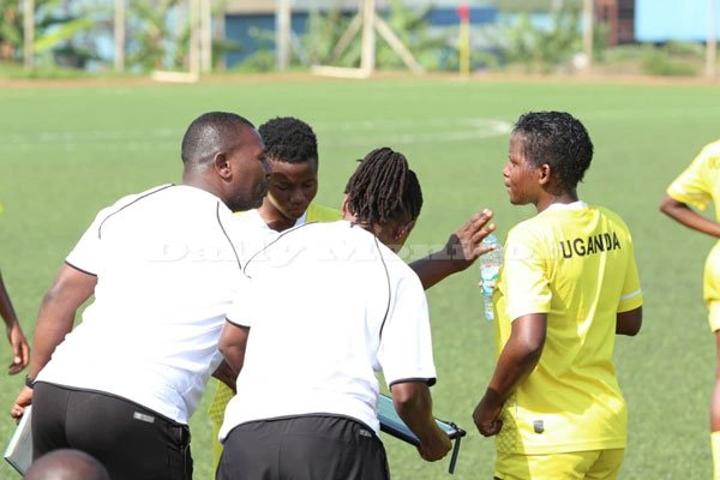
Coach Ayub Khalifa. PHOTO/FRED MWAMBU
Factfile…Coaching profile
2001 to date – Head coach, Kawempe Muslim
August 19, 2019 – Head coach, September 1, 2021 – Uganda Women Under-17
September 2, 2021 to date – Head coach, Uganda Women Under-20
Honours
Airtel-Fufa women’s football coach of the year – 2019
National Secondary schools games (girls’ football) winner – 2009, 2010, 2011, 2012, 2013, 2014, 2015, 2016 and 2019
East Africa Secondary schools games (girls’ football) – 2012 & 2019
Fufa Women Elite League champion – 2015, 2015/16, 2016/17 & 2017/18
Cosafa Women’s Under-17 champion – 2019
Cecafa Women’s Under-17 champion – 2019
Record with National teams
2019 Cosafa Women U-17
Sep 20: Uganda 1-1 Zambia
Sep 22: Uganda 11-0 Mauritius
Sep 24: Comoros 0-20 Uganda
Sep 27: Uganda 12-0 Botswana (S. Final)
Sep 29: Uganda 2-1 S. Africa (Final)
2019 Cecafa Women U-17
Dec 9: Uganda 4-0 Burundi
Dec 12: Uganda 11-0 Djibouti
Dec 13: Eritrea 0-10 Uganda
Dec 15: Tanzania 1-1 Uganda
Dec 17: Uganda 2-0 Kenya
For More News And Analysis About Uganda Follow Africa-Press