Africa-Press – Uganda. President Museveni has said much as the country has registered more political and economic gains under his tenure, he is unsatisfied with the growth rate, which has now stagnated between six and seven percent, 36 years later.
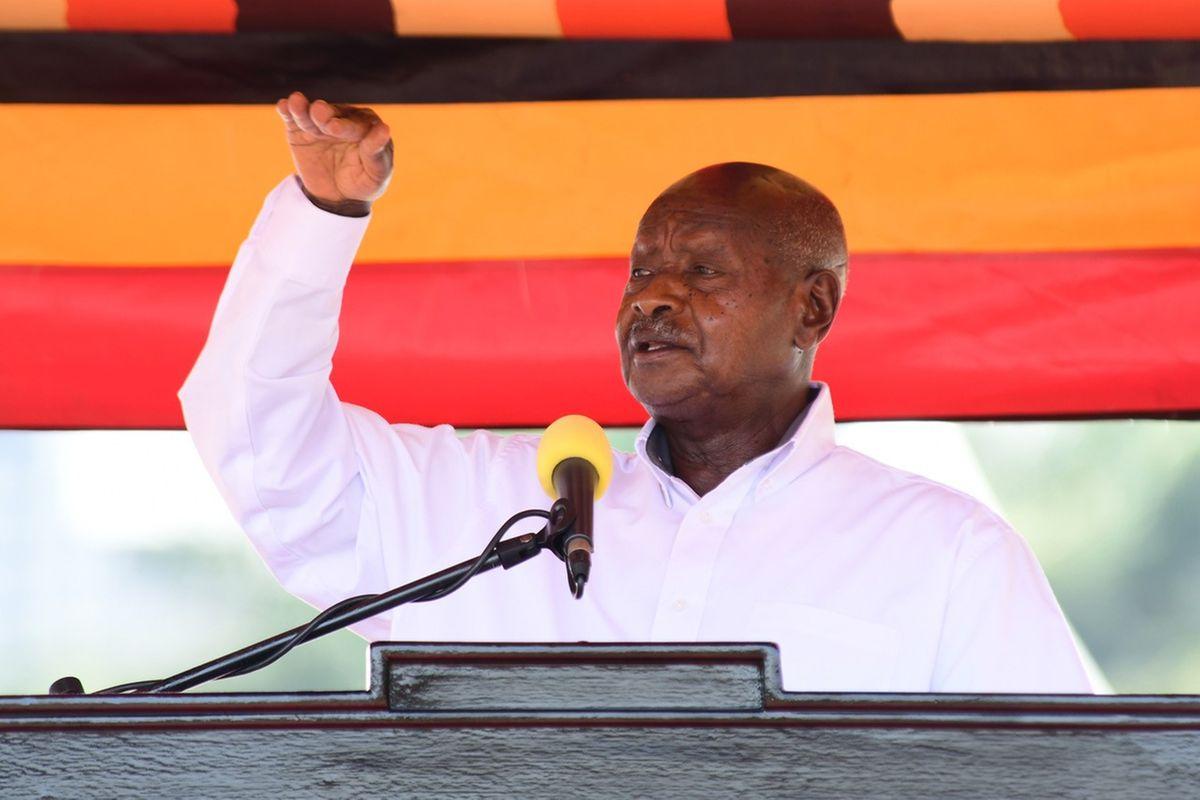
Speaking at the commemoration of the National Resistance Movement (NRM) Liberation Day at Kololo Independence Grounds in Kampala yesterday, the NRM leader said despite the progress, more inclusive and transformative economic progress could have been achieved given the country’s potential.
In line with the day’s theme, “celebrating the 36th NRM/A Victory Day: A Call to Duty for all to Contribute Towards Uganda’s Socio-economic Transformation Journey’’, Mr Museveni emphasised that the country should no longer aim at simply attaining Lower Middle Income status, but rather higher status.
“I am not satisfied with this level of growth. It is high time to rapidly develop to High Middle Income status, not just Low Middle Income status,” he said.
“I do not fully agree with our planners, who keep talking of these rates of growth of six percent, seven percent. We can grow rapidly to a much higher level,” he said.
The Middle Income country goal is anchored on household earnings, which should translate into inclusive growth in terms of health, education, access to land, emerging opportunities and capital.
When President Museveni took over power in 1986 after a five-year guerilla war, the economy was said to be in ruins.
The new leader promised Ugandans sustainable socio-economic transformation as one of the fundamentals of the NRM.
“The economy of Uganda will be $44 billion in July. When we started, it was only $1.5 billion. This means the economy has grown 29 times since that time…and in July, the GDP per capita will be about $980 (Shs3.5m), that is very near the Middle Income status at $1,039 (Shs3.7m). In July, we shall be about $50 (Shs177,000) short of the Middle Income status,” he said.
According to the National Planning Authority (NPA), Uganda aspires to become an Upper Middle Income country by 2040 as spelt out in the Uganda Vision 2040 (NPA, 2013). The Vision sets out to achieve a per capita income of $9,500 (Shs33.6m), as well as improving the wellbeing of all Ugandans commensurate to Upper Middle Income standards, to be realised through the implementation of the five-year NDP III.
According to the World Bank, middle income countries are nations with per-capita gross national income ranging between Shs3.7m and Shs45.4m.
Uganda’s target was to attain Lower Middle Income status by 2020, with an annual per capita income of Shs3.7m, according to NPA 2(NDP2).
This means all Ugandans, including children who are not working, must be earning Shs3.7m per year.
This has not been achieved.
The President, however, cautioned leaders at all levels to do more to guide the public to attain better economic and financial welfare.
Mr Museveni said some Ugandans and, or areas, are already living the high level kind of life, while others lag behind. According to the President, there is need for targeted interventions by leaders.
Officers of the Uganda Prisons Service perform a Goose March during the commemoration of the National Resistance Movement Liberation Day at Kololo Independence Grounds in Kampala on January 26, 2022.
He added: “We cannot go on beating about the bush, mukole n’amaanyi, mwesibe bbili [work extremely hard, be determined], and just empty talk without giving clear guidance, researched guidance to the people. Making the people make mistakes because we do not give them enough guidance, because we have not done any research. We are just running up and down.”
“This is the time now to go to another level, do not continue talking about small things, let’s go to a high-middle income level. Target an economy of half a trillion, not just a few billions. That is not enough. And I am sure we can achieve it,” he said.
He added: “We are already moving, now we have a lot of products, a lot of surplus…but we need more and we shall be able to market them.”
Middle Income status
The World Bank defines a Lower Middle Income economy as one with income per capita of between $1,046 (Shs3.7m) and $4,095 (Shs14.5m), while the Higher Middle Income lies between $4,096 (Shs14.5m) and $12,695 (Shs45m).
Uganda had set its eyes on attaining Lower Middle Income status by 2020, the mantra that underlined President Museveni’s 2016 re-election campaign. The goal was missed, while Tanzania made the cut.
Finance minister Matia Kasaija, in 2018, highlighted factors, including the disproportionate population growth and productivity and delays in exploitation of oil resources to have hindered the country’s aspirations.
Mr Museveni yesterday said the disruptions by the Covid-19 pandemic further thwarted the dreams, but promised that Uganda would be a Middle Income country by the end of his term in 2026.
According to the International Monetory Fund, the authorities remain committed to maintaining macroeconomic stability even as they work to exit from the Covid-19 crisis, and to support sustainable growth and an inclusive recovery. They envision a transition to higher middle-income status by 2040.
“If all of us were to wake up and follow what we have been telling you, our economy will be, just using agriculture alone, our economy will be $586b. It will be more than half a trillion. This is what I am demanding from, especially the NRM leaders, you should not just go on being called leaders when we are leading nobody anywhere, just running around,” he said.
Mr Museveni is optimistic that the Parish Development Model, the latest of the party’s similar attempts at alleviating poverty, will deliver the much desired transformation.
He highlighted other enablers, including the available markets and the growing levels of education.
For More News And Analysis About Uganda Follow Africa-Press