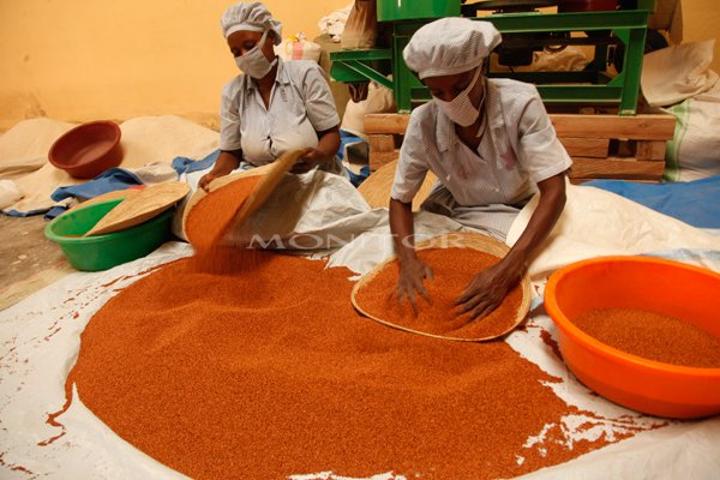
Africa-Press – Uganda. The umbrella body for grain traders in East Africa has said more than 70 percent of grains produced by smallholder farmers are being rejected by international traders because of poor quality.
Speaking at a joint media briefing with Uganda National Bureau of Standards (UNBS) yesterday, the country leader of East Africa Grain Council (EAGC), Mr Paul Ochuna, said the persistent poor quality is contributing to low prices and lack of market for important grains such as maize.
He explained that the grains are majorly failing in the areas of aflatoxin content, a cancer-causing toxin, high moisture content and poor grain colour because they are dried on bare ground or dirty places.
“You find that averagely, over 70 percent of the grain that is produced by smallholder farmers is rejected because of the high level of aflatoxin [and high moisture content]. In case they are to sell, the commodity will be sold for animal feed and, therefore, it will fetch a low value,” Mr Ochuna said.
He added: “The problem of aflatoxin is really big. And this is mainly because smallholder farmers are not using the best post-harvest management practices. The most affected crops are maize, millet and sorghum.”
The revelation comes a few days after President Museveni launched the Parish Development Model, a programme that focuses on increasing agricultural production in the country.
In March last year, Kenya banned the importation of maize from Uganda, claiming that it contained high levels of aflatoxins. However the ban was later lifted after discussions between the two countries.
Mr Hakim Mufumbiro, the head of Food and Agricultural Standards at UNBS, told journalists that government effort is crucial in addressing the issue of aflatoxin and poor quality grains.
“Sometimes warehouses reject maize when the moisture content is 16 percent or beyond and yet the standard is 13.5 percent. The higher the moisture in the commodity the more likely the mould will grow in the product and for aflatoxins to appear,” he said.
He added: “Overall, there is a very good move towards improvement. Six or seven years ago, Uganda was not even trading maize with Kenya because our maize couldn’t meet the set standards. But right now Kenya is our biggest partner.”
Mr Mufumbiro said besides the machine installed at Soroti to rid maize of aflatoxin, the government is also working on natural remedy against aflatoxins.
“The government has been working on biocontrol which prevents aflatoxin right from the garden by planting strains that prevent the development of moulds,” he said.
Statistics from EAGC indicate that Uganda produces about 5.5 million metric tonnes of grains, offering exporters and local dealers sufficient supplies and yet hindered by lack of quality.
According to government statistics, grain trade brings more than $350 million (Shs1.2 trillion) annually.
[email protected]
For More News And Analysis About Uganda Follow Africa-Press