Africa-Press – Uganda. From John Dalton to Benjamin Franklin, representations of the real world in the reel world can lead one to believe that 19th century scientists were all male.
In reality, though, at the dawn of the 1800s, Marie Curie, a Polish and naturalised-French physicist and chemist conducted and pioneered research on radioactivity.
She was the first woman to win a Nobel Prize, the first person to win a Nobel Prize twice, and the only person to win a Nobel Prize in two scientific fields.
Before Curie, the trail was blazed by the likes of Mary Anning, an English fossil collector, dealer, and palaeontologist; Augusta Ada King, Countess of Lovelace, an English mathematician and writer; Alice Hamilton, an American physician, research scientist, and author; as well as Lise Meitner, an Austrian-Swedish physicist who was one of those responsible for the discovery of the element protactinium and nuclear fission.
In the early years, many achievements of women went uncredited while others were wrongly attributed to men who were more established. The marginalisation of women in science has been around for so long that there is even a term for it—the Matilda Effect.
Matilda effect
The Matilda effect is a bias against acknowledging the achievements of women scientists whose work is attributed to their male colleagues. This phenomenon was first described by suffragist and abolitionist Matilda Joslyn Gage in her essay, Woman as Inventor.
The academy award winning film Hidden Figures, is also a result of the Matilda effect.
The film follows three black female mathematicians—Katherine Goble Johnson, Dorothy Vaughan, and Mary Jackson—who worked at the National Aeronautics and Space Administration or Nasa during the Space Race.
It’s not just science where women are largely anonymous. There is no female equivalent of Michelangelo or Rembrandt. Critics say this doesn’t mean that there are no great female artists. It only, they add, presents a society problem when it comes to storytelling that has vehemently failed women.
In Uganda, where documentation of life history is abjectly poor, erasure of women is the order of the day. Ms Uwera Portia and Ms Keisha Kanyangi are looking to tackle such deficits.
The siblings took their baby steps by starting an annual exhibition called Because of Her.
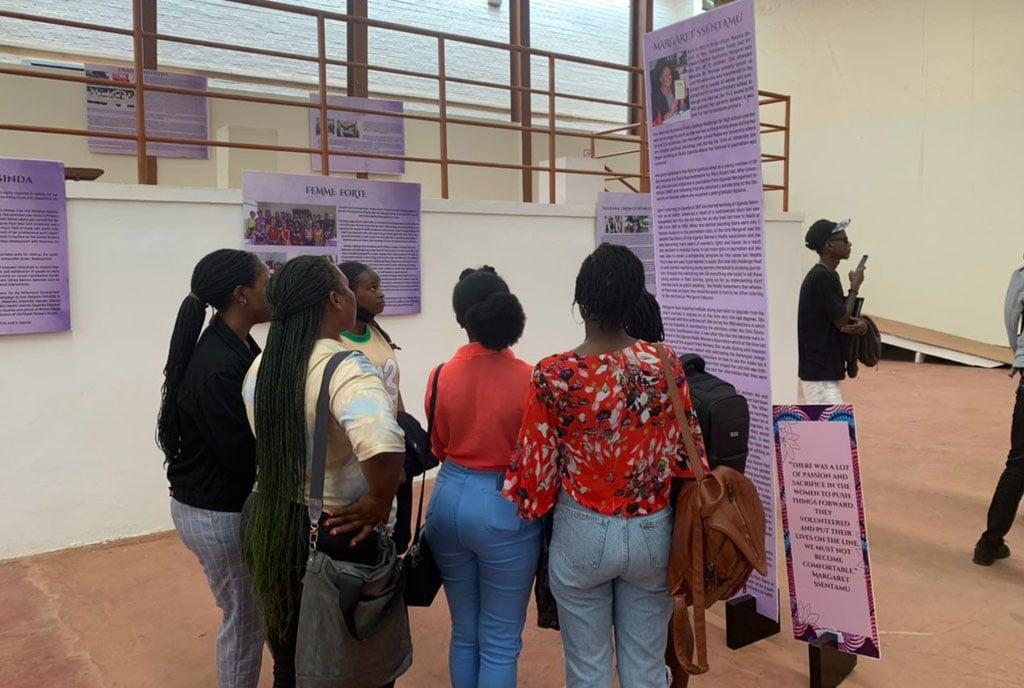
Only in its second year, the exhibition celebrates women who have been change makers in different sectors of education, media, philanthropy and healthcare. Ms Uwera told Monitor that the exhibition sets out to capture the pivotal role played by unsung heroines in our society.
“At Because of Her, we recognise the need to profile and celebrate the extraordinary women who have broken glass ceilings and worked tirelessly to improve the quality of life for women in Uganda and society at large,” Ms Uwera said.
Last year, the exhibition celebrated Uganda’s first female lawyer, doctor, graduates and academicians, among others.
It also feted other powerful women in the arts, activism, legal and communication sectors such as singer Sheebah Karungi, storyteller Patience Ahumuza, Justice Catherine Bamugemereire, Maggie Kigozi, Prof Sylvia Tamale and Prof Josephine Nambooze.
Prof Nambooze was the first female from East Africa to qualify as a physician circa 1959.
Second time around
This year’s exhibition ran from March 20 to 27 at the Uganda Museum. Unlike last year’s showcase that was in the main exhibition hall, this time round they curated within the vintage car exhibition hall.
The theme of Change Makers zoomed in on women who impacted different sectors such as Geraldine Namirembe Bitamazire, an academic and politician; Sylvia Nagginda, the current Nnabagereka or Queen of Buganda; and human rights lawyer Primah Kwagala.
The exhibition paid attention to the caesarean section in the pre-colonial era. Most of these were performed in Bunyoro.
Women in the community used to cook groundnut soup, beans and millet bread and fed expectant mothers intensively. This was for ordinary births.
When things got complicated, they recommended the caesarean section. This was as early as 1879.
Catholic missionary Robert Felkin witnessed a Caesarean section being performed on a young woman in Bunyoro. He documented it in the book The Development of Scientific Medicine in the African Kingdom of Bunyoro Kitara.
Details of this childbirth procedure made up the centrepiece of this year’s exhibition. Ms Kenyangi says they are a family that loves history, which is basically one of the reasons that inspired them to create an exhibition that celebrates milestones of women through history.
“But you will also notice that history about the achievements of women is blurry,” she told Monitor, adding that—when one learns about their history—the targeted people can achieve and change a lot for the future.
Ms Kenyangi was particularly touched by Elizabeth Bagaya’s story. “Just imagine if all the things she did had been done by a man, we would not have heard the end of it.”
Last year, the exhibition’s centrepiece was written in history as well, documenting Kigezi’s Queen Muhumuza. Muhumuza or Muhumusa was a fierce queen in areas that are currently split by Uganda and Rwanda.
During her reign, she is known for leading the first armed resistances against colonisation in the region.
Going forward, both Ms Kenyangi and Ms Uwera are not in doubt about the exhibition’s future.
They agree that it will have to become more artistic as opposed to information based.
For More News And Analysis About Uganda Follow Africa-Press