Africa-Press – Uganda. Alex Katwiremu, a youthful teacher at Kabaseegu Pentecostal Primary School, Kyazanga Town Council, Lwengo, District, has been charged with management of the school garden and he is also the teacher of integrated science and agriculture at the school.
Setting up a school garden
Seeds of Gold had a brief interview with him at the school last week about the reasons for setting up a school garden. “Most of the children today begin attending school at a very young age,” he says.
“And they have limited opportunity to acquire farming skills in their homes since most of the time they are at school. Yet when they leave school, whether after Primary Seven or at a higher level and fail to get formal employment in government, in private companies, and in NGOs, you will often hear our leaders telling them to go into farming. But why should they be expected to be good farmers when the schools which they attend don’t give them the farming skills,” says Katwiremu.
Time for the garden
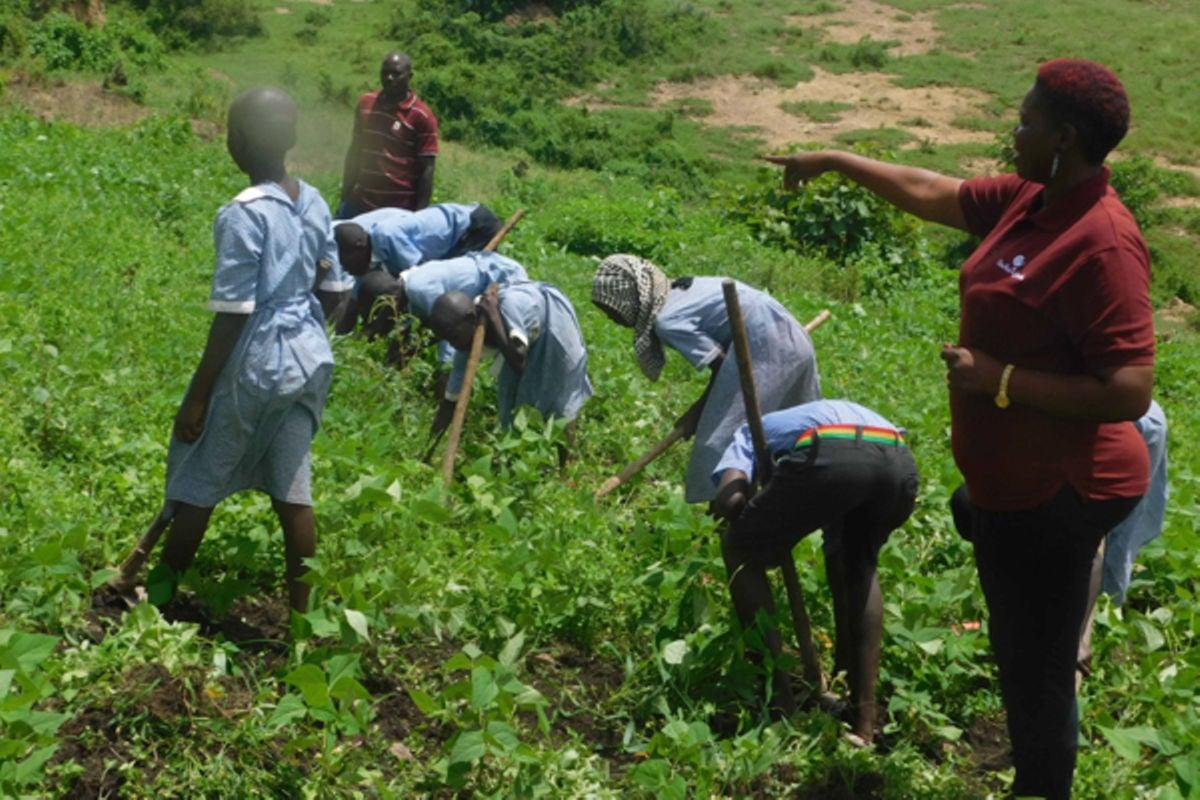
Each class at Kabaseegu Pentecostal Primary School is allocated about one hour of work in the school garden once a week.
In class Katwiremu gives simple illustrations of such activities as planting seeds, how to pot seedlings, and how to dig and space gallows but most of the practical teaching and learning takes place in the school garden.
“The pupils are not forced to go to work,” he says, “but rather they are persuaded and encouraged to enjoy work. We don’t want them to regard manual work as a form of punishment. In fact nearly all of them have their own small gardens, allocated to them by their parents at their homes where they further practice the skills that they get from the school. On their own they discover the importance of farming when they harvest their crops and eat them or sell them and get some money.”
Planting lessons
Katwiremu teaches the children how to plant the beans and maize. They learn to plant the crops in lines and they are taught the reasons for doing so. He said when crops like beans or maize are planted in lines the farmer has some space in which to move, inspecting the garden or spraying pesticides or fertilisers. The children are also taught when and how to weed the crops. They are further taught such skills as keeping the soil fertile by burying the weeds under the soil during seed bed preparation.
“We are fortunate that the soil is fertile by nature but we also try out a few other soil fertility conservation practices besides burying the weeds in the soil. For the time being we don’t have livestock whose droppings we could use as manure, yet due to budgetary constraints we cannot buy enough manure,” he says.
Dora Karungi, headmistress of the school, is credited with introducing the idea of the school garden at Kabaseegu Pentecostal Primary School. “Apart from being a teacher, I am a model farmer at Bijaaba Village in Kyazanga Sub-county,” she told Seeds of Gold.
“I am also a board member of Kyazanga Farmers Cooperative Society. I am also a member of Slow Food, an international movement that advocates and promotes organic farming and production of clean and fair food. So I felt it was unfair for me not to inculcate farming skills to the children of the school that I head. I discussed the idea with the school parent leaders and they gave me a go-ahead,” says Karungi.
Kyazanga Farmers Cooperative Society to which she belongs provides quality seeds to its members and also sends out extension officers to see what the farmers are doing and to alert them about any mistakes that they sometimes make. The cooperative society undertakes to buy the farmers’ harvest if they decide to sell some of the beans.
“Some days the children eat the beans and maize that they have grown in the school garden. In Slow Food we refer to this as food sovereignty — when people grow their own food in their local areas.”
Pupils to plant trees
A few months ago the school was identified by Masaka District Land Care (MADLAC) an organisation that works to promote tree planting and environment conservation agricultural practices in Masaka Region.
Karungi disclosed that the organisation has donated tree seedlings to the school and assisted the pupils to plant all of them. It has also provided training in land care practices to both the school teachers and the parents.
It has set up a tree nursery bed on the school compound where the children are taught to pot tree seedlings. Seeds of Gold visited the nursery bed and observed that besides potting tree seedlings, the children have also mastered Robusta Coffee seedlings preparation. Coffee is the main cash crop in the area.
Fiona Nantamba, a pupil in Primary four is aware of some of the reasons for planting trees. She told Seeds of Gold, “They are used as poles for supporting hydro-electricity wires. They also provide shade.” Huzailu Matovu a Primary Three pupil said, “Trees are a source of timber for making furniture.”
MADLAC Coordinator, Mathias Walukagga, has told Seeds of Gold, “We intend to work even more closely with Kabaseegu Pentecostal Primary School. We want to provide it with a rainwater tank to facilitate cleanliness and simple irrigation of the young trees. We also intend to donate livestock to the school to boost agricultural education. We actually wanted to begin with piggery but the school foundation body chose to reject it and we are now looking at starting poultry.” The headmistress, Karungi, had earlier told Seeds of Gold that when the school begins to keep livestock it will be in a position to generate manure for growing crops.
Tips other schools
Masaka District Inspector of Schools, Gerald Nsambu has said, “Ideally every school should have a school garden to give practical farming skills to the children. However the big constraint is lack of farming space at most of the schools. You will notice that the old schools built on church or mosque land also have a lot of space for setting up a school garden. Yet there are also hundreds of schools sitting on small plots in urban settings. Such schools cannot be expected to teach practical agriculture because of land shortage. Otherwise work in the school garden is one of the extra-curricular activities that every school should engage in.”
Challenges
Karungi says she has challenges sustaining the school garden. There are not enough hoes for all the pupils to use in a single lesson. “The few hoes that we use have been donated by the parents,” she says.
“Secondly, we do not have enough space for the school garden. Our wish is to have a bigger garden where we could plant more crops to not only produce food for the children but also to generate some income for the school. Thirdly we need livestock to teach our children how to look after animals and birds and to get manure for the crops. Successful crop production goes hand in hand with livestock keeping.”
Challenges
Dora Karungi says she has challenges sustaining the school garden. There are not enough hoes for all the pupils to use in a single lesson. “The few hoes that we use have been donated by the parents,” she says. The other challenge they face is poor road network from their farm to the town where they sell their produce. “Our aim is to expand our farm to at least 10 acres and sell the produce to major markets in Uganda,” says Karungi.
For More News And Analysis About Uganda Follow Africa-Press