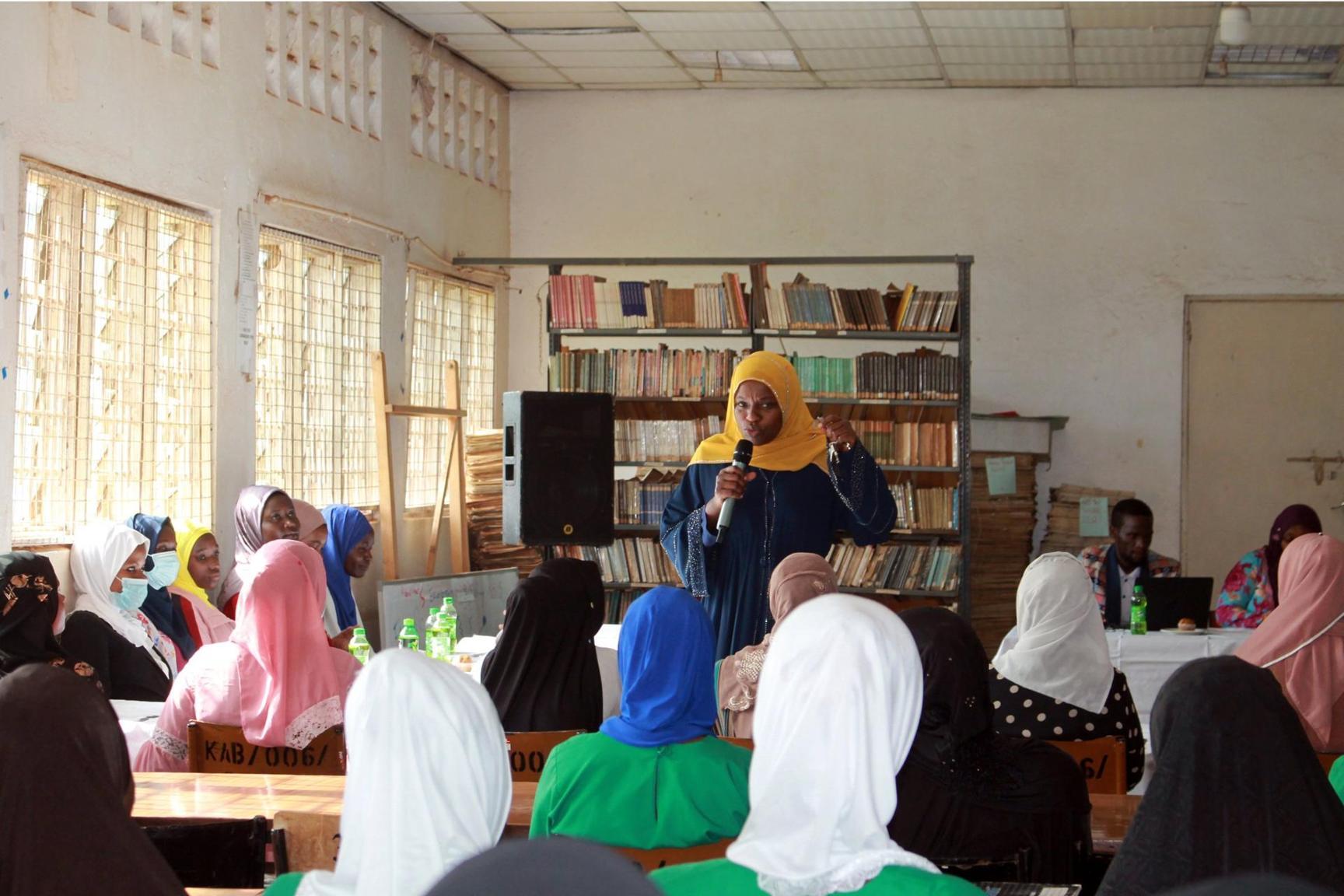
Africa-Press – Uganda. Sporting a dress that covers her entire body and a veil that’s mandatory for every student at Islamic University in Uganda (IUIU)’s all-female campus, Ms Shonah Kisakye is frank about her travails.
Ms Kisakye, 19, stopped pursuing a certificate in nursing and midwifery after being hamstrung by lack of tuition. Her father—whom she tells Monitor is the family’s sole breadwinner—has unsuccessfully tried to keep his six children in school.
“I have tried to do odd jobs even here at the university such that I can top up on what my father has, but still we come short of what’s needed,” Ms Kisakye, the eldest child in the family, reveals.
Seated next to Ms Kisakye is Ms Sophia Nasser. With the 24-year-old student’s father in and out of hospital, pursuing a Bachelor’s degree in Information Technology has proved to be a Herculean task.
“I came and told the director about my struggles,” Ms Nasser discloses, adding, “From the time of Covid-19, my father wasn’t earning as much as he was earning before and when he was sick, I had to forget school to take care of him.”
Elsewhere, Ms Esther Kainembabazi—a sophomore Mass Communication and Journalism student—has also been buffeted by problems occasioned by the pandemic.
“The salary he is earning was slashed yet besides tuition, we have other needs like eating and putting on clothes,” she tells Saturday Monitor about her father’s predicament, adding, “So I had to come to the director to get help.”
Dr Madina Nabukeera, the director whom Ms Kainembabazi refers to, says these stories of lack have become commonplace at the campus she superintends over. She further reveals that a peculiar solution has in recent times presented itself.
“Men always come here looking for girls to marry, and if the girl accepts, we marry them off,” she said, adding of the marriages, “I know this is not out of love; it’s about the need to get tuition.”
Dr Nabukeera proceeds to describe such marriage arrangements as “painful.” She also questions their sustainability.
An outlier
Constituting just 14 percent of the country’s population, Muslims in Uganda have always been something of an outlier. Their golden age—at least in Buganda—was between 1862 and 1875, during Kabaka Mutesa I’s reign, following Islam’s introduction from the East African coast in 1844.
Since the roots of formal education in Uganda can be traced back to Christian missionaries, there was always a feeling among Muslims that Islamic virtues they wanted passed on to their children would be undercut.
“Many of the schools shared the same grounds, if not buildings, with churches. Muslim parents were afraid of this kind of education because it exposed their children to Christian ideas and values and had the potential to lead to Christian conversion,” Omar Dawood writes in his paper titled Marginalisation of Muslims and Measures to promote minority rights in Access to Justice in Uganda.
Dr Muhammad Kiggundu, who heads the Department of Humanities and Language Education at Makerere University, says Muslim families in Uganda relied on Madarasa or Koran schools.
“These were schools mainly established in homes of a few prominent Muslim scholars (Mu’alim), where lessons were usually taught on verandas or any available space,” Dr Kiggundu says.
It, therefore, came as no surprise that in the aftermath of colonialism, Muslims had only two university graduates.
“In the 1960s, we had only two Muslim graduates. That’s Ali Kirunda Kivejinja and Abubaker Mayanja. Because education was in the hands of the Church, Muslims had to convert like Yusuf Lule,” Dr Nabukeera says, referring to Uganda’s fourth president who converted from Islam to Anglicanism while at Kings College Budo, an Anglican-founded school.
It was against this historical marginalisation of Muslims in the education sector that in 1988, the Organisation of Islamic Cooperation (OIC)— the Jeddah-based organisation whose objective is to protect and safeguard the vital interests of Muslims—teamed up with the current regime in Kampala to form IUIU. The main campus of the university is in the eastern city of Mbale. Campuses in Kampala (2001), Arua (2004), and another exclusive to females in Kabojja (2008) have since been stablished.
“The objective of this female campus was to create a suitable environment for the girl-child to complete higher education with affordable tuition charges,” Dr Nabukeera says.
Empirical evidence has, however, showed that the girl-child was still running into a brick wall, thanks to financial bottlenecks. Dr Nabukeera, who has been the director of the female campus since its inception, says a “zero balance policy” that bars one from writing “exams unless you have completed your tuition” has been a stumbling block for many.
It doesn’t help matters that you can count off the fingers of one hand the scholarships offered by Islamic organisations such as International Islamic Charity Organisation (IICO) and the African Muslim Agency (AMA).
“We could send them any scholarship applications, but they could only give two [students],” Dr Nabukeera discloses.
Zero balance policy
With nearly 300 students not being able to write their exams because of tuition, Dr Nabukeera says she had to be creative. She wrote a concept paper to IUIU leadership, imploring them to change the policy of “zero balance” to “pay you sit.”
She says of the latter: “It would tell students to pay some amount to sit a paper. You pay another amount, I give you another paper. That way, we would avoid having many students on halted progress.”
Despite the IUIU top brass not buying into her proposal, Dr Nabukeera rebelled and went ahead to implement it.
She found comfort in the fact that her proposal was in the Sustainable Development Goal No.16. The goal stipulates thus: “Promote peaceful and inclusive societies.”
“These girls come here crying for me. They want to sit exams. What should I do? Because if they don’t sit exams, it means another year here and an additional burden,” Dr Nabukeera says.
IUIU’s top brass favour the zero balance policy because the university is mainly run on tuition that students pay. To make ends meet, a number of students from IUIU’s female campus have gone to the Middle East to do odd jobs.
“We have transcripts here which have not been claimed because girls have gone to Saudi Arabia to work such that they pay money,” Dr Nabukeera reveals.
With money not coming from either donors or the government, Dr Nabukeera last year came up with another idea of getting money. Dubbed Run for a Girl Child Education, the cause promotion only managed to rake in Shs5 million.
Shs4m of it came from Speaker Anita Among. This has not deterred Dr Nabukeera from knocking on more doors and running various publicity campaigns.
With Shs17 million in the kitty now, students such as Ms Kainembabazi have had their deficits cleared. Entirely.
“I hope people continue to participate in this run because I would be struggling with fees,” she says of the cause promotion.
For More News And Analysis About Uganda Follow Africa-Press