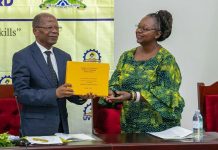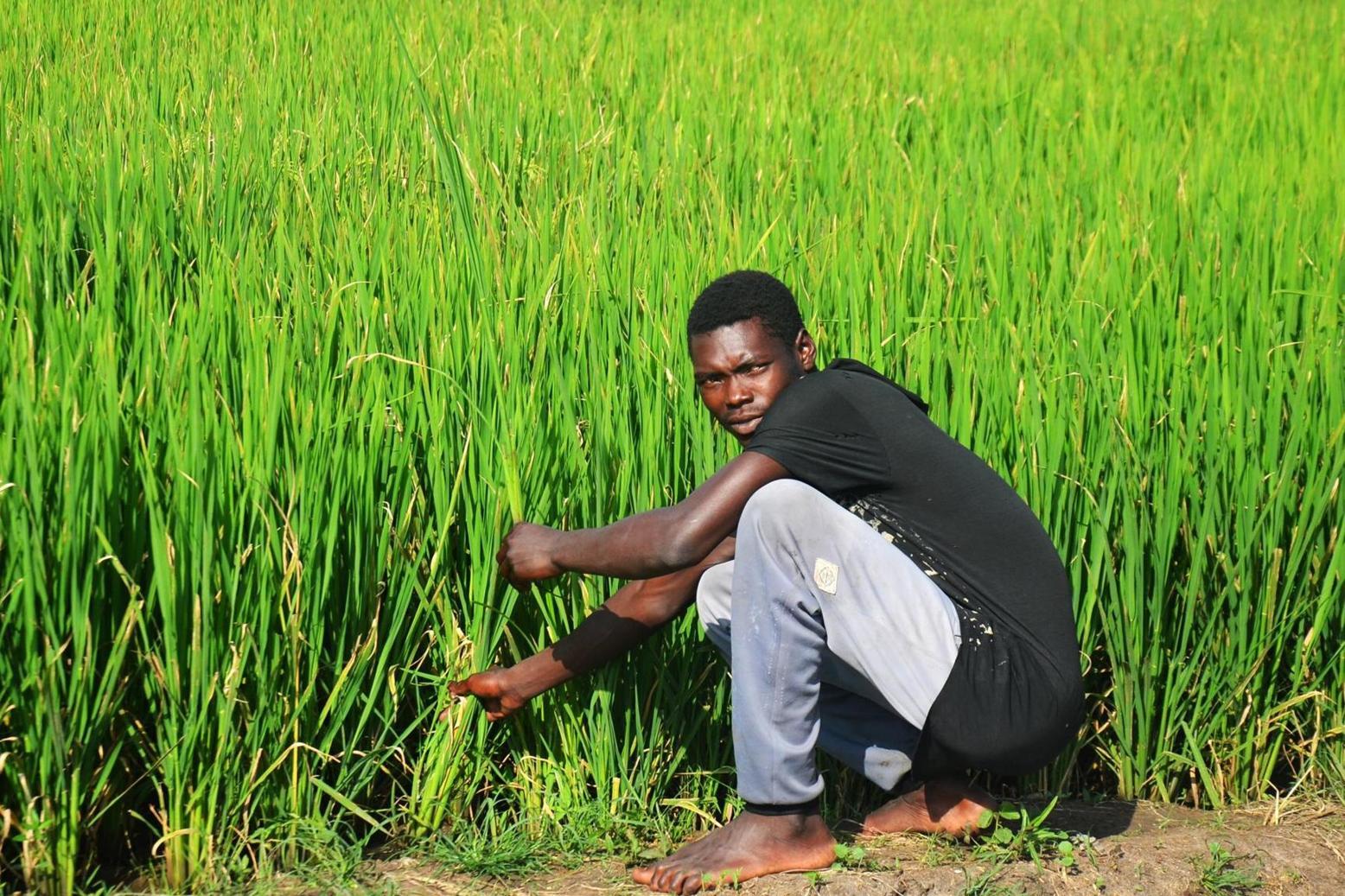
Africa-Press – Uganda. The Food and Agriculture Organisation (FAO) has launched a new hybrid rice variety called Water-Saving and Drought Resistant Rice (WDR-73), which is said to double yields.
Launched under FAO-China-Uganda, South-South Cooperation (SSC) Project Phase III, the new variety was developed by Shanghai Agrobiological Gene Centre in collaboration with the National Agricultural Research Organisation (Naro).
Dr Charles Owach, the assistant FAO representative in charge of programmes in Uganda, says the variety has the ability to boost yields by at least 30 percent compared to the locally-grown varieties.
“In Uganda, WDR-73 cultivation experiments were conducted in Lukaya, Luweero and Arua, and in well-managed farms, grain yields increased from 4.35 tonnes to more than six tonnes per hectare,” Dr Owach said at the weekend.
He added that the new rice variety is water-saving and drought-resistant compared to the irrigated paddy and traditional upland varieties, hence important for food security.
Mr Peter Muyimbo, the coordinator of FAO SSC Project Phase III in the Ministry of Agriculture, Animal Industry and Fisheries (MAAIF), said with enough water, the new variety can yield in excess of 3.8 tonnes, while on highlands, it yields between 1.5 tonnes and 3 tonnes.
This, he adds, might not be possible with our previous varieties.
Dr Zaochang Liu, a co-breeder of WDR-73 from Shanghai Agro-biological Gene Centre, says the new variety helps in mitigating climatic change because it decreases methane gas emission and is more nutritious.
Dr Jimmy Lamo, a principal research officer, who is also a rice breeder at Naro, said the WDR-73 variety was developed through conventional breeding of Huhan 7A and Hanhui 3. He added that it was bred by Shanghai Agro-biological Gene Centre and Shanghai Tiang Biotechnology Co limited.
“The cereal, which has a larger grain similar to supper rice, has since been released in China, Bangladesh, Pakistan, Vietnam and Nigeria,’’ Dr Lamo said.
Mr Higenyi Michael Bory, the chairperson of Butaleja, one of the rice-growing Districts, said local seeds that were introduced many years ago had lost the capacity to boost yields.
With this new variety, Mr Higenyi says from an acre, a farmer can use 5kgs of seeds compared to the traditional variety, where a farmer has been using 20kgs and harvests between 15 and 20 bags.
“In WDR-73, a farmer can harvests more than 40 bags. You plant less and get much more from one acre,’’ he said.
Mr Robert Sagula, a rice farmer in Butaleja District, said: “We have been getting 1.2 tonnes of rice from the other varieties such as K-85 from Kibimba and Namulonge-1, but we tried the new variety and we were able to get four tonnes from an acre.’’
Funding Partnership
According to the MAAIF, 1,000 farmers benefited from the first phase, 10,000 from Phase II and they expect 100,000 farmers to benefit from the third phase, which kicked off in 2022 and ends in 2025.
The government has invested $9m (about Shs32.5b), while China has pumped in $3m (about Shs11b) in Phase III, which focuses on innovative technology transfers, high-yield rice and foxtail millet production, and livestock management, among others.
For More News And Analysis About Uganda Follow Africa-Press