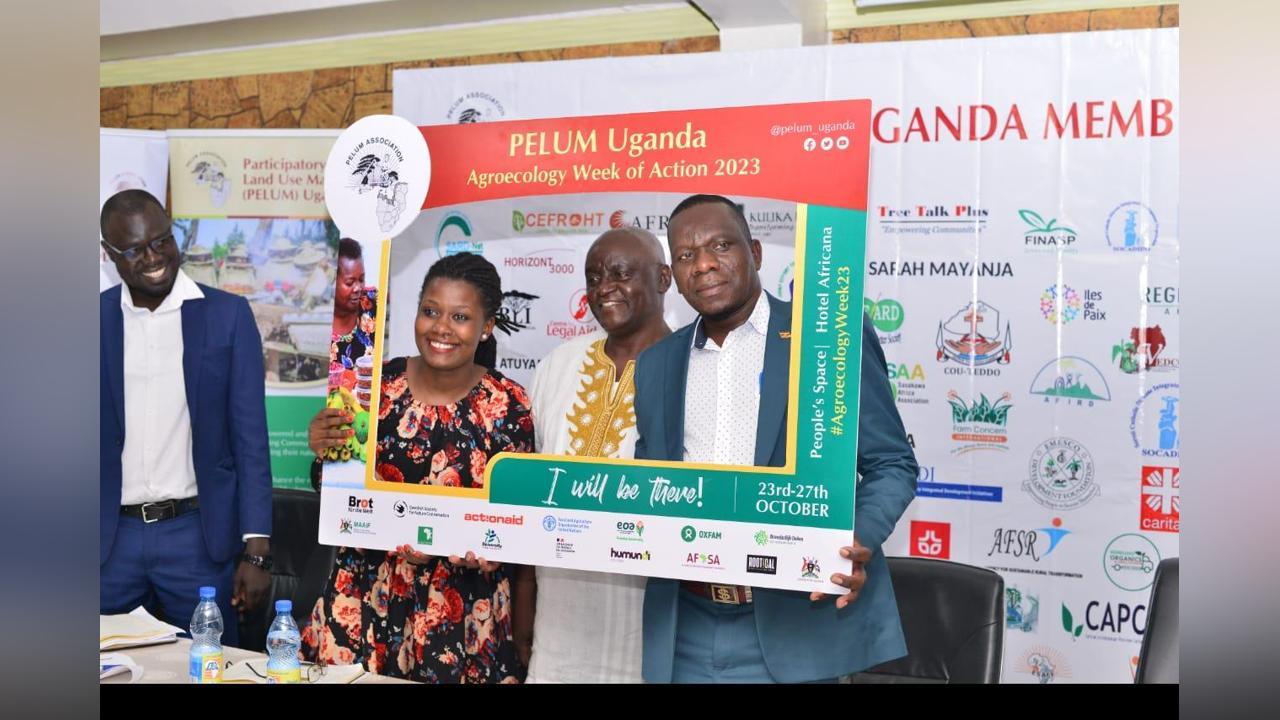
Africa-Press – Uganda. PELUM Uganda in collaboration with the Government of Uganda (the Ministry of Agriculture, Animal Industry and Fisheries and the Ministry of Trade, Industry and Cooperatives) and on behalf of the National Agroecology Actors on this day Monday/ 23rd / October/2023 would like to inform the public about the National Agroecology Week of Action (AWA) 2023 that is running from today, 23rd to 27th October 2023, and hosted here at Hotel Africana. The AWA will be streamed live onthe different online platforms.
The 2023 National Agroecology Week of Action has 3 specific events organized under various themes to engage the public.The events are ;
The 5th National Agroecology Actors’ Symposium (NAAS) to be held on Tuesday 24th October under the theme “Accelerating A Just, Inclusive and Resilient Food System Through Agroecology “.
The 2nd Agroecological Market Systems Expo (AMASE) scheduled for Wednesday the 25th October, under thetheme “Advancing Agroecological Entrepreneurship and Synergies for Sustainable Market Development,”and
The 13th Annual Indigenous and Traditional Food and Seed Fair to be held from Thursday the 26th – Friday the27th October 2023 under the theme “Nurturing healthy, nutritious and resilient food systems for all’’.
The 3 events will provide platforms for participation of different actors within the Agriculture and Agroecology spaces. Thelive stream sessions shall be relayed on PELUM Uganda’s online platforms i.e. X (Twitter), YouTube, and Zoom. Widepublicity shall be done on the traditional mainstream media.
Our mandate and core business as the National Agroecology Actors together with the Government is not only to scale up but also to scale out and scale deep Agroecology in Uganda by addressing the concerns of Agroecological Production and Market Systems; Institutional and Policy frameworks; and positive mindset and behavioral adjustments through ensuring availability of adequate supportive atmosphere.
Agroecology as defined by the Food and Agricultural Organisation (FAO) is a holistic and integrated approach that simultaneously applies ecological and social concepts and principles to the design and management of sustainableagriculture and food systems. It seeks to optimize the interactions between plants, animals, humans, and the environment while also addressing the need for socially equitable food systems within which people can exercise choice over what theyeat and how and where it is produced.
Scaling up of Agroecology in Uganda is critical towards achieving the Sustainable Development Goals (SDGs) most especially the SDG 2 on Zero Hunger that requires a transition towards more sustainable food systems with more socio-economic benefits and with less environmental consequences.
In light of this background, the three events of the Agroecology Week of Action have been designed to promote scaling up ofAgroecology in all the three spheres of Public Policy, Agriculture production and Market Systems.
The 5th Annual National Agroecology Actors Symposium aims at providing a platform for Agroecology actors to share experiences and strategies for food systems transformation through scaling up of Agroecology in Uganda with the view of improving Public Policies.
The 2nd Agroecological Market Systems Expo (AMASE) to be held at the People’s Space at Hotel Africana will feature avariety of activities designed to highlight the potential of agroecological businesses in improving livelihoods and transforming food systems. These activities include public awareness campaigns, “Akatale” – Market showcasing agroecological products, multi-sectoral services exhibitions, panel discussions, and networking opportunities. Strengtheningentrepreneurship capacity as well as identifying and discussing public policy issues regarding trade in Agroecological products, services, and territorial market development will be prioritized.
The 13thAnnual Indigenous traditional Food and Seed Fair is aimed at showcasing the significance of Uganda’s Indigenousand Traditional food and seeds in fostering healthy and sustainable food systems for now and the future. The Traditional food systems further contribute towards the achievement of food security and improved nutrition, maintaining genetic diversity of seeds and plants, and promote sustainable agriculture.
At the 13th Annual Indigenous seeds and Traditional Food Fair, there will be exhibitions from different member organisations showcasing their indigenous/traditional/cultural food products and/ or work on promoting indigenous foods and seeds and awards will be given to the best exhibitors.
It is further critical to note that access to secure, nutritious, and healthy food is one of the aspects offering greater human security and societal stability. Indigenous and Traditional food systems have served as a major source of healthy diets amongst the local communities. Indigenous Peoples around the world are stewards of nature and holders of vast local knowledge and traditions, handed down from generation to generation, that guide them in living interdependently with the environment. Indigenous and traditional food systems represent a treasure strove of knowledge that contributes to the well-being and health, preserving a rich biodiversity, and providing nutritious food. Indigenous and traditional territories are home to 80 per cent of the planet’s biodiversity and often play a wider role in environmentalconservation. Furthermore, the agricultural biodiversity within indigenous and traditional food and seed systems contributesto food and nutrition security, improved financial situations, and for combating ‘hidden hunger’ caused by micronutrient(vitamin and mineral) deficiencies.
Despite their critical importance, the food systems, crops and knowledge systems of Indigenous and traditional peoples are often perceived as “backward” or unproductive 1and are threatened by the industrialisation of agriculture and food,economic development and globalisation, leading to widespread losses of food-related biocultural diversity in many countries (FAO: Rome, Italy, 2021). The modernisation of agri-food systems has helped to reduce undernutrition but has notresolved persisting micronutrient deficiencies and has contributed to rising obesity and other diet-related diseases whilebeing one of the most significant drivers of environmental degradation, biodiversity loss and climate change.
All the above events are expected to bring together policy makers, technical staff of Government, farmers, private sectoractors (Agroecological input dealers, producers, certification bodies, processors, business service providers), financialinstitutions, media, research institutions, youth, development partners, civil society, and the academia.
Today we are gathered here to flag off these three major events and to invite the public to join us throughout this week.
We further call upon the third estate- press and media who are key stakeholders in upscaling Agroecology to convey ourkey message today and those that will be garnered with the Agroecological Week of Action this week to raise awareness and mobilize the different stakeholder to participate.
For More News And Analysis About Uganda Follow Africa-Press