Africa-Press – Uganda. The artwork of the Ugandan digital artist Denzel Muhumuza titled Woven Worlds is a captivating piece from his collection—The Sun, The Moon, and The Truth—where the vastness of the planetary solar system is reimagined through the lens of traditional woven baskets.
“Each celestial body finds representation in the intricate patterns and textures of these culturally significant artefacts. This artwork symbolises the profound connection between our culture and the universe, emphasising that our roots are intricately woven into the cosmic fabric,” Muhumuza told Monitor.
Woven Worlds invites viewers to contemplate the interplay between tradition and the cosmos, fostering what Muhumuza considers “a deeper understanding of how our cultural heritage is not only rooted in the universe but intricately woven into its very essence.”
The wide digital artworks by Muhumuza and floating poetry by the Rwandan writer Gretta Ingabire at the exhibition The Sun, The Moon and The Truth cultivated a sense of appreciation as well as rekindled ancestral bonds through the lens of culture and tradition. The exhibition was curated by Gloria Coutinho.
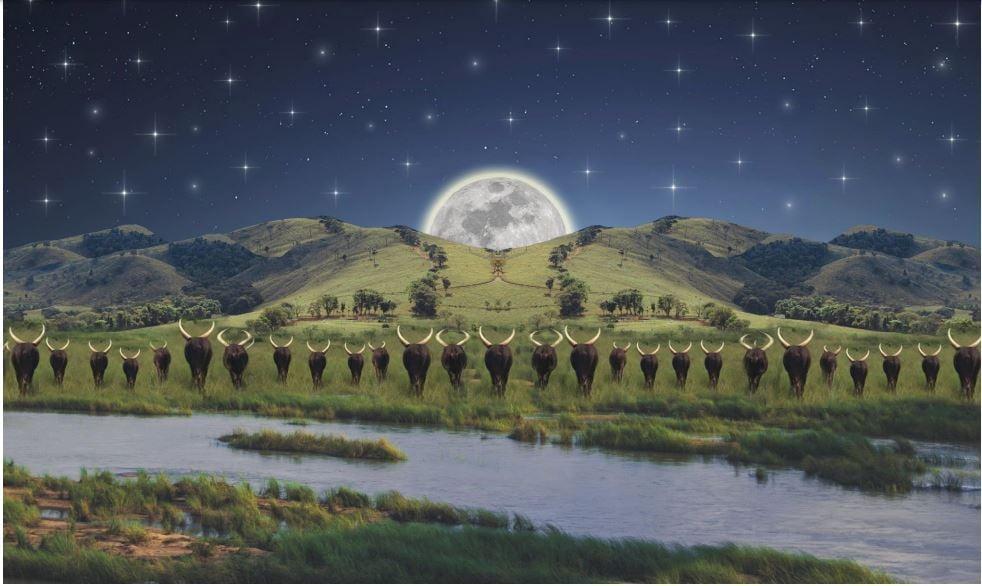
In Tales by the River, the moonlight casts a mesmerising glow on a vast landscape as a herd of majestic long-horned Ankole cows gracefully depart from the riverbank. This, per Muhumuza, is a tribute to the rich cultural heritage of the Bachwezi. Set in Ibanda, the piece captures the essence of local folklore and the captivating narratives surrounding the Bachwezi.
Tales by the River serves as a visual storytelling conduit, inviting viewers to immerse themselves in the enchanting stories that echo through the village.
Earth’s Embrace depicts the serene beauty of rural Uganda, where a female farmer stands amidst her cauliflower-laden farm, cradling a basket of nature’s bounty. “This piece serves as a poignant tribute to the profound connection between humanity and the earth, highlighting the nurturing embrace of agriculture,” Muhumuza said, “The farmer’s tranquil gaze reflects the symbiotic relationship we share with the land, showcasing the earth as a provider and sustainer.”
Elsewhere, Earth’s Embrace invites viewers to reflect on the essential role of agriculture in our lives. It emphasises the reciprocal bond between humans and the earth as a source of nourishment, growth, and sustenance.
The Seed of Life, meanwhile, intricately weaves together traditional woven baskets from Uganda, forming a sacred geometry pattern. Symbolising the interconnectedness of all things in nature, these baskets come together harmoniously. Amidst the pattern, traditional Buganda shields are incorporated, embodying the concept of ancestral protection.
“This artwork is a visual narrative, illustrating how the cultural elements of woven baskets and shields converge, mirroring the interdependence found in nature,” Muhumuza said of The Seed of Life, adding that it “not only celebrates Uganda’s rich heritage but also serves as a powerful reminder of the harmony and ancestral bonds that persist through time.”
Rooted in Faith depicts the moon, cradled on an island, becomes a celestial shrine protected by traditional Buganda shields. On either side, a man and a woman in prayer embody the spiritual guardianship of Lake Nalubale.
The piece pays homage to the cultural and spiritual ecosystem surrounding the lake. Fishermen, sailing toward the moon-lit island, symbolise the profound connection they share with the lake. As they embark on their journey, Rooted in Faith envisions a celestial shrine to the moon.
Muhumuza’s other artworks are: Kanyamaza, Pathways of Existence, Connected by the Roots, Journey Within, Family Trees, Third Eye Open, Portal of Fort, Burning Like The Sun, The Milky Way, Ancestral Echoes, Ankole Falls, and The Universe Hides in All.
Muhumuza said “creating digital artwork […] serves as a powerful medium to tell stories that resonate with the core values of representation, empowerment, and cultural heritage.” The motivation to position African people as beautiful, powerful, and spiritually rich individuals with agency in their lives, he added, “stems from a deep commitment to challenging stereotypical narratives.”
He added that his “work is profoundly influenced by the wisdom of my ancestors, my Ugandan culture and African heritage.” It serves as a bridge between the past and the present, “encapsulating the rich tapestry of traditions, stories, and cultural nuances that define our collective history.”
Ancestral Presence, which is one of Ingabire’s three poems, is about the achievements and resilience of our forefathers as storytellers, their spirits and tree shrines.
“A mystical embrace of the ancestral presence/Where spirits of the land and people interlace/Trees like Icubya, Rwandan forgotten 300 year old shrine tree/Are storytellers of the distant past/Of ancestors who journeyed, leaving their mark/Stories of resilience they hold for decades/Trees like these still carry reverence/Reminds us of Dignity and Respect…,” the poem reads in part.
The poem What We Are reminds us of the everyday life of our ancestors and how they bonded with nature.
“We are because they were/The danced to the rhythms of thunder and rain/Celebrating life’s cycles, both joy and pain/The weather seasons they learned to read, and ability that remained/From the blossoming sunflowers in the rainy season/To the millet that tolerates the dry season/A sacred bond with nature, they did understand so well/For nature’s cycles they found their own,” goes the poem.
Freethinking, another poem, suggests that we shouldn’t look at things superficially. Conformity for the sake of conformity is a dead soul in a body, it notes.
“We created our works around a theme of our relationship with the natural world. I would say the natural world inspired my understanding of this theme, the diverse nature in Uganda has influenced most of my thoughts and to also explore the influence nature had on our ancestors,” Ingabire said, adding, “The artworks of Denzel Muhumuza were also a big inspiration because we wanted to create something that complements each other’s creation.”
On why she has chosen poetry to express herself, Ingabire, said: “Poetry has been one of my deepest tools of expression as an artist, and with this project as a writer I wanted to bring out the best I can do to create with Denzel something authentic and thoughtful to share with people. But in the book, you will also find very few theatrical monologues, essays and a letter, which is also something this project has helped me to explore as a writer.”
This exhibition is a project outcome of Vivid Synergies’s first artists in residency group Muhumuza, Ingabire and Gloria Coutinho—a project by Afriart Gallery (AAG) connecting East African artists, writers and curators based in Uganda, supported by a grant from Ignite Culture: ACP-EU Culture Programme (Eastern Africa).
The exhibition’s curator, Coutinho, said the works of Muhumuza and Ingabire usher us into a world of mindfulness and enlightenment. This, she added, stimulates the audience to tap into “our already existing inner connection with our natural environment, cultivating a sense of appreciation as well as attempting to rekindle ancestral bonds through the lens of culture and tradition.”
According to Coutinho, Muhumuza’s artworks manifest as surrealistic digital collages that portray people existing within tranquil natural environments and amongst celestial bodies that are part of the vast universe. The writings of Ingabire manifest as a verbal art form—an extension of the visual art and this shared narrative expressed by way of poetry and storytelling.
“While the exhibition is a celebration of beauty and a reinforcement of connectivity, it also an open gateway into socio-political dialogue regarding our existence within/as a part of nature, digging deeper into our spirituality and connections with our ancestral roots and beliefs as people of African descent,” Coutinho said.
The exhibition that opened on December 2, 2023 at the Akamwesi Mall Shopping Mall on Gayaza-Kampala Road in Wakiso District closed on January 6, 2024.
Benefits from residency
Asked how she has benefited from this residency, Ingabire replied: “I have learnt a lot from this residency. Through research we were able to do around our theme, our meetings that were very interesting to learn from each other, and the workshop that helped us meet people with a different perspective on what we we’re creating. This residency has also broadened my knowledge on many aspects like of our cultures, and heritage as well as what we consider home including the natural world.”
Muhumuza said: “Through the programme, I have had the opportunity to expand and refine my art portfolio, exploring new techniques and themes that have added depth and diversity to my body of work. Moreover, the interactions with fellow residency member Gretta, and the team at Afriart Gallery have provided invaluable insights and perspectives, contributing to a more nuanced understanding of my artistic motivations and objectives.”
For More News And Analysis About Uganda Follow Africa-Press