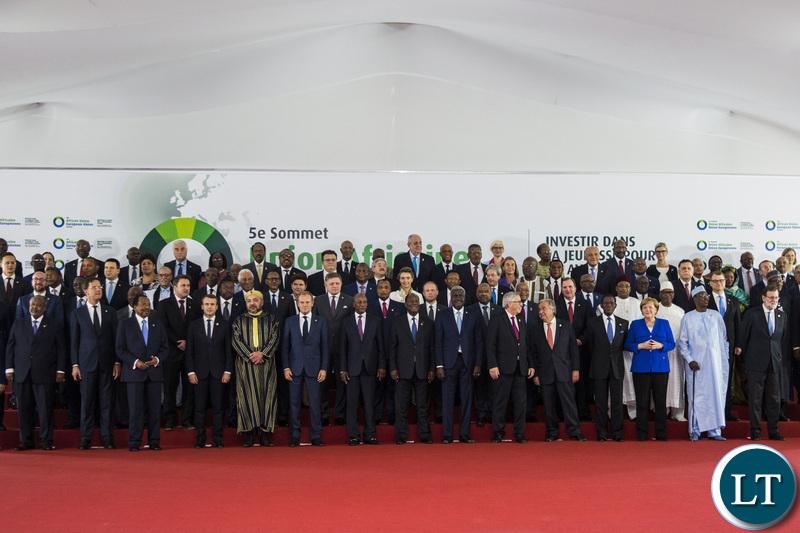
Africa-Press – Zambia. I read that African leader, including our own travel to Brussels, Belgium this week for the sixth Summit taking place on 17 and 18 February. While I refrain from discussing the objective of the summit in this paper, as it could be a topic on its own, I share the results of my research about Africa’s trade with the EU on the one hand, and Zambia’s trade with the EU on the other. While foreign direct investment is one of the most crucial forms of cross-border capital flow into Africa and is important for structural transformation, trade is equally so and I hope it is one of the things that the summit will delve to discuss, in particular how to support Africa’s structural change or a movement from exporting raw materials to manufactured goods to the EU in big quantities.
Whatever discussion takes place during the summit, EU and African leaders will learn that Africa’s exports of all products to the EU have been declining instead of rising in absolute values in the last two decades. The EU and other developed countries often tell us to use trade as an engine of economic development. African leaders too are fond of telling the world, “We don’t want free aid. Help us to trade more.” For many years, Africa’s least developed countries have been enjoying free duty of exports of all their products to the EU.
Yet, Africa’s exports have been falling lamentably. As Figure 1 below shows, Africa’s exports to the EU tumbled from their highest peak of over $200 billion in 2012-2013 to just about half in 2020. Meanwhile, the same Figure shows that Africa’s exports to China have been increasing steadily, reaching almost $50 billion. Obviously, one explanation for Africa’s declining exports to the EU is due to its market diversification to China.
My interpretation is that despite the EU’s gesture to provide free market access, Africa’s response is lackluster. But one has to analyze and find answers to why and part of it is likely to be the very reason d’etre of the summit. Just as it is difficult to blame the EU, it is too to pile the blame on African countries for the declining trend in the latter’s exports to the former. During China’s presence in Africa, many arguments have been floated. The EU and other developed countries find Africa’s partnership with China as lacking good economic governance while China and Africa contend it is based on mutual interests and respect. Whatever the case, it is clear that Africa is divesting its exports from the EU and channeling it to developing Asia in general and China in particular.
As Africa’s quest for export value addition increases, one wants to think that this will be one of its priority discussions with its EU partner. Currently, the proportion of Africa’s exports of manufactured goods to the EU in total stands at only 35% and this is largely due to South Africa’s majority contribution. Excluding South Africa, Sub-Sahara African countries’ proportion of exports of manufactured goods in total to the EU was only 7% in 2020 compared to primary commodities’ share of 93%. In other words, they exported only $2.6 billion manufactured goods relative to $36.1 billion worth of primary commodities.
As our Head of State is also available at the summit, Zambians would like know that our country’s exports to the EU have equally been slumping miserably as Figure 2 below shows. In the first place, total exports were only $ 228 million in 2020, of which manufactured goods accounted for only 12% leaving primary commodities with a larger share of 88%. It means the larger part of what Zambia exports have no value addition. I agree with the President when he says that he will go and push for value addition at the summit although what creates value addition is largely the country that is exporting.
Yes, he must persuade developed countries to channel their foreign direct investment to Zambia given that that is one of the main drivers of value addition or global value chains and networks. But, again, that largely depends on prevailing conditions in Zambia: whether they’re conducive enough to attract investment.
Zambia has been importing more from the EU than it has been exporting, leading to increased trade deficits. It means our country has not been leveraging external revenue obtained from exports to support economic development.
Finally, we saw that Zambia’s total exports of all products to the EU stands at only £228 million, very low numbers to the largest global export market. Of this, exports of manufactured goods stand at only $25 million. Clearly, these numbers are depressingly low and will have implications when we negotiate with the EU. We are clearly not a trading partner with the EU.
To acquire export value addition, the beginning is Zambia’s business sector and its full integration in government decision-making. Government and the business sector must become one. This one unit must work with the best. As Honorable Mutati said this week, “We must dance with the best if we want to develop.” It must work with owners of foreign direct investment in order to bring them to Zambia.
To attract foreign direct investment, there’s need for Zambians to understand the difference between misconceptions and realities. Often, we make our own conclusions that don’t match realities on the ground with owners of foreign direct investment. We think we know what they want when we don’t. We think we have what they want when we don’t. Foreign investors don’t come simply because we ask them to. They’re driven by a package of factors created at country level. Owners of foreign direct investment are not governments but their private sector. Lastly, we need foreign direct investment because our private sector is almost non-existent. Our private sector must work with their counterparts in Viet Nam in order to understand what I’m saying.
For More News And Analysis About Zambia Follow Africa-Press