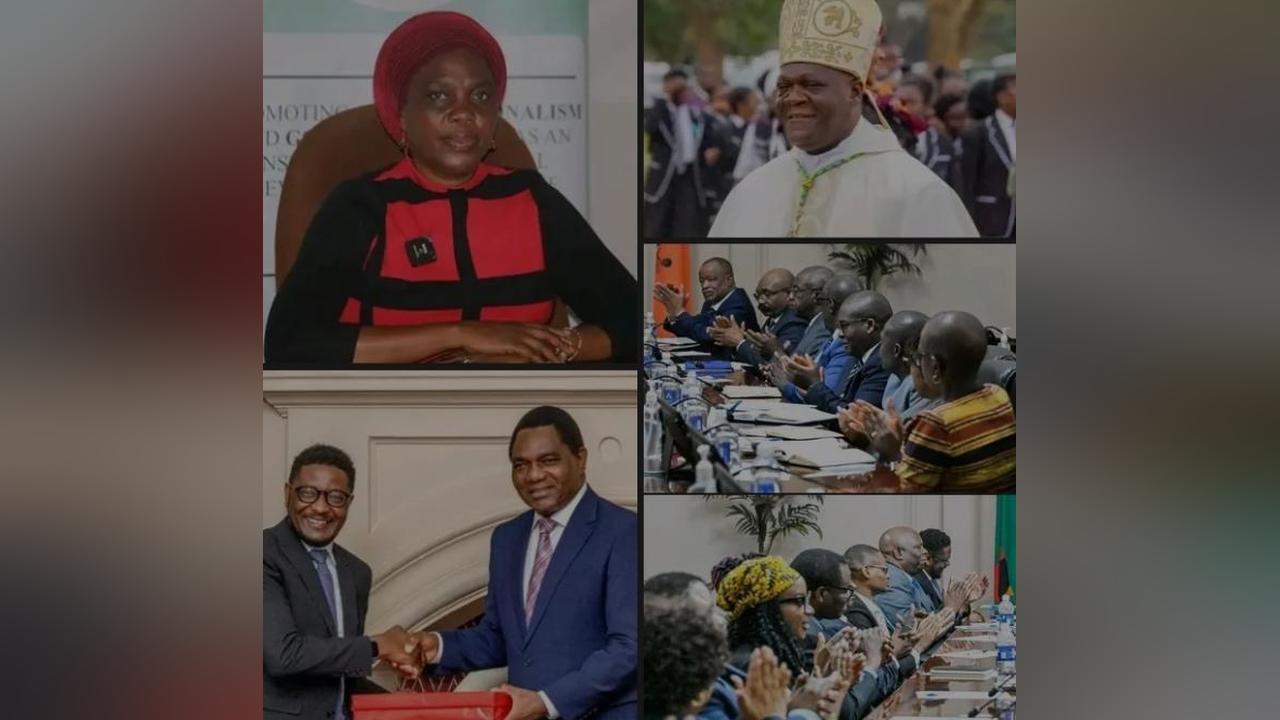
Africa-Press – Zambia. Zambia’s constitutional debate has evolved into a new phase after a day dominated by public submissions at State House, the release of the Technical Committee’s report, and a rising confrontation between national churches, civic bodies and urban elites.
The central question now is no longer whether Bill 7 will reach Parliament. It is whether the political class will secure two thirds support for it.
1. The President signals the next step
Late Monday evening, President Hakainde Hichilema confirmed receipt of the Technical Committee’s report. He described the two month nationwide consultation as “professional” and “disciplined”, adding that the Committee received “11,860 submissions, the highest number ever recorded in any constitutional review effort.”
President Hichilema thanked contributors, stating that their input “reaffirmed our collective commitment to building a better Zambia for all.” His tone signalled intent. The Bill is moving to Parliament.
2. A livestream that shifted the national frame
Unlike Friday’s Oasis Forum engagement, which was held behind closed doors, Monday’s event was broadcast live from State House. For two hours, viewers watched an array of actors defend Bill 7. These included rural and urban CSOs, student bodies, youth groups, civic alliances, traditional leaders, Seventh-day Adventist clergy, Pentecostal pastors and governance NGOs.
Their message was consistent. The reform process was legitimate. Citizens had been consulted. The Technical Committee had done its work. Bill 7 must proceed to the National Assembly.
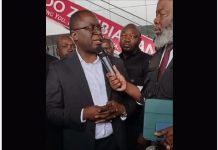
Solomon Ngoma, speaking for a consortium of eight CSOs, told the President:
“There is no civil society organisation that is bigger than another. No church is more Zambian than others. Thousands submitted to this process. Others simply chose not to participate.”
3. Counter-church voices challenge Catholic political dominance
A significant part of Monday’s submissions came from clergy outside the Catholic bloc. SDA leaders, Pentecostal pastors, and rural church networks argued that religious authority cannot rest with one tradition.
One pastor said:
“Some churches behave as if they own the government. But Zambia belongs to all of us. We all have a voice in this process.”
These comments were widely seen as a response to the high profile Catholic-led prayer rally on Friday, where bishops and PF-aligned figures gathered at Pope Square dressed in black.
The imagery revived old prominence controversies about whose moral authority carries weight in national politics.
4. Urban elite vs wider civil society
A recurring theme in Monday’s livestream was the character of the Oasis Forum. Several speakers described it as a “a loud minority,” and an “urban elite group” centred in Lusaka that treats itself as the country’s moral compass.
A women’s rights activist said:
“Lusaka is not Zambia. People submitted from all ten provinces. A loud minority cannot overturn the views of thousands.”
This counter-narrative has angered Friday’s prayer rally participants, many of whom expected the President to halt the process after their visit to State House. Instead, the livestream showcased organised support for Bill 7 from constituencies that rarely appear in elite debates.
5. The Oasis Forum’s letter escalates the standoff
On Sunday, Oasis Forum released a detailed statement declaring that “dialogue has failed” and accusing government of continuing “an illegal process.”
Their demands remain unchanged:
1. Withdraw Bill 7 from Parliament
2. Start a fresh process outside the Technical Committee
3. Install an independent legal framework
4. Delink the process from the 2026 elections
They warned that failing to withdraw the Bill “may result in anarchy” and urged Zambians to join a national campaign against the amendment.
Government countered by suspending further meetings, arguing that the Forum “arrived with fixed positions” and “offered no alternatives.”
6. A fractured opposition ecosystem
The anti-Bill 7 coalition is broad but unstable. It includes segments of the Catholic Church, Oasis Forum, parts of PF, and urban activists. But they disagree on strategy:
– Some push for mass protests.
– Some want a court route.
– Some want political confrontation.
– Some want a referendum.
Online, the debate has collapsed into binaries that reduce nuance. Those supporting Bill 7 are supporting everything. Those opposing are opposing everything.
This has hardened positions and simplified a complex legal argument into a tribalised political fight.
7. The numbers question: can Parliament reach two thirds?
The next stage is parliamentary. Even supporters of Bill 7 acknowledge that the outcome is uncertain. The UPND needs a combined two thirds from its MPs including from the opposition and independents. The PF bloc has declared it will vote against the Bill.
Rumours of bribery have circulated online, with claims that some PF MPs were given 3 million kwacha each. These allegations remain unverified and speculative. But they reflect growing mistrust in the legislative process and an attempt by the anti-Bill 7 voices to pre-frame the outcome as compromised.
The historical benchmark looms. Bill 10 failed on the floor. It did not fail in the streets. Many citizens now ask a simple question:
If PF believes the Bill will fall, why resist parliamentary debate?
8. Why the delimitation panic?
A central claim by academic Sishuwa Sishuwa is that delimitation is a tool for internal party management and future political engineering.
But he frames this argument without releasing evidence, stating only that he has “seen the report.”
He argues that constituencies will be divided to favour UPND strongholds. His language, heavily interpretive and speculative, has been embraced by PF supporters as validation of their fears.
Yet the public record shows that delimitation recommendations were produced under the Lungu regime. This makes the political motivation harder to establish.
A sitting president cannot add new voters to a constituency. A split constituency still votes the same number of citizens.
The claim that new borders automatically guarantee victory remains unproven.
9. The bigger question: who speaks for the people?
Monday’s livestream forced a national conversation. Does civil society authority rest only with Oasis Forum? Do church statements represent all believers? Does participation by 11,860 citizens outweigh the absence of others? Is legitimacy earned by numbers, institutions or public visibility?
The submissions reflect a country wrestling with competing voices of moral authority.
10. Where Zambia stands now
Bill 7 will move to Parliament. Oasis Forum will escalate its campaign. Church blocs will continue pulling in different directions. Opposition parties will treat the Bill as a mobilisation tool ahead of 2026. Government will frame the process as people-driven and constitutional.
The next decisive moment will not be on the streets or in prayer rallies. It will be on the parliamentary floor where a two thirds majority either holds or collapses.
Zambia is now entering the phase where political messaging meets constitutional arithmetic. Thank you for reading this Explainer. Our aims remains to keep you informed. Stay with us!
© The People’s Brief | Gathering —Mwape Nthegwa; Drafting —Francine Lilu; Analysis —Ollus R. Ndomu
For More News And Analysis About Zambia Follow Africa-Press