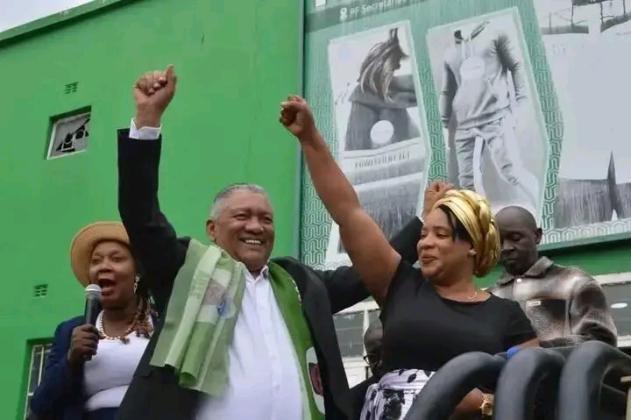
Africa-Press – Zambia. The High Court’s refusal to overturn the acquittal of Given Lubinda should have settled one narrow question only: whether the State proved its case. Three judges found that it did not. Full stop. But in Zambia’s polarised politics, even judicial outcomes are no longer legal facts. They are partisan trophies. Today, the PF base celebrates the Lubinda ruling as proof that the courts are independent.
Yesterday, the same base framed the jailing of other PF figures as evidence of a judiciary captured by Hakainde Hichilema. The contradiction is no longer subtle. It is now structural.
The State failed to prove that Lubinda’s US$280,000 and the Kingsland City house were proceeds of crime. The trial court said so. The High Court agreed. That is how the rule of law works. Yet the political reaction tells a darker story. Miles Sampa instantly cast the outcome as “victory,” not for due process, but for a wounded political camp. The judiciary is applauded only when it delivers outcomes that flatter one’s preferred narrative. When it convicts, it is captured. When it acquits, it is suddenly free.
This selective faith in institutions is one of the most corrosive habits in our public life.
More revealing is what this moment does to the broader argument around politically exposed persons and criminal liability. In Zambia, many politicians still behave as if the criminal justice system is for ordinary citizens, not for them. When one of their own is convicted, illness follows. Sympathy campaigns follow. Prison visits become political stages. Promises of “freedom when we return to power” are issued casually, as though judicial sentences are temporary political inconveniences.
The message is never subtle. Jail is negotiable. Law is partisan. Power is the real appeal court.
This is exactly why the Lubinda acquittal matters in a deeper way. Not because it exonerates or condemns anyone morally, but because it demonstrates that courts can dismiss weak prosecutions even when the accused is politically toxic. That is not evidence of capture. That is evidence of judicial discretion. The same system that acquits also convicts when evidence meets the threshold.
You cannot legally discredit a court for one outcome and canonise it for another without sliding into intellectual dishonesty.
There is also an uncomfortable silence within the PF base on violence as a political tool. For years, violence was rationalised as mobilisation. Even now, when PF figures face convictions linked to electoral violence, the dominant reflex is not introspection but grievance. However, the burnt Mahindra vehicle that triggered the Chitotela case belonged to UPND. This fact is not in dispute.
What is in dispute is whether some actors in our politics are prepared to accept that crime remains crime even when committed in party colours.
What we are seeing is not merely legal controversy. It is a contest over moral territory. The PF base wants rehabilitation without accountability. It wants release without reckoning. It wants acquittals to validate innocence and convictions to confirm persecution. That framework empties the justice system of meaning. It transforms courts into extensions of political warfare rather than arbiters of fact.
The Lubinda ruling, ironically, strengthens the case that the judiciary is not operating under executive choreography. If the courts were truly captured, politically convenient acquittals would be the rule, not the exception. Yet multiple PF figures remain convicted. Others remain on trial. Some are acquitted. Some lose on appeal. That uneven pattern is precisely what independence looks like in practice. It is messy.
It is unsatisfying to extremists. It frustrates propaganda from all sides.
Zambia now stands at a dangerous rhetorical cliff. If every conviction is labelled witch-hunt and every acquittal is declared liberation, then law itself dissolves into political theatre. The country cannot build accountability on applause lines. Either the courts matter consistently, or they do not matter at all.
There is no sustainable middle ground.
The Lubinda acquittal should not be weaponised as proof of virtue, just as other convictions should not be dismissed as proof of vendetta. If we want a mature republic, we must learn to lose and win in court with the same discipline.
Anything else is not politics. It is institutional sabotage dressed as loyalty.
© The People’s Brief | Ollus R. Ndomu
For More News And Analysis About Zambia Follow Africa-Press