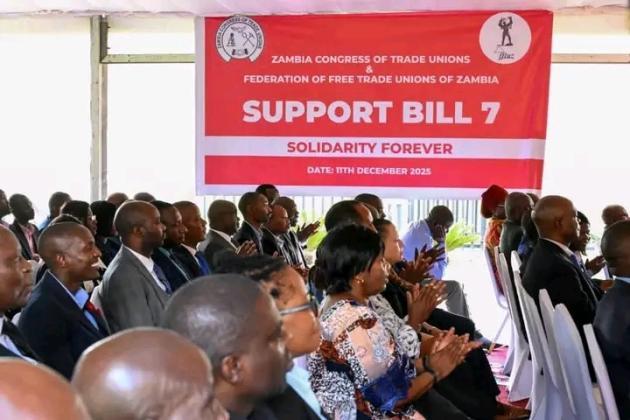
Africa-Press – Zambia. The recent conduct of the Zambia Congress of Trade Unions (ZCTU) at State House is not merely disappointing; it is profoundly dangerous to the integrity of the labour movement and to Zambia’s democratic culture.
By openly endorsing Bill 7 and issuing threats to Members of Parliament who may oppose it, the ZCTU leadership has committed a serious and avoidable error. They have chosen proximity to power over fidelity to workers.
This behaviour deserves outright condemnation.
Trade unions are not extensions of the executive. They are meant to be independent centres of worker power, organised to defend and promote workers’ interests, challenge and restrain anti worker reactionary government and corporate excesses wherever they arise. When union leaders begin to campaign for controversial reactionary government and anti worker positions, they cross a red line. They stop being representatives of workers and become reactionary political functionaries. That transformation is fatal to the credibility of organised labour.
The context makes this mistake even more glaring. Zambia is currently enjoying one of the strongest commodity price environments in decades, with copper prices exceeding $11,000 per tonne. Yet workers remain overtaxed, wages are stagnant, and the cost of living continues to rise. Mining corporations still benefit from favourable arrangements, while ordinary citizens should shoulder the heaviest burden through PAYE and indirect taxes. Any serious labour leadership would have used access to State House to demand economic justice for workers, not to praise a divisive constitutional amendment.
Equally troubling is the silence on urgent labour and social crises. Over a thousand volunteer doctors remain unemployed despite repeated promises from the government. Public service workers are stretched, demoralised, and underpaid. These are real, lived struggles of working people. That ZCTU leadership chose to ignore these issues while defending Bill 7 speaks volumes about how far it has drifted from its core mandate.
Let us be honest. The UPND government, like many neoliberal administrations, understands the value of neutralising potential opposition. Access, resources, and financial inducements are used to tame weak MPs, opportunistic political figures, and now, regrettably, sections of the labour movement. But such tactics never endure. Loyalty bought with money and privilege is temporary. When economic pressures deepen and political fortunes change, those who traded principles for favour are discarded without ceremony.
By aligning itself with reactionary executive power, the ZCTU has misjudged both history and the mood of the working class. Workers do not want unions that threaten MPs on behalf of an anti worker and pro transnational corporation president. They want unions that defend democratic accountability, protect wages, fight the exploitation and humiliation of workers, and speak truth to power without fear or favour. Any union that abandons this role forfeits its moral authority.
I want to be very clear. When the Socialist Party forms the government next year, we will respect the independence of the labour movement and do everything possible to strengthen them and their protection of workers. We will not seek to buy unions, silence them, or turn them into praise singers. On the contrary, we will welcome criticism from organised labour in defence of the interests of the workers because a strong, independent, and militant union movement is essential to a just, fair, humane, and democratic society. Governments that fear unions fear the people.
Zambia’s future cannot be built on co-option, intimidation, humiliation, or manufactured consensus. It must be built on accountability, social justice, and respect for institutions of the people to perform their proper roles. The ZCTU leadership still has an opportunity to correct this dangerous course, but the warning could not be clearer.
When trade union leaders betray workers, the consequences primarily involve the erosion of trust and unity, leading to a significant loss of bargaining power and tangible negative impacts on wages and working conditions.
Workers become disillusioned and cynical about their representation, leading to a profound loss of trust in union leadership and the union movement as a whole. Disunity among the rank-and-file, often coupled with a perception that leaders are “close to management” or politically compromised, significantly weakens the union’s ability to negotiate effectively for better pay, benefits, and conditions.
When leaders prioritize political affiliations over workers’ interests, the union can become a tool for political gain rather than an independent voice for labour rights.
Ultimately, the primary purpose of a trade union—to protect and advance the interests of its members—is defeated when leaders are compromised. This can result in workers feeling they are at the periphery of the agency relationship rather than at its heart.
Workers are watching. History is watching. And neither is kind to institutions that forget why they exist. To betray the suffering and struggling workers of Zambia is to betray Christ.
Fred M’membe
For More News And Analysis About Zambia Follow Africa-Press