

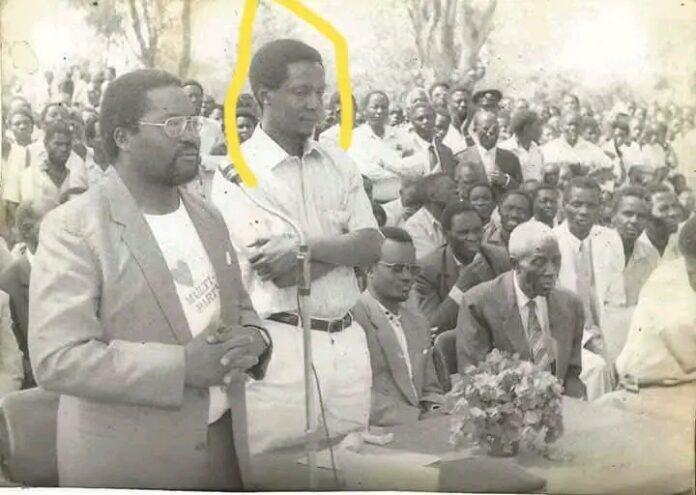
BALDWIN NKUMBULA JR: THE DEATH THAT CLEARED THE ROAD TO THE 1996 ELECTIONS
INTRODUCTION: A DEATH THAT CAME AT THE WRONG TIME FOR DEMOCRACY
Baldwin Nkumbula Jr did not die in a political vacuum. He died on the eve of a critical national moment. Zambia was moving toward the 1996 general elections, elections that would test the credibility of its young multiparty democracy and determine whether the ruling elite would face serious challenge or enjoy unchecked continuity.
His death in August 1995 came not years before that contest, but just months ahead of the political mobilisation phase. It removed from the landscape a credible opposition figure at precisely the moment when opposition unity, legitimacy, and historical symbolism mattered most.
Timing in politics is never neutral. And in this case, timing was devastatingly convenient.
THE MAN, THE NAME, AND THE ELECTORAL THREAT
Baldwin Nkumbula Jr was the elected Member of Parliament for Bweengwa, and the son of Harry Mwaanga Nkumbula, a name that still resonated deeply across Southern Province and beyond. In electoral terms, that lineage was not decorative. It was powerful.
He had joined the Movement for Multi-Party Democracy before the 1991 elections, making him part of the founding coalition that swept UNIP out of power. His later resignation from government over corruption allegations, and his emergence as president of the National Party, gave him a rare political profile: liberation legitimacy combined with reformist credibility.
As Zambia moved toward the 1996 elections, such a figure was dangerous to a ruling party increasingly accused of authoritarian drift. Nkumbula represented continuity with nationalist history without submission to the ruling elite. He embodied an alternative political future at a moment when the electorate was becoming restless.
THE JOURNEY THAT ENDED A CAMPAIGN BEFORE IT BEGAN
On 27 August 1995, Nkumbula Jr was driving a Mercedes on the Kitwe–Ndola road when the vehicle overturned. He died. The men who survived were not politically neutral companions.
One was Castro Chiluba, son of President Frederick Chiluba, a man whose political future was directly tied to the outcome of the upcoming 1996 elections. Another was Mubanga Kafuti, a cousin of President Chiluba. Overseeing national security at the time was BY Mwila, Minister of Defence, a political appointee and uncle to the president.
Thus, when Nkumbula died, he did so in the presence — and under the shadow — of presidential bloodlines, at a time when the ruling establishment was preparing to defend power at the ballot box.
That context cannot be dismissed as coincidence.
THE OFFICIAL STORY AND THE SPEED OF CONVENIENCE
The government declared Nkumbula’s death a road accident. A Commission of Inquiry appointed by the executive endorsed that conclusion. There was no independent judicial inquest. No publicly released autopsy. No forensic transparency.
The matter was closed with a speed that contrasted sharply with the gravity of the loss. The state did not behave like an institution searching for truth. It behaved like an institution managing risk.
As the country edged closer to the 1996 elections, one potentially destabilising question was efficiently removed from the agenda.
THE COUSIN WHO SPOKE AND THE ELECTION THAT SILENCED HIM
Mubanga Kafuti later alleged that Nkumbula Jr was killed by agents linked to State House. This allegation was acknowledged by international human rights organisations. Yet no serious criminal investigation followed.
Instead, Zambia entered an intense election period. Political energy shifted. Institutions closed ranks. The allegation became an inconvenience in a year when stability — or the appearance of it — was prioritised over accountability.
The 1996 elections came and went. Nkumbula did not.
THE ABSENCE OF FORENSIC TRUTH IN AN ELECTION YEAR
Election years expose the true character of institutions. In Nkumbula’s case, the absence of a publicly accessible autopsy and independent forensic inquiry was not merely an investigative failure; it was a political decision.
Accidental deaths do not threaten elections. Political scandals do. Transparency creates uncertainty. Silence creates control.
By denying the public forensic clarity, the state insulated itself from destabilising questions at a critical electoral moment. That choice permanently damaged public trust.
THE OPPOSITION THAT NEVER RECOVERED
Nkumbula’s death weakened opposition coherence ahead of the 1996 elections. His party lost momentum. His symbolic weight vanished. His ability to mobilise voters rooted in liberation history was extinguished.
Whether by design or consequence, the removal of Nkumbula Jr reshaped the political terrain. The ruling party entered the elections facing fewer credible threats, while questions surrounding his death remained unresolved and politically radioactive.
This is how political outcomes are shaped without a single ballot being cast.
ACCIDENT, POLITICS, AND THE COST OF CONVENIENCE
The state insists Nkumbula’s death was accidental. History insists the investigation was inadequate. The timing insists on scrutiny.
When an opposition leader dies under disputed circumstances less than a year before national elections, and the state responds with secrecy rather than openness, suspicion is not paranoia. It is rational.
Democracy does not collapse only through coups. Sometimes it erodes quietly, through unanswered questions and politically convenient silence.
CONCLUSION: A DEATH THAT SHAPED AN ELECTION WITHOUT A VOTE
Baldwin Nkumbula Jr, MP for Bweengwa, son of Harry Mwaanga Nkumbula, early MMD member turned opposition leader, died in August 1995. Zambia went to the polls in 1996 without him.
The state says his death was an accident. The political timeline says his absence mattered. The investigation says nothing, because it never truly spoke.
In the end, Nkumbula did not just die before an election. His death altered the election itself — by removing a voice, weakening opposition, and demonstrating how power protects itself when accountability becomes inconvenient.
That is not conspiracy. That is political reality.
And it remains one of Zambia’s unresolved democratic scars.
#tztpost 🇿🇲