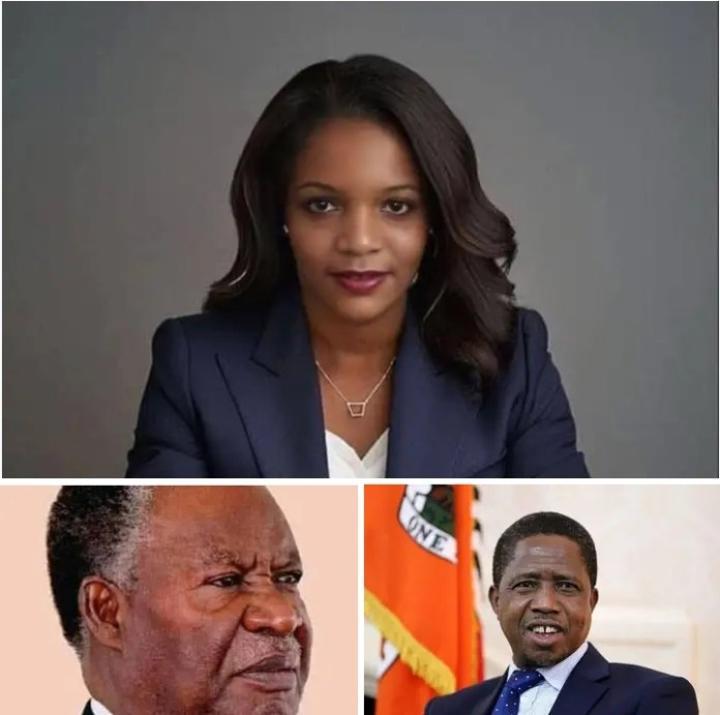
By Linda Banks
Africa-Press – Zambia. The Fall of the Patriotic Front and the Crisis of Opposition Politics in Zambia
By Linda Banks
The Patriotic Front, once Zambia’s most formidable political force and a vehicle of hope for millions, now stands at the edge of political irrelevance. This was the party that carried Michael Sata’s populist fire and later governed under Edgar Lungu. Today, it is fractured, confused, and struggling to speak with one voice.
So begs the question, What went wrong? Why did a party so deeply embedded in Zambia’s political consciousness unravel so quickly after losing power in 2021? And what does its decline tell us about the wider state of opposition politics, the conduct of the ruling United Party for National Development (UPND), and the future of Zambia’s democracy as the country edges toward 2026?
Answering these questions requires more than recounting events. It demands an honest examination of leadership culture, institutional weakness, and political behaviour.
A Party Without a North Star
The Patriotic Front’s crisis is not cosmetic,It is existential. After its defeat, the party failed to pause, reflect, and redefine itself. Instead of rebuilding institutions, clarifying ideology, and renewing leadership, it slid into factional warfare.
Internal voices have openly acknowledged the loss of structure, unity, and discipline. Rival centres of authority emerged. Press statements contradicted one another. Courtrooms replaced conferences, personality politics overwhelmed policy thinking.
This is a predictable outcome when a party relies too heavily on charismatic authority rather than strong institutions, across Africa, many organisations are often caught in the act of ignoring grooming successors. Movements built around individuals, struggle when leadership transitions arrives. When the glue disappears, coherence collapses.
The electorate has noticed. And it is asking a simple question: can a party that cannot govern itself be trusted to govern a nation?
Leadership Vacuum and the Weight of Legacy
The death of Edgar Lungu was a moment of national reflection, but for the PF it reopened unresolved fractures. Without a clear succession framework, ambition filled the vacuum. Parallel structures appeared, legal manoeuvres replaced political consensus.
Where institutional succession is weak, factionalism thrives. Where factionalism thrives, credibility erodes. Defections followed, supporters drifted. Elected figures crossed the floor, not always out of conviction, but often out of survival.
The canoeists (PF)did not merely lose power, It lost its boat, it lost gravity.
The Ruling Party and the Opposition Dilemma
How much responsibility does the UPND bear for this decline? PF figures have accused the ruling party of using state machinery to restrict opposition activity, citing limited political space and legal constraints.
From a strategic standpoint, incumbency always carries advantage. Yet it would be dishonest to place the PF’s collapse solely at the feet of the ruling party. A weak house is easy to shake. Internal disorder creates opportunities that political opponents inevitably exploit.
At the same time, President Hakainde Hichilema’s government has not been spared public scrutiny. While debt restructuring and renewed international engagement have attracted praise, many Zambians continue to feel the weight of unmet expectations. The cost of living remains high, perceptions of official arrogance persist, public patience is wearing thin, and a growing segment of the electorate is openly questioning the UPND’s hold on power.This has led to the UPND today resembling a wounded buffalo, still powerful, still dangerous, but limping under the pressure of expectation.
Many Parties, No Compass
Beyond the PF, Zambia’s opposition landscape is crowded but unfocused. Multiple parties compete for attention, yet none commands enough national appeal to challenge incumbency alone.
African political history is instructive. Divided opposition rarely wins. Kenya, Nigeria, and South Africa all offer lessons in how fragmentation hands victory to ruling parties.
Zambians see the same pattern repeating. Endless alliance negotiations. Public quarrels, collapsing coalitions. These disputes are often presented as ideological differences. In truth, they signal weak leadership and, too often, naked greed.
Who leads. Who controls the ticket. Who benefits.
The public understands this instinctively, If politicians cannot manage their ambitions in opposition, how will they manage state power?
Nyuu Under the Microscope
Into this space steps a powerful slogan, Nyuu. New leaders, New ideas. A new political culture.It resonates because Zambians are tired ,tired of recycled faces, tired of disappointment, tired of being asked to trust the same hands that once dropped the ball. But slogans invite scrutiny.
Is Nyuu truly new, or is it old politics dressed in fresh language?
Look closely at those leading the charge, are they genuinely fresh political minds, or familiar figures repackaged for another season? Some of the loudest advocates for renewal are individuals who once stood close to power, defended excesses, and normalised arrogance.
Zambians did not reject a government only because of debt or economics, they rejected arrogant attitudes. Leaders who stopped listening, stopped respecting the people, and confused entitlement with leadership. So the question must be asked, have the lessons truly been learned?
Campaign Managers/Bloggers and Political Judgment
Opposition leaders must ask themselves an uncomfortable question, are we choosing strategists who broaden our appeal, or gatekeepers who sabotage it? Leadership is judged not only by the candidate, but by the company they keep. Campaign managers are mirrors. They reflect judgment, values, and political maturity.
Across democracies, elections are lost not because candidates lack ideas, but because their inner circles repel undecided voters. Campaign managers known for insults, abrasive language, and public baggage do not build coalitions. They shrink them.
You cannot insult your way to State House.
You cannot bully your way into credibility,
You cannot promise unity while thriving on division.
From Critique to Construction
If the opposition is serious about offering Zambia an alternative, Nyuu must become a discipline, not a chant.
Renewal must be visible, those whose public image is tied to past failures should step back into advisory roles. Experience matters, but dominance does damage.
Opposition parties must agree on a transparent and credible method for selecting a single presidential candidate,the process matters as much as the person. Trust begins with how choices are made.
Campaign teams must be rebuilt around competence, restraint, and public credibility. Language matters. Tone matters. Respect matters.
Above all, the opposition must remember this truth: power is not seized, it is entrusted. And Zambians will not entrust their future to movements that look like yesterday arguing with itself.
In conclusion, the fall of the Patriotic Front is not merely the story of one party. It is a warning about institutional weakness, ego over ideology, and the political cost of arrogance.
The UPND, though dominant today, is not invincible. But incumbency will not be dislodged by noise, confusion, or recycled politics.
Zambia stands at a crossroads. Will opposition leaders choose unity over ego, strategy over spectacle, renewal over recycling?
Nyuu is still possible.
But it must be demonstrated, not declared.
The people are watching.
The window is narrowing.
And history is unforgiving to those who mistake ambition for leadership.
Linda Banks is a Journalist covering politics, justice, social issues and international affairs across Africa and the UK.
Source: The Zambian Observer – The Zambian Observer
For More News And Analysis About Zambia Follow Africa-Press