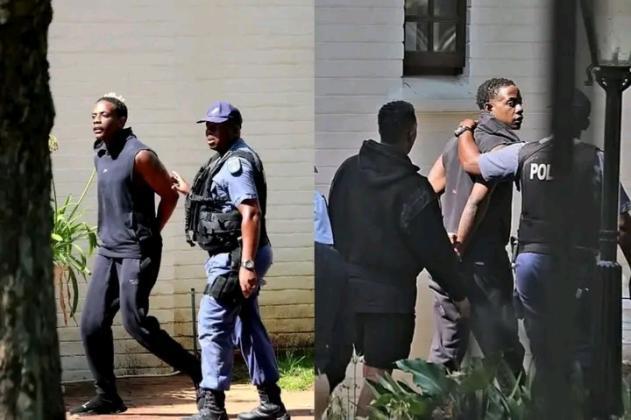
Africa-Press – Zambia. An alleged firearm discharge involving Bellarmine Chatunga Mugabe in South Africa has triggered public debate, political commentary and intense online speculation. Yet beyond the noise lies a narrower and far more technical inquiry, one that will ultimately determine the trajectory of any legal process: what does the forensic evidence reveal?
In firearm-related incidents, public perception often forms rapidly. Scientific determination does not. Investigators must move deliberately through a chain of evidence that begins at the scene and ends, if necessary, in a courtroom. The core question is neither political nor social. It is evidential. Who discharged the weapon?
Scene Control and Evidence Preservation
The evidential strength of any firearm case is shaped within the first hours. Scene management is critical. Cartridge cases, potential bullet fragments, impact sites and the firearm itself, if recovered, must be secured, photographed and logged before contamination occurs.
Every individual who enters the scene becomes part of the evidential matrix. Improper handling of the weapon, movement of spent cartridges or delayed forensic attendance can complicate later reconstruction. In cases attracting media and public scrutiny, adherence to strict chain-of-custody protocols becomes particularly important, as defence teams often challenge procedural integrity before addressing substantive evidence.
Gunshot Residue: The Microscopic Indicator
One of the most significant forensic indicators in firearm investigations is gunshot residue, commonly known as GSR. When a firearm is discharged, a cloud of microscopic particles is expelled from the breech and muzzle. These particles typically contain lead, barium and antimony and may settle on the hands, sleeves and torso of the shooter, as well as nearby surfaces.
In assessing such evidence, forensic scientists do not merely ask whether residue is present. They evaluate distribution patterns, particle morphology and concentration levels. A high density of characteristic particles on the webbing of the thumb and index finger may carry different interpretive weight than isolated particles on clothing.
Timing is also decisive. GSR can diminish rapidly through normal activity such as washing, friction or environmental exposure. Conversely, secondary transfer is possible through close contact with a shooter or contaminated surface. The presence of residue, therefore, does not automatically confirm discharge, and its absence does not automatically exclude it. Interpretation requires contextual alignment with other evidential findings.
Ballistic Examination: Linking Weapon to Discharge
If a firearm has been recovered, ballistic analysis becomes central. Every firearm leaves unique microscopic markings on cartridge cases and bullets when discharged. These markings are produced by the firing pin, breech face, extractor and rifling inside the barrel.
Laboratory test fires allow forensic examiners to compare these microscopic signatures with recovered evidence. A conclusive match can establish that a particular weapon was used in the incident. However, ballistic comparison identifies the firearm, not the individual who fired it. That distinction remains critical.
Trajectory and Spatial Reconstruction
Beyond matching weapon to projectile, investigators examine the geometry of the event. Trajectory analysis reconstructs the angle and direction of fire. Using laser rods, string alignment or three-dimensional modelling, forensic teams determine shooter position, height and orientation at the time of discharge.
If allegations suggest firing into the air, trajectory evidence may reveal vertical patterns. If horizontal trajectories are identified, the question of endangerment becomes more significant. Distance determination may also be possible through examination of powder deposition patterns on impacted surfaces.
Such reconstruction transforms a static scene into a dynamic sequence of movement and positioning.
Fingerprints, DNA and Handling Evidence
Latent fingerprint analysis may establish whether an individual handled the firearm or associated components. Recovery of ridge detail from the trigger, grip or magazine can confirm contact.
Touch DNA sampling from high-contact areas may further strengthen evidential inference. However, forensic practitioners caution that handling does not equate to firing. Shared access to a weapon introduces interpretive complexity. Exclusivity of contact strengthens the evidential chain.
Digital Corroboration and Multimedia Authentication
Modern investigations rarely rely solely on physical evidence. Mobile phone footage, surveillance recordings and metadata often provide additional layers of corroboration.
Forensic video analysts examine footage for signs of editing, compression artefacts or time discrepancies. Acoustic analysis can estimate the number of shots and sequence timing. Digital evidence, when properly authenticated, can either reinforce or contradict physical findings.
Legal Threshold Under South African Law
Under South African criminal law, unlawful discharge of a firearm requires proof beyond reasonable doubt. Prosecutors must demonstrate not only that a weapon was fired but also that the accused individual discharged it and that the act was unlawful or negligent.
In cases involving prominent individuals such as Bellarmine Chatunga Mugabe, investigative procedures are likely to face heightened scrutiny. Defence counsel typically examine collection methods, laboratory protocols and expert interpretation in detail. Even minor procedural inconsistencies can become focal points in court.
Awaiting Verified Findings
At the time of publication, no official forensic conclusions have been publicly released. Until laboratory results and investigative findings are formally disclosed, assertions remain speculative.
Forensic science operates independently of public sentiment. It relies on microscopic particles, ballistic striations, spatial reconstruction and legally admissible interpretation. In firearm investigations, conclusions emerge from convergence. Residue patterns, ballistic matches, trajectory analysis, handling evidence and digital corroboration must align coherently.
As this matter develops, one question continues to anchor the investigation: who discharged the firearm?
The answer, if established, will rest not on commentary or conjecture, but on measurable, verifiable scientific evidence.
Shepard Yuda is a specialist in forensic analysis and criminal justice reporting.
For More News And Analysis About Zambia Follow Africa-Press