By zambianobserver
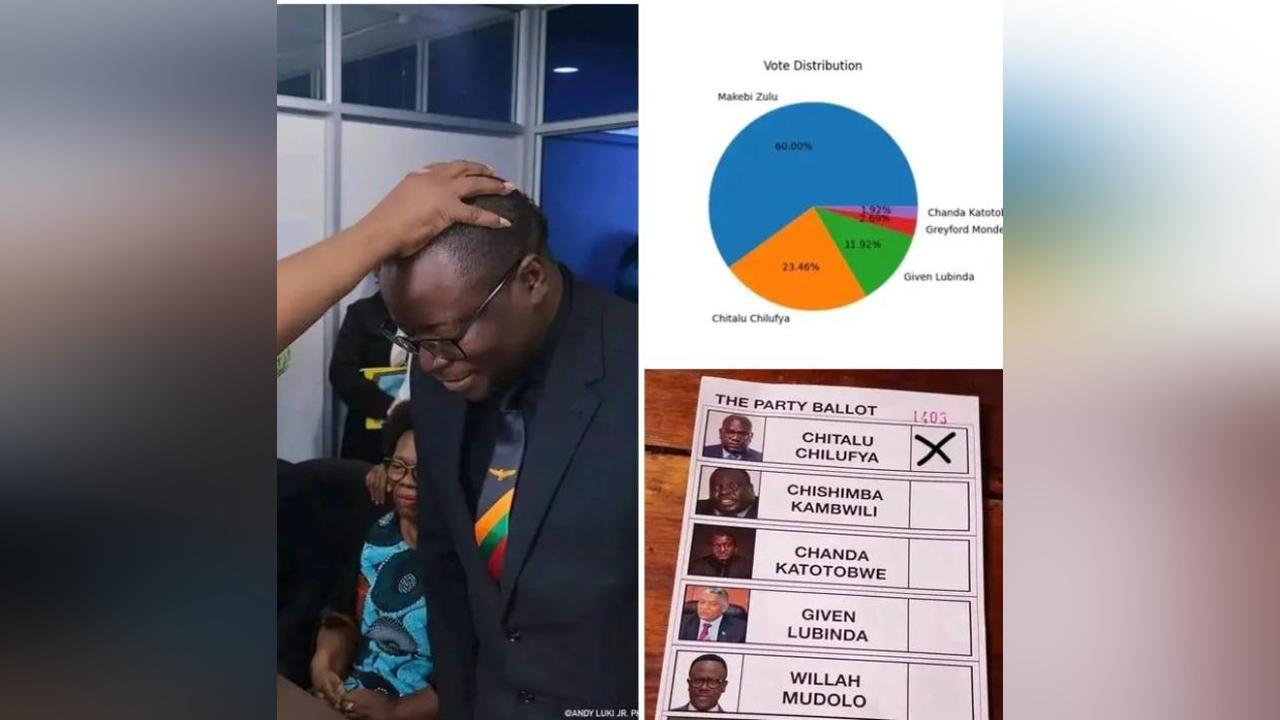
Africa-Press – Zambia. If the social media results hold, Makebi Zulu has emerged as the new political centre of gravity inside the Given Lubinda camp of the Patriotic Front. The reported numbers circulating online suggest a commanding win, with Makebi said to have polled about 60 percent, ahead of Chitalu Chilufya on 23.46 percent and Given Lubinda on 11.92 percent. But politics is rarely settled by numbers alone, especially in PF. Within PF, victory is only the first round. Legitimacy is the second. Survival is the third.
What makes this moment unusual is not only the reported outcome, but the silence around it. No major losing candidate had publicly conceded at the time these results spread online. That matters. In a normal party, defeat produces a statement, a protest, or a handshake. In PF, silence usually means calculations are still underway. The old guard appears unsettled. Supporters of Lubinda and Chishimba Kambwili are already signalling discomfort. This means Makebi may have won the ballot, but he has not yet won the room.
The deeper issue is that PF has been living inside parallel realities for months. One camp says the party is back. Another cites court orders. A third leans on Registrar of Societies records. A fourth insists the real contest is still pending. This confusion did not begin yesterday.
Earlier this year, the Kabwe High Court granted an injunction restraining the Lubinda-led faction from acting in the name of the party and from convening its planned convention, after the Robert Chabinga-aligned side argued it was the lawful structure. The injunction deepened uncertainty over whether any elective gathering outside that legal framework would survive scrutiny.
Then there is Miles Sampa, who has now publicly distanced himself from the reported convention, saying: “I am not part of the elective general conference. I am waiting for the court judgment on March 27.” His position is politically important. Sampa is no longer the undisputed force he once tried to be, but he still sits inside the legal architecture of the PF dispute.
The moment Sampa says he is waiting for court, he is effectively saying the political process alone cannot settle the matter. That pushes the whole Makebi outcome back into the shadow of litigation.
This is why the reported Makebi victory must be read carefully. On one level, it is a generational statement. He appears to have defeated not just Lubinda, but a field of old PF names including Chitalu Chilufya, Grayford Monde, Chishimba Kambwili, and Chanda Katotobwe. This would suggest ordinary delegates, or those present at the gathering, wanted a fresher face over the familiar hierarchy.
It also suggests the Edgar Lungu emotional current still has electoral weight inside PF, because Makebi has built much of his political profile around defending Lungu’s legacy and framing himself as a harder political inheritor of that cause.
But a party election is not the same as national mobilization. Makebi’s challenge begins now. He must unify three categories of people who do not naturally trust one another: the Lubinda structure, which has just been defeated; the regional heavyweights, especially from PF’s old strongholds who will demand relevance; and the factional survivors orbiting court cases, parallel offices and rival alliances
If he fails to consolidate those blocs quickly, PF will simply produce another president with no full party.
The regional arithmetic also matters. PF’s old political engine has historically drawn strength from Eastern, Northern, Muchinga and Luapula. But those provinces are no longer politically frozen. UPND has been testing ground in areas once assumed to belong to PF by history. The northern circuit is not sealed.
Eastern is fluid. Luapula is restless and volatile. So even if Makebi consolidates the internal PF vote, he still has to rebuild confidence in regions where the party’s support has fragmented across Tonse, Pamodzi, Chabinga’s structure and smaller opposition players.
And this is where the timing becomes brutal. Zambia is already in late March. Parliament dissolves in May. That means candidate adoption fights, court rulings, alliance talks and campaign positioning will now collide almost at once. PF does not have the luxury of a long healing season. It needs clarity quickly.
A disputed winner, a silent loser, an unresolved court fight and multiple factions are not ingredients of electoral recovery. They are ingredients of further paralysis.
So what comes next? Three possibilities stand out. First, the old guard could swallow the result and line up behind Makebi for survival. Second, they could refuse to legitimise the process, leaving him with a paper victory and a fractured structure. Third, the courts could intervene in a way that reopens the entire question of who had authority to convene and elect in the first place.
In PF history, the third outcome can never be ruled out.
The most likely projection is this: Makebi’s reported win has not ended PF’s crisis. It has merely changed the face of it. The party may now have a new political symbol, but it still lacks a universally accepted centre. In plain terms, PF may have elected a president before settling the argument about which PF was voting.
This is why the real headline is not simply that Makebi won.
It is that PF remains PF: a party forever one convention away from another faction.
The People’s Brief is a reader-built publication. Follow us for verified reporting, share our stories, and contribute your analysis or commentary by writing to us at [email protected].
Source: The Zambian Observer – The Zambian Observer
For More News And Analysis About Zambia Follow Africa-Press