
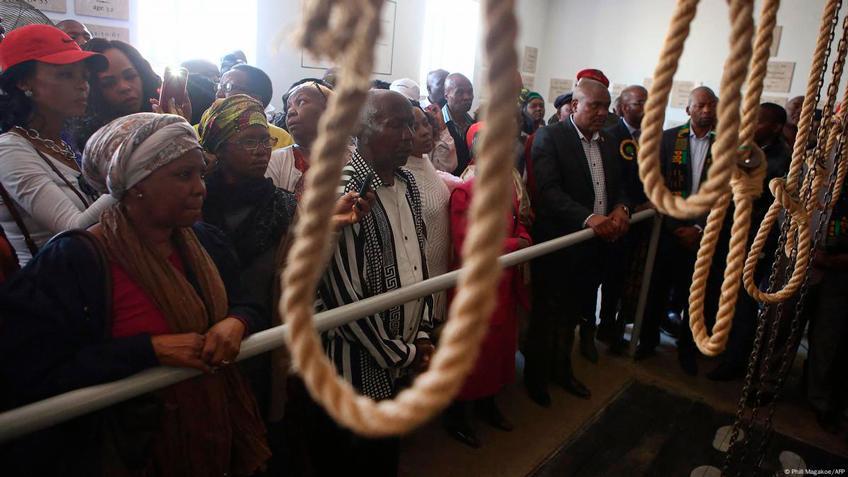
Africa-Press – Zimbabwe. Zimbabwe officially abolished the death penalty on Wednesday after President Emmerson Mnangagwa ratified a law that commuted the death sentences of around 60 inmates to prison sentences.
A moratorium on executions had been in place in the country since 2005, but courts continued to impose the death penalty for crimes such as murder, treason and terrorism.
The law on the abolition of the death penalty, published today in the Official Gazette, stipulates that courts can no longer impose the death penalty for any crime and that any existing death sentence be commuted to prison.
However, a provision provides that the abolition can be lifted in the event of a state of emergency.
At least 59 people were on death row in Zimbabwe at the end of 2023, the human rights non-governmental organization (NGO) Amnesty International said in a statement, hailing the abolition as a “historic moment”.
“We urge the authorities to move swiftly towards total abolition […] by removing the clause included in the amendments to the bill that authorises the use of the death penalty in a state of emergency,” the NGO added.
Twenty-four countries in sub-Saharan Africa have abolished the death penalty for all crimes, while two others have abolished it only for ordinary crimes, according to the organisation.
Of the 16 countries that carried out executions in the world in 2023, only one, Somalia, is in sub-Saharan Africa, according to the NGO.
President Emmerson Mnangagwa, who faced the death penalty in the 1960s during the war of independence, approved the abolition law after a bill was passed in Parliament.
The last executions in neighbouring Mozambique were in 2005, when two people were hanged, a punishment included in the penal code of the former Federation of Rhodesia, during the British colonial period, but maintained after independence in 1980.
The death penalty was also abandoned in part because at a certain point no one was willing to take on the role of state executioner.
For Amnesty International, the decision is presented as “a beacon of hope for the abolitionist movement in the region”.
Other African countries, such as Kenya, Liberia and Ghana have recently taken “positive steps” towards abolishing the death penalty, but have not yet enacted it into law, according to the NGO.
Mnangagwa, Zimbabwe’s leader since 2017, has spoken publicly of his opposition to capital punishment and, according to the Associated Press, cited his experience of being sentenced to death – later commuted to 10 years in prison – for blowing up a train during the war of independence from white minority rule.
The head of state has also used presidential amnesties to commute death sentences to life imprisonment.
According to Amnesty International, there were 1,153 known executions worldwide in 2023, up from 883 the previous year, although the number of countries carrying out executions fell from 20 to 16.
Due to a veil of secrecy, the figures do not include those of North Korea, Vietnam and China, which the human rights group described as the “world’s leading executioner”.
Iran and Saudi Arabia were responsible for almost 90% of all executions recorded by Amnesty in 2023, followed by Somalia and the United States of America (USA).
Executions have been suspended in Mozambique’s neighbouring country Zimbabwe since 2005, following the hangings of Stephen Chidhumo and Edgar Masendeke, but the law remains in force.
From 1980 to date, 79 people have been hanged, but no one has been executed in the African country since 2005.
For More News And Analysis About Zimbabwe Follow Africa-Press