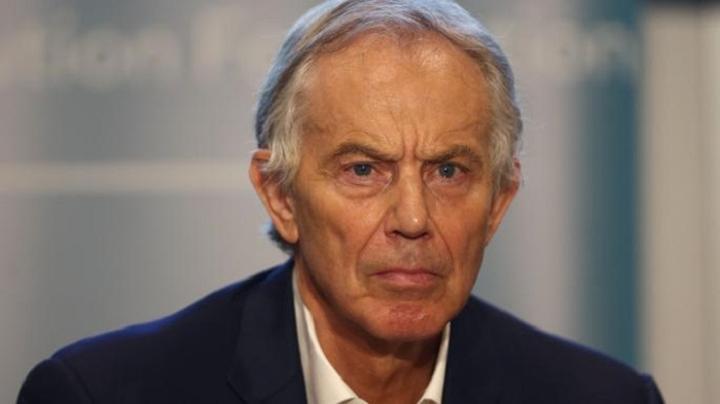
Africa-Press – Zimbabwe. Newly released UK government documents reveal that former Prime Minister Tony Blair’s administration briefly considered military action to remove Zimbabwean President Robert Mugabe, but ultimately dismissed it as “not a serious option.”
The papers, released by the National Archives, show that ahead of Zimbabwe’s 2005 parliamentary elections, the Foreign Office explored various strategies to address Mugabe’s increasingly authoritarian rule, economic collapse, and human rights abuses.
Options under consideration included tougher sanctions, cutting aid, freezing Zimbabwean assets, withdrawing the UK ambassador, and, in the most extreme scenario, doing “to Mugabe what we have just done to Saddam.”
The July 2004 briefing, titled Zimbabwe: Policy Options, was sent to Laurie Lee, a foreign policy adviser in No. 10, following a stark report from Brian Donnelly, the outgoing British ambassador in Harare.
Donnelly warned that British policy had failed to bring democratic change and suggested that, if Mugabe won the 2005 elections, “we should be ready to consider a radical new approach.” However, Donnelly was clear about the limits of action:
“Short of a truly catastrophic breakdown in public order, armed intervention is a nonsense. And even then, it should be an African, not a British-led.”
He also proposed that Blair consider closer engagement with Mugabe, modelling his approach on the Prime Minister’s dealings with Libya’s Colonel Gaddafi. The Foreign Office paper outlined the risks of military action in detail:
“We know from Afghanistan, Iraq and Yugoslavia that changing a government and/or its bad policies is almost impossible from the outside.
“If we really want to change the situation on the ground in Zimbabwe, we have to do to Mugabe what we have just done to Saddam.”
The paper concluded that military action was unworkable: the UK would have to act alone, there was no clear exit strategy, British citizens could be at risk, and African countries and the wider international community would oppose it. Any intervention would also be illegal without a UN resolution.
Instead, the UK was advised to continue isolating Mugabe’s government internationally while quietly supporting the democratic opposition.
In a handwritten note forwarding the paper, Blair largely endorsed this approach, recommending criticism of Mugabe until the elections, with the option to re-engage afterwards.
Mugabe stayed in power until a 2017 military coup at the age of 93 and died in Singapore in 2019, aged 95.
For More News And Analysis About Zimbabwe Follow Africa-Press