Africa-Press – Angola. The Minister of Justice and Human Rights said, Wednesday (20), in Luanda, that the country has an exemplary human rights strategy at the level of Africa and “even the world” in matters of combating trafficking in human beings. .
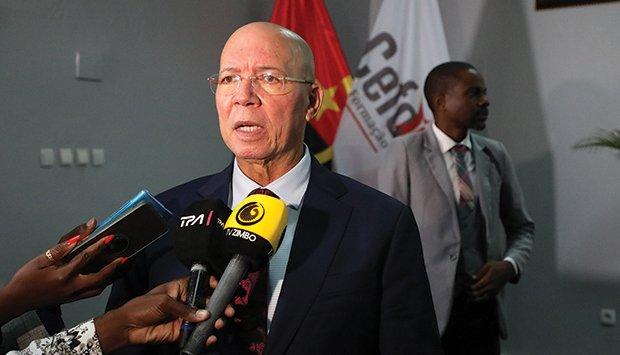
Francisco Queiroz made the statement in reaction to the US State Department’s annual report on Trafficking in Persons, released on Tuesday. The document maintains Angola in the second position of “Tier” (out of four), for the third consecutive year.
Speaking to the press, at the end of the press conference for the presentation of the balance report of the Commission for the Reform of Justice and Law (CRJD), he mentioned that, in this sense, the Government has tightened the siege and the measure has culminated in the reduction of human trafficking in the country.
The report, he said, is the result of the Executive’s commitment, not only in terms of Justice, but also of the commitment to the rights, freedoms and fundamental guarantees of citizens.
Also referring to human trafficking, Francisco Queiroz said that African countries have been the most affected, because of their weaknesses.
However, he welcomed the fact that Angola has a specific program to combat trafficking in human beings. “For the third year in a row, the country has been ranked very highly,” she said, referring to the US State Department report.
Despite the good assessment, he acknowledged that “there are still some concerns”. “We have to be very attentive to the movement of people, especially children, girls and other citizens who are kidnapped for sexual slavery, forced labor and the extraction of human be placed on the international market where there is a lot of money”, he warned.
Regarding the balance of the Report of the Commission for the Reform of Justice and Law, created by Presidential Order nº 72/20, of 26 May, the Minister of Justice and Human Rights said that he had managed to bring the sector closer to the citizens.
Francisco Queiroz said that this was possible through a new legislative mechanism for the organization and functioning of the Supreme Court, the Attorney General’s Office and other instruments.
The also coordinator of the Commission, said that, since its creation, a total of 38 laws have been approved and are practically ready to be approved. Of the total, he said, ten have already been approved, two are in Parliament for approval (Labor and Administrative Process Codes), six are being analyzed by the Council of Ministers, while another ten are already being evaluated by that auxiliary body. of the President of the Republic.
In this legislature, he revealed, three Courts of Appeal (one in Luanda, another in Benguela and the same number in Huíla) and 29 District Courts were also approved and started operating. The latter replaced the provincial ones.
Professor Carlos Feijó, a member of the Commission for the Reform of Justice and Law, said that there is a clear orientation from the Government in order to avoid discrepancies in the remuneration system of judges and prosecutors.
In response to concerns around the same issue, Carlos Feijó said that the idea is to bring as much as possible the remuneration among judges of all courts.
“The issue has already been taken to the Council of Ministers, but there is still no final decision on the remuneration status, either for prosecutors or judges of all categories, because the situation that the country is experiencing required another type of reflection”.
As an example, he said that the Court of Appeal will have a new category of judges: the counselor judges of the Supreme Court, judges and law judges. The central idea, he stressed, is to confer greater dignity on judges and a certain unification in the entire remuneration system for judges.
In this, it is necessary to make a difference because the career regime for bailiffs was approved. This regime must comply with the new remuneration regime.
“We must not confuse the remuneration system of justice officers with the remuneration statute of counselors, judges and the law judges. More than this – and no less important – is the proposal of the remuneration statute not to distance, but to unify the remuneration of judges and prosecutors”, he clarified.
The Commission had a two-year term that ended on 26 May, but was extended for another two months at the request of the members. The term expires at the end of the current month.
For More News And Analysis About Angola Follow Africa-Press