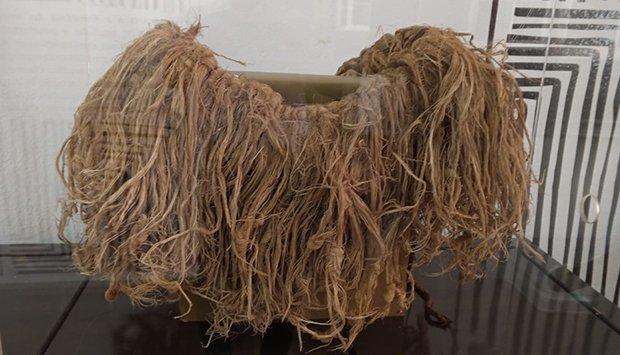
Africa-Press – Angola. The “Mzombo”, with great historical symbolism for the peoples of the eastern region of the country, is the work of the month on display at the National Museum of Anthropology, in Luanda, which marks the reopening of cultural activities and guided tours of the institution.
Speaking to the museum’s director, Álvaro Jorge said that the object is a skirt used after the circumcision ritual of young people from the Nyaneka-humbe and Côkwe ethnic groups.
According to the museum director, the exhibition aims to show society the cultural richness of the museum piece, its value, as an ancient practice and custom. “With the exhibition, we want to encourage young people to know more about the importance of the play in a given socio-cultural context.” The director explained that circumcision is an ancient practice carried out in several continents such as Africa, the Americas and Oceania. Bantu inhabitants in the country, said that the object is also used for the practice of religious cults and other cultural manifestations.
Álvaro Jorge stressed that the piece on display at the museum belongs to the Ngangela ethnolinguistic group. The garment is a skirt made of vegetable fiber worn by young people after the traditional circumcision ritual, while they are in the “mukanda”, a small camp, where they stay for the time the wound will heal.
Álvaro Jorge said that circumcision is a rite of passage for children between the ages of eight and 18. In some cases, he recalled, the act is practiced on newborns in some Nyaneka-humbi groups, as well as on adults who are already married.
Circumcision, he describes, is always carried out during the cacimbo season, in which the Côkwe and Nyaneka-humbi, gather a number of young people and campers, stay away from the village for a period of six months or three years.
He adds that a small knife (tetulia in Côkwe) is used in the operation, and the sounds of drumming are used to “muffle” the cries of pain of teenagers in the act of circumcision, and in this way to avoid arousing the curiosity of the villages.
After cutting the foreskin, the operator gives it to the “Tchilobola” (responsible for the young people), who has the mission of burying it next to a tree, as well as to stop the blood, a mixture of water with medicines made up of oil. palm, ash and a plant to promote healing.
Álvaro Jorge revealed that while they are encamped, the presence of strangers is prevented, especially women, under penalty of suffering great punishment for curiosity.
There, he assures, the circumcised young people are subjected to all kinds of tests, such as learning to fish, hunt and collect edible fruits for survival, thus enduring the cold and heat.
At the end of the learning process, which also involves geographic knowledge of the habitat, physical preparation, moral and psychological knowledge, he says that from now on, they are prepared to return to the community as a man and are welcomed with songs and dances. Tradition says, according to the director, a young person who is not circumcised can have consequences in the future, such as having children with physical disabilities and being discriminated against in society, as they are considered “not pure” people.
For More News And Analysis About Angola Follow Africa-Press