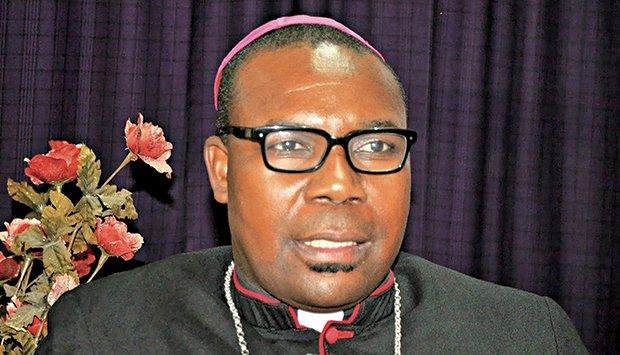
Africa-Press – Angola. Dom Zeferino Zeca Martins admitted, in an interview,that each party wants to serve the Nation in the best possible way. But, he advanced, for this to happen, “it is necessary to educate citizens, form a solid collective conscience, with values such as unity, brotherhood and social cohesion”.
Referring directly to the elections, he underlined, for them to take place, the people must have a light spirit, duly prepared for the final results, accepting that this or that party wins, recognizing the fairness and transparency of the scrutiny. It is this spirit that wards off, the archbishop stressed, “resentment or a tendency to be aggressive”.
What should be the attitude of the citizen during the electoral process?
We want to build a democratic society, where people’s fundamental rights and freedoms, guaranteed in the Constitution of the Republic, appear. This means that we have to get rid of the mentality that preceded the establishment of democracy in the country, linked to a period marked by marked differences among Angolans. On certain occasions, we also note that, for people who have gone through very difficult phases, at certain times, they show reservations about following certain political or social dynamics.
Despite this, there is a great desire to move forward, and if we look back, we notice that we have evolved. There is maturity, above all. For democracy means the existence of a plural government that serves the people. I mean, we have to live with different opinions, contrary ideas, sometimes, but they must contribute to a single objective, that of achieving stability, concord and harmony between people, no matter if we are in a political or social environment. .
What reading do you make of the current situation? That is, do you believe, taking into account everything you mentioned, do you notice that in practice things happen differently?
We note that, in our society, the idea of democracy is not yet mature. There is a way to go, where everyone has responsibilities, whether political leaders or those governed. It turns out that, many times, too much importance is given to aspects that value the culture of violence, with the presence of a very strong verbal language, which messes with social psychology. Note, for example, that when someone presents a different idea, or wants to put a different flag somewhere, there is a tendency to provoke conflict, demonstrating that the people are not yet properly prepared to realize an authentic democracy.
On the other hand, there is the impression that for politicians democracy is just a volatile concept, which we express on a daily basis, without the required persuasion and depth, where leaders come out vividly and preach it. It is important to value the party to which one belongs, its ideology, but even more important is to value citizenship, the State, the people. We have to walk, as a society, to reach this democratic understanding.
Is there a need to promote education for citizenship?
We should go from there. Leaders must educate the people to recognize themselves in the other, insofar as the other must be granted the right to have their own, different thinking, being the common essence that must guide citizens in the achievement of common ends, as a people. Deep down, I admit that each party wants to serve the Nation in the best possible way, but for this to happen, it is necessary to educate citizens, form a solid collective conscience, with values such as unity, brotherhood and social cohesion.
For the elections to take place, the people must have a light spirit, duly prepared for the final results, accepting that this or that party wins, recognizing the fairness and transparency of the scrutiny. It is this spirit that drives away resentment or the tendency to be aggressive.
Are you saying that acceptance of results is linked to state of mind?
The acceptance of the results is conditioned to several situations, including people’s state of mind. The way we look at things is decisive in a process, but more important is how we are at the moment, what mood we have, how we are spiritually. Then, we must take into account the fact that in the whole process there are always differences, so, as a guideline, we must strive for consensus, especially between competing forces, since we are dealing with elections.
If the competing forces, in their ideas, in their dialogues, are completely at odds, what message do they convey to the people? This issue needs to be on the table. It is easy to see, if this is so, that they convey the message of an Angola that fails, that is not doing well, especially in the field of political leadership. We never heard in the entire process, from the preparation of the elections, agreement between the competing political forces, we always observed divergences.
I’m not saying that everyone should agree on everything at all times. I would like to point out that the differences of a political nature, in the negotiation framework, in relation to the dialogue of the electoral process, always send a message to the citizens, especially the more informed ones, that there are negative aspects, which can affect the interpretation of the results. If we look at Africa, we see that electoral processes that are completely disjointed, because they are tainted by a negative political message, are at the base of convulsions. In that sense, Angola is doing well. However, it is necessary for the political class, especially the cream of competing forces, to focus on passing positive messages that serve national unity, despite being in an environment of political-electoral competition.
As a country, we want our society to be founded on the foundations of peace and concord, and for the electoral process to be conducted with transparency, for the growth of Angola.
What is the role of the Catholic Church in this process?
The Catholic Church always hits the same “nail”, warning that the interests of Angola are above the interests of political parties. , after all, the parties are at the service of Angolan society.
We seek to ensure that serious and honest dialogue in our society serves as an opening capable of leading all the children of Angola to actively participate in its construction. It is true that some are better organized than others, but this does not prevent everyone from participating.
The church always insists on political and social growth, based on the inclusion of its citizens. Alongside spiritual situations, we are also concerned with social problems. In fact, the ultimate aim of the church is the salvation of souls, instituted by our Lord Jesus Christ. Hence, since the mandate she received, she is obliged not only to announce the word of God, which saves, but also to watch over life here on earth, in all its dimensions, so that the person is dignified.
The dignity of the person…
The Catholic Church also works based on the fundamental rights of the person, enshrined in the United Nations Charter, such as the right to life, health, education, among others. These are necessary instruments for the dignity of the human person. For this reason, she makes every effort to assist in its spiritual and material dimension. It is for this reason that the church does not allow the human being to go through material need, hence it invests in the great organization that is Caritas. The dignity of the person is directly linked to the social environment, whose conditions are created by political stability, with the electoral process being a fundamental milestone.
How is the church in providing social assistance?
The church gives food, drink, in short, gives access to school and health. This does justice to the gospel itself that we read in the letter to Santiago, which says: show me your faith without works, and I, by my works, will show you my faith. Good works are a reflection of the faith we have in Jesus Christ, who commanded us to assist our brother. And the Archdiocese of Huambo carries this forward, proclaiming the gospel, on the one hand, and we have the arms of Caritas and other similar institutions.
Have you received support from the Government or from individuals?
It is true that, on some occasion, schools and medical posts were rehabilitated. In fact, a school is currently being built in the Parish of Nossa Senhora de Fátima, with four classrooms, under the Integrated Program for Intervention in Municipalities (PIIM). We are also concerned with recovering structures destroyed during the war years.
Can you name some destroyed infrastructure?
I refer to the Mission of Bimbe, in Bailundo, built by Alsatian priests, on the border between France and Holland. It was one of the best temples that Angola had. It is completely destroyed, members of the Government have already come here, they have carried out their survey, and we are waiting. We have, for example, the great Seminary of Quipeio, which trained priests who are spread around the world, some of whom are now bishops of the Catholic Church, others are members of the State apparatus, such as ministers, judges, prosecutors, lawyers .
These structures are fallen and abandoned. The same happens with homes and schools assigned to missions, destroyed as a result of the war. Huambo was one of the provinces that had structures of great importance at the ecclesiastical level.
The church cannot abdicate any of the missions, because all the goods we have, such as temples, seminaries, religious houses, hospitals, schools, are goods of the citizens themselves, fundamentally of the poor.
Some missions had vocational training centres, such as the Cuando mission and the Casa dos Rapazes. Is there any recovery forecast for these centers?
The Catholic Church is structured in such a way that dioceses govern and administer their own goods. If a congregation erects its goods, although they are in the diocese, the goods belong to that congregation. The Cuando Mission belongs to the missionaries of Espírito Santo, who have been evangelizing that locality for a long time. In this case, the ultimate responsibility rests with the missionaries themselves. I believe that they, too, are looking for help to rehabilitate her.
It looks like everything is on track. No?
We have everything organized. In fact, these missions, in this case, were erected by European missionaries. In those days, they built the missions, formation centers and schools, with donations that they brought to Africa. Today, the missionaries are us, the children of this Angola. In the Cuando Mission, for example, in addition to the professional training center, there was a tile and brick factory. Casa dos Rapazes has a professional training center, with services of great magnitude, such as the mechanical workshop, carpentry with very modern machines, from Italy, which have just been assembled. There is also a bakery, which is fully operational, and is one of the only ones in Huambo that produces wood-fired bread.
“Catholic Church maintains commitment to the formation of young people”
Is the carpentry fully operational?
We are looking for someone who can handle modern carpentry equipment, to open the instruction process. We have forests to extract the wood, which could very well be used for the manufacture of furniture, such as doors, chairs, tables, beds, among others. But the carpentry is at a standstill. The equipment has been in place for 5 or 6 years. The diocese is trying to survive, because, after all, the support that came from the Holy See practically stopped sending. In other words, the Holy See hardly sends anything, because there are many dioceses to support. So we have to look for ways to satisfy our needs.
How is the Archdiocese of Huambo doing in terms of vocation?
Thanks be to God, we are at a good time, when young people respond to the Lord’s call. At the archdiocese level, we have four seminaries, one Minor, which has about 138 boys, aged between 13 and 18, coming from different missions. The São João Evangelista Propaedeutic, with approximately 116 young people, the Philosophy Seminary 120 and the Theology Seminary, which has graduates from Huambo and the dioceses of Uíge, Cunene, Dondo and Viana.
In this symbiosis, we feel good because this is the universality of the church and the interdiocesan ecclesial fraternity. As finalists, we have, for this year, seven young people finishing their formation to be ordained to deacons and, later, to priests. As bishops we must take advantage of this abonatory moment, welcoming young people with joy and as a great gift from the Lord. The same thing happens in consecrated life, there are many young women who today knock on the doors of convents, of different religious congregations, wanting to offer their lives to the Lord, and there is no better offer than this, to want to dedicate their lives to God. The great responsibility of looking after these lives and pampering them rests upon us, seminary rectors, bishops.
For More News And Analysis About Angola Follow Africa-Press