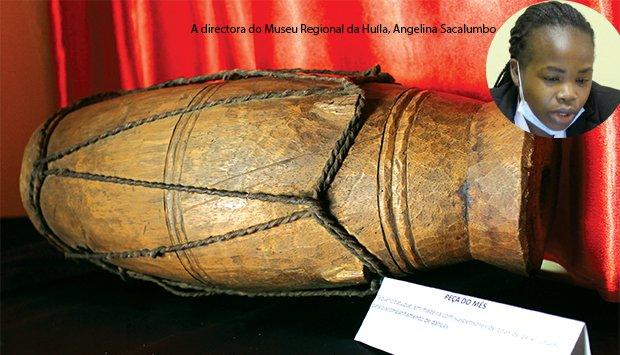
Africa-Press – Angola. Ongomba, a fundamental percussion instrument in the traditional and cultural festivities of the peoples of southern Angola, is the ethnographic piece featured this month at the Huíla Regional Museum, in Lubango.
The Ongomba instrument, which in Portuguese means batuque, contextualizes the outstanding events of the time, such as the male and female initiation parties, better known in southern Angola as Ekwenje and Efiko. The director of the Huíla Regional Museum, Angelina Sacalumbo, explained that the batuque on display, a museum piece measuring 43 centimeters in length and 15.5 in diameter, is representative of all types of musical instruments of the genre in the culture of the peoples of Huila, Cunene, Namibe and Cuando Cubango.
“The museum has other types of drums in its collection. We chose this one to represent the four provinces because of the size of the window. We have drums used on different commemorative occasions such as puberty parties, healing rituals, circumcision and others,” he said.
The drumming on display, cataloged since the museum was founded in 1957, is an original exhibit taken from the ethnographic collection of more than 1560 pieces, to be placed in a showcase reserved for the exhibition, with a description of the cultural value for the inhabitants of southern Angola. .
He explained that the election of the batuque as the piece for the month of August arises from the need to publicize the existing museum collection. He mentioned that the choice of the piece of the month happens regularly depending on the context and the historical moment.
“The piece of the month is chosen taking into account what it represents for the period in the culture of the southern region of Angola. The batuque was chosen for its history and, mainly, for the season marked both by the festivities of Efiko and Ekwenje, as well as by the festivities of the Nossa Senhora do Monte”, he clarified.
The museum director underlined that batuque is widely used in southern Angola because of the essence, exclusivity and purpose of its sound. In addition to Ongomba, the museum has other varieties of drums such as Epwita and Cinguvo, useful instruments at parties and as a means of communication, respectively.
Angelina Sacalumbo said that it is forbidden to play the drums on display due to the conservation rule for museum pieces, having argued that, for this reason, the approximately 1,600 people who visit the Huíla Regional Museum per month “are really curious, because no one is allowed performing or feeling the sound of the exposed Ongomba”.
The Huíla Regional Museum, he recalled, was closed for about a year due to restoration works in the premises destined for technical reserves, which house most of the pieces inaccessible to the public.
The Huíla Regional Museum is a public, permanent, scientific, non-profit institution at the service of society and its development, open to the public that acquires, conserves, researches, disseminates and exhibits the material testimonies of man.
An inseparable history of genesis
The creation of the Huíla Regional Museum is inextricably linked, in its most remote genesis, to the creation of the first museums in Angola.
Initially called the Huíla Museum, it was installed in a residential building belonging to the doctor Arnaldo Correia who, having moved to Luanda, donated the house for scientific and cultural purposes.
With the aim of collecting, housing, studying and disseminating Paleontological, Archeological and Ethnographic material, the Huíla Museum was founded in 1957 by Peixoto Correia, with Machado da Cruz acting as the first curator of this institution.
After National Independence, in 1975, the institution was renamed the Regional Museum of Huíla, for being, first, the only existing museum in the south of Angola and, second, for housing collections from the provinces of Namibe, Cunene and and Cuando Cubango, the result of years of collection and scientific research throughout this region.
Until 2014, it functioned as a dependent body of the Provincial Directorate of Culture of Húíla, and in that year, the Organic Statute was approved by Executive Decree no.
For More News And Analysis About Angola Follow Africa-Press