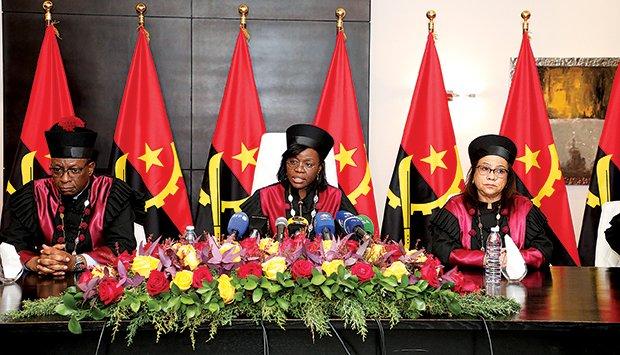
Africa-Press – Angola. The Constitutional Court (TC), in the guise of an Electoral Court, declared the definitive electoral results of the national tabulation announced by the National Electoral Commission on the 29th of last month, within the framework of the General Elections of August 24, 2022, to be valid.
The presiding judge of the Constitutional Court, Laurinda Cardoso, explained that, after confronting the evidence, “the TC decided, in a plenary session, to dismiss the applicants’ claims and declare the definitive electoral results valid”.
Laurinda Cardoso mentioned, in this regard, that the court, for the purpose of a better assessment and taking into account the need to discover the material truth, carried out, through the Data Processing Center of this body, a thorough and careful verification of the evidence presented by the appellants and by the defendant, the National Electoral Commission (CNE), resulting in the production of a summary report.
In order to draw a final picture, the judge stressed that the rulings of the Constitutional Court, in terms of electoral disputes, are not appealable, “because this court is the last resort of appeal under the terms of article 6 of the Organic Law on General Elections, therefore, they automatically become res judicata”.
Laurinda Cardoso indicated that, once the electoral dispute phase is concluded, the National Electoral Commission will be able to publish, in the Diário da República, the National Tabulation Minutes of the Definitive Results of the General Elections of 24 August, for all legal purposes.
Subsequently, he continued, under the terms of the Constitution and the legislation applicable to the matter, the President of the Republic and the Vice-President of the Republic, as well as the deputies elected to the National Assembly, must be invested in their respective functions.
Legal Insufficiency
Regarding the request to create the objective conditions necessary for the reconciliation of results through the comparison of the minutes entered in the CNE system with those produced by the CNE itself and whose copies are legitimately in the possession of the competitors, it was considered that there was no basis for the request by the appellant to make such a reconciliation of results by comparing the minutes held by the appellant (UNITA) and the defendant (CNE).
In these terms, from the various photocopies of the minutes attached by the UNITA party to the case file, it was found that the legal formalism (exclusive accounting of the summary minutes of polling stations) was not observed for the alleged exercise of parallel monitoring of the tabulation carried out by the CNE, which to do. This situation did not allow to produce the same counting result as the defendant, not least because, underlines the judgment of TC nº 769/2022, “the appellant even counted photocopies of the minutes of the polling stations as if they were other supposed non-existent minutes, giving the alleged discrepancy that it claims, but which, in fact, does not exist”.
Continuing, the appellant litigates in bad faith, when he presents distorted results based on documents that he knows are forged and duplicated, false, null, polling station minutes, as well as adopting a fraud speech, jeopardizing the integrity, impartiality and transparency of an independent public entity whose function is to organize the General Elections, the highest exponent of democracy in Angola, reads the document.
UNITA, according to the ruling, in its appeal request mentioned the provincial constituencies of Luanda, Zaire, Cuando Cubango and Namibe, but in its allegations it refers to twelve provincial constituencies, namely Luanda, Zaire, Cuando Cubango, Namibe, Cabinda, Huambo, Bengo, Benguela, Huila, Cunene, Cuanza-Sul and Lunda-Sul. According to verification, as the document attests, this party only gathered evidence referring to 9 provincial constituencies, namely Luanda, Zaire, Cuando Cubango, Cabinda, Huambo, Bengo, Benguela, Huíla and Cuanza-Sul.
In this chapter, according to the judgment, the sheets attached to the file are photocopies/or prints, in color and/or in black and white, of photographs from various sources (including those taken from social networks such as Facebook), of the various types of minutes used during the electoral process, even the original of the polling station summary minutes.
According to the findings, UNITA did not present any official copy of the minutes delivered to the polling stations. The general quality of the photocopies, adds the judgment, is very low, and, it continues, it was also found that seven of the photocopies of the minutes delivered were filed outside the provinces identified in the folders.
Based on this, the judges of the Constitutional Court dismissed the contentious electoral appeal filed by the UNITA party. In view of this fact, the TC declares, by way of reinforcement, that the only competent body to proceed with the calculation of electoral results, in accordance with the law, is the CNE, with the express exclusion of any entity, and the law does not make an exception to other entities to verify the reconciliation of minutes, because the “minutes of the CNE are authentic”.
Opposition parties promise to resort to other bodies
Without advancing further elements on the continuation of the insistence on presenting appeals in organs of justice, the competing political forces promise to hold demonstrations, in reaction to the outcome in court, and guarantee that they are “strictly peaceful and orderly”.
The protest actions result from the validation by the Constitutional Court (TC) of the final electoral results of the August 24 election. The document’s signatories decided to create a working group, which will study the framework and conditions for the organization and convening of the aforementioned demonstrations, which must be coordinated with public order bodies.
The working group, which is responsible for organizing the demonstrations, was instructed to present a report within 48 hours, which will be discussed with civil society organizations.
The final electoral results consecrate the MPLA winner of the General Elections of 24 August, with 51.17 percent, electing 124 deputies, followed by UNITA, with 43.95, with 90 seats. Then come the other competing political forces, namely PRS, PHA and FNLA, with two deputies each.
For More News And Analysis About Angola Follow Africa-Press