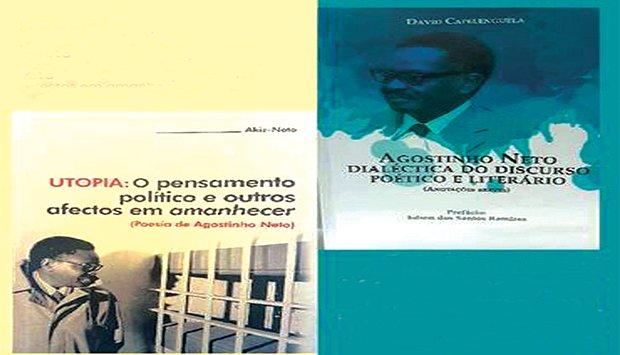
Africa-Press – Angola. Two literary works that address the cultural and political dimension of the Founder of the Nation are launched yesterday at 4:30 pm at the Dr. António Agostinho Neto, at Praia do Bispo, in Luanda, during a session of selling and signing autographs.
These are the works “Utopia: The political thought and other affections at dawn”, by Akiz Neto, and “Agostinho Neto Dialéctica do Discurso Poético e Literário”, by David Capelenguela, whose releases are part of the range of activities that the Memorial is to be held to greet the centenary of the birth of its patron.
In a statement sent, David Capelenguela said that the work addresses the critical analysis of some poems by Agostinho Neto over time in several perspectives.
The also general secretary of the Union of Angolan Writers (UEA) revealed that, in the book “Agostinho Neto Dialéctica do Discurso Poético e Literário”, he gives his point of view on Agostinho Neto as a poet, craftsman and inspiration who composed his poetic texts.
For David Capelenguela, in a previous analysis, the book is a reflection of everything he extracted from the work of the Greater Poet, in the various cultural aspects.
In “Utopia: Political Thought and Other Affections at Dawn – Poetry by Agostinho Neto”, Akiz Neto makes a critical approach to the nationalist and anti-colonialist avant-garde consciousness of the poet of nationality, the Poet Maior Agostinho Neto, only from his third poetic book “Breaking Dawn”.
As a result of the critical analysis, he added, we are going to meet the thought of blackness and nationalism, revealing feelings and philosophical reasons around the theme.
“The spirit of freedom and unity are enshrined in the polysemic philosophy of Agostinho Neto”, said the author, adding that recurring to the plurisutopia of Neto’s language, goes through the meeting of July 1, 1970, with Pope Paul VI, between Agostinho Neto, Amílcar Cabral and Marcelino dos Santos, whose theme was the liberation of Africa.
“The distribution of old monuments and the consequent construction of new ones is a revelation of Agostinho Neto, dealing with the Social and Economic Formation established by the colonialist. The updating of the Onomastic question (anthroponymy and toponymy) taking into account the African- finally, a support for romantic issues associated with other affections such as religion, the collective of students, memory and other convivialities within political philosophy”, he concluded.
Authors’ profile
David Capelenguela is a writer with an extensive published work, including “Véu do vento”, “Gravuras Doutro Sentido” and “Acordanua”. sociological and anthropological.
Born in Huíla province, David Capelenguela is the seventh secretary general of the Angolan Writers’ Union (UEA), the first cultural association created after National Independence, on December 10, 1975.
AKiz Neto is the author of the poetic work “Poesia Porta Mental”, which reached the market with the seal of the Union of Angolan Writers (UEA), where it was also launched. The work is a monologue that “is heard, in a kind of solitary gesture for the benefit of humanity”.
“Poesia Portal Mental”, by AKiz Neto, is part of the UEA’s “Guachi da vida” collection, according to professor Katia Frazão, it is built by a ruminant ecstasy that walks in an opinion contrary to existence.
Exposure
As part of the activities carried out by the Memorial, in favor of the centenary of its patron, the exhibition “Sagrada Esperança”, by António Domingues, which brings together a set of 10 works by painting, which illustrate an equal number of poems by Neto.
The exhibition “Sagrada Esperança”, an initiative of MAAN, with support from the Goethe Instituto Angola, is a collection in which the painter used the oil on canvas technique, with warm colors, exposed for the first time when the Founder’s body of the Nation, was transferred to the Mausoleum.
António Pimentel Domingues was born in Lisbon on 1 November 1921 and died in Lisbon on 14 August 2004. He was a Portuguese painter and illustrator. He studied at the António Arroio School of Decorative Arts, where he later taught. While studying at night, António Domingues was a blacksmith and model maker in a lithograph, where he specialized in graphic arts. In 1942, he attended the artistic gatherings at Café Hermínius, on Avenida Almirante Reis, in Lisbon.
Initially linked to neorealism, he would become one of the founding members of the Grupo Surrealista de Lisboa, in 1947, together with his longtime companions (Leonel Rodrigues, Moniz Pereira, Marcelino Vespeira, Alexandre O’Neill, Mário Cesariny and others), influenced by the French movement, which extended to different arts, from painting to literature.
For More News And Analysis About Angola Follow Africa-Press