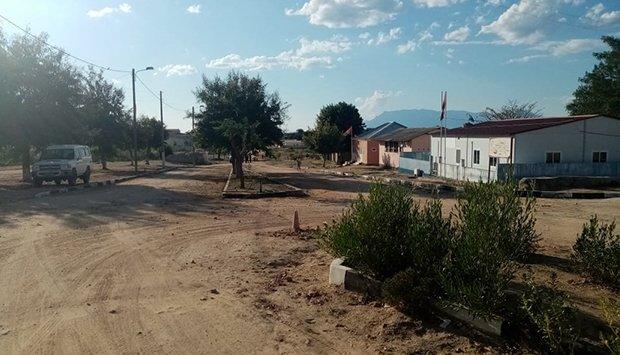
Africa-Press – Angola. The municipality of Camucuio, province of Namibe, completes, today, 105 years since its foundation, in 1917.
It is said that at the time the region was conceived as a colonial project for the occupation of land. The town, located 234 kilometers north of the city of Moçâmedes, has more than 60,000 inhabitants, mostly farmers and livestock herders.
With an area of 700,452 square kilometers, the municipality has three communes, namely Cacimbas, Chingo and Mamue, limited to the south by the municipalities of Bibala and Moçâmedes and to the north by Quilengues (Huíla) and Chongoroi (Benguela). The region has a tropical dry semi-desert climate, annual rainfall of 150 mm, with a temperature that averages up to 30 degrees centigrade.
The inhabitants are distributed in different ethnic groups, with greater emphasis on the Mucubais, Nhaneca Humbi, Ovimbundu, Mucuisses and Mutchilengues.
Agriculture and raising goats and pigs are the main activities of the population to ensure self-sustainability. Maize, massambala, massango, beans, vegetables and tubers are the most cultivated products in the region, but the poor state of the access roads make it difficult for the products to flow from the villages to the main consumption centers.
Some peasant families from Camucuio told Jornal de Angola that, despite having a shortage of seeds and other means, they are committed to agricultural activity for food resilience and praise the support of the local administration.
Peasant Katuia Figueiredo expressed satisfaction at having recently benefited from maize and massambala seeds. “Rain here in the southern region delays. Therefore, the advice I leave to my fellow peasants is that those who depend exclusively on rain, when it falls with intensity, have to commit to making the most of it and thus contributing to the reduction of hunger”, he said.
Within the scope of the Program to Combat Hunger and Poverty, the Municipal Agriculture Directorate and the United Nations Food and Agriculture Organization (FAO) are engaged in the implementation of field schools to develop new farming techniques in the communities.
The municipal director, José Gaspar, said that more than eight tons of cereal seeds are being distributed in a phased manner to the peasant population. “We are implementing the field schools project, which aims to disseminate improved techniques, in order to go beyond the charitable activity towards market agriculture”, he revealed.
The municipal director of Agriculture in Camucuio admitted that there were “many constraints” in this undertaking, due to complications in the access roads. “Farmers find it difficult to evacuate products to the city”, lamented José Gaspar, who, however, welcomed the fact that the main road was being repaired. He hopes that the tertiary roads will also be rehabilitated, as it is through them that products go from the countryside to the city and vice versa.
Regarding livestock, the official said that it is expected, for the near future, to vaccinate more than 30,000 head of cattle against symptomatic anthrax and nodular dermatitis. The municipality of Camucuio is among the places most affected by the drought, along with Bibala, Virei and others in the municipality of Tômbwa and Moçâmedes. To mitigate the impact of drought on populations, administrations were forced to draw up strategic plans to guarantee the living conditions of drought victims.
More than 30 water holes were rehabilitated and built, in the municipality of Camucuio, to supply the population, water the cattle and practice agriculture. The holes drilled under the Integrated Plan for Intervention in Municipalities (PIIM).
More water and energy
The municipal director of Energy and Water, Severino Chivela, said that projects aimed at expanding the water supply network to the inhabitants were in the pipeline.
With regard to electrical energy, Severino Chivela assured that projects are also underway to install more poles to improve public lighting in all communes in the municipality.
In all, 461 families consume energy in the municipality of Camucuio. The problem has been fuel consumption, since the municipality is supplied from a thermal source. 30 cubic meters of fuel are used monthly, but the company Prodel has support in this regard.
Economic Sector
The authorities of the municipality of Camucuio licensed 151 citizens to trade and proceeded to formalize seven agricultural cooperatives, transforming the poles and associations into cooperatives.
The municipal director for Integrated Economic Development, António Tchinanga Mpeio, said that the work of municipal agents to support production and the economy was also being monitored.
So far, 70 producers have been registered and municipal agents supporting production and the economy continue to register producers on the ground.
“We have already finished here at the municipality’s headquarters and, at this time, we are doing it in the communes. We are also following the PAPE (Action Plan for the Promotion of Employability), which here, at the municipal level, is being led by INEFOP (National Institute of Employment and Vocational Training). We already have the registration, in a first phase, of 21 young people benefited. In the second phase, another 14 young people are expected, who will benefit from professional kits”, he said.
More Than 200 Teachers Guarantee Teaching
The municipality of Camucuio has 17 schools, including two complexes and a high school, in addition to two schools built under the PIIM and already in operation.
According to the municipal director of Education, Tchinanga Mukuko, more than 200 teachers work in Camucuio, guaranteeing teaching and learning to around 5,000 students distributed in pre-school, primary, first and second cycles.
The director highlighted the importance of the school lunch program, which has already benefited more than two thousand children.
“We selected 10 schools that benefit from this program. We think it is an added value, because it has had an effect and we see the satisfaction on the faces of parents and guardians, who do not get tired of monitoring this program with the schools”, he said.
Mukuko guaranteed that in all schools that benefit from school lunches, there is no mention of students dropping out. Even when there are faults, they are well justified.
Drought Effects
Camucuio is one of the localities in Namibe province affected by the cyclical drought that devastated the southern region of the country. To alleviate the hunger caused by the drought within families, the local government and other living forces of society, such as churches and NGOs, carry out actions aimed at supporting the populations. The municipal commander of Civil Protection and Firefighters, Salomão Tchilanda, informed that more than 30,000 families have already benefited from food support.
It revealed that, of the more than 60 thousand inhabitants, 58 thousand are affected by the drought. Of these, the most vulnerable stand out (25,000 people) who, for some time now, as a result of donations they have received from the Provincial Commission to Combat Hunger and Drought, have benefited over 30,000 people.
Still in the chapter of support for families affected by the drought, the populations are benefiting from motor pumps to encourage the practice of irrigated agriculture in the dry season.
Municipal authorities have implemented awareness campaigns to encourage families to raise small animals, such as goats, pigs and others, in addition to supporting families with motor pumps, professional training, kits and livestock.
In terms of infrastructure, projects for urbanization and upgrading of the seat of the municipality of Camucuio are about to begin, which will bring many benefits to citizens. A source told that there is already a plan through which three areas were identified for the urban expansion of the municipality, starting from the center of the urban core.
Of the identified neighborhoods where these projects will appear, there are social, commercial, health infrastructures and green areas.
Citizens’ satisfaction
The citizens of Camucuio expressed satisfaction with the fact that the municipality is moving towards growth. “To be honest, I’ve noticed a certain growth. When I arrived here, a few years ago, this region was in very bad shape, but now there’s really some change. There are already roads and other infrastructures”, acknowledged Lázaro António.
The citizen also referred to the fact that several structures are being built, with emphasis on the building where the future bodies of the local authority will operate.
Júlia Marques praised the improvement in public lighting and the supply of water and electricity. “The road from here to Bibala is also better. The municipality has really improved a lot”, she acknowledged, before asking for improvements in other aspects.
The citizen Nanga Mpeio is also expecting improvement in the municipality’s social services. “I want the municipality to actually change and also to develop with what is our contribution as citizens, helping the Government to do more things, because in addition to what is the obligation of the State, there is also the duty of the citizen”, he defended.
Myths and realities of a locality
There is a mysterious mulembeira in the municipality of Camucuio . It is said that the tree was planted in 1917 by the first peoples of the Mucubal ethnic group.
According to the mayor Mupinga Joaquim Pequenino, whoever prune or pluck a branch from the tree can suffer terrible consequences or even lose his life.
“Here, it is necessary to respect the tradition of the municipality. We have this mulembeira from the administration… no one can come and cut”, he underlined.
Anyone who wants to cut a branch, he explained, has to buy a liter of wine and deliver it to the traditional authorities who perform a ritual. This procedure is usually done in the afternoon. A member of the traditional authority performs some rites, takes the bottle of wine and puts it in his mouth. The next day, he performs the same ritual and from there he can take a machete to cut a branch of the mulembeira.
“If, out of stubbornness, the person decides to cut anyway, things get really bad”, warned the mayor again.
Citizen Florinda Nangula confirmed the mystery surrounding the mulembeira. “According to those who were here, the tree cannot be pruned without those rituals. The death of one of the first municipal commissioners (administrators) say it was caused by having ordered pruning (the mulembeira) without the rituals being carried out”, he said. Is it over there.
Sapalo Antonio also confirmed the version. “This tree, as they say in the slang, is untouchable. Whoever cuts it (without complying with the rituals) will have consequences”, said the citizen, admitting that with these mysteries all the feeling within the population is of some fear. “In my particular case, I don’t get into this adventure of trying to cut (the tree) because I really have that fear that if I do, what I’ve already heard will happen”, he said.
The deputy municipal administrator of Camucuio, António Nkolondjo, attested to the veracity of the mulembeira’s mysticism. “It is said that the space where this administration is installed was the Quimbo do Soba and the Mulembeira was the Tchoto (Visiting Room of Embala do soba). It was under this tree where they debated community affairs and also when there were ceremonies and parties , it was all done under this tree,” he said.
It also confirmed the death of someone, who, out of stubbornness, cut a branch of the mulembeira and died. “I don’t know if it’s a coincidence, but since then this myth has emerged that that tree cannot be pruned, otherwise something bad will happen,” he said.
As for the meaning of the name given to the word Camucuio, the mayor Pinda Pequenino said that it comes from a fig tree. “Camucuio itself is not here at the headquarters. Camucuio is down there where there is a river and beside it a fig tree which, translated into the local Mucubal language, is called mucuio”, he said.
When the natives went to the river to drink water, they took advantage of the rest under the mucuio and from there the residents, whenever they were asked where they were going, replied that they were going to the mucuio.
“It is said that this is where the name Camucuio came from. ‘Ca’ from the diminutive and the main word Mucuio”, he said.
For More News And Analysis About Angola Follow Africa-Press